
Articoli correlati a The Use of Remote Sensing in the Modeling of Forest...
Sinossi
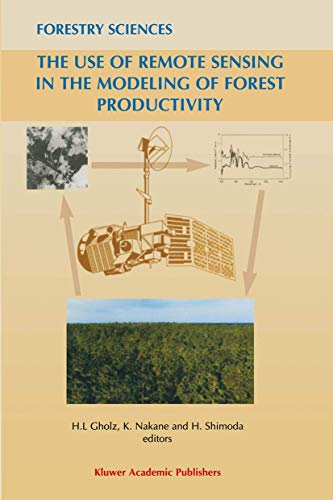
Forests comprise the greatest storage of carbon on land, provide fuel for millions, are the habitat for most terrestrial biodiversity, and are critical to the economies of many countries. Yet changes in the extent and dynamics of forests are inherently difficult to detect and quantify. Remote sensing technologies may facilitate the measurement of some key forest properties which, when combined with other information contained in various computer models, may allow for the quantification of critical forest functions. This book explores how remote sensing and computer modeling can be combined to estimate changes in the carbon storage, or productivity, of forests - from the level of the leaf to the level of the globe. Land managers, researchers, policy makers and students will all find stimulating discussions among an international set of experts at the cutting edge of the interface between science, technology and management.
Le informazioni nella sezione "Riassunto" possono far riferimento a edizioni diverse di questo titolo.
Recensione
`The approaches discussed in the book are not limited to forests only they can easily be utilized in evaluation of other types of ecosystems. This is why the book will certainly be highly valuable for a wide range of scientists and land managers.'
Biologia Plantarum, 40:4 (1997/8)
Contenuti
Preface. Section One: Stand-Level Analyses. 1. Assessing Leaf Area and Canopy Biochemistry of Florida Pine Plantations Using Remote Sensing; H.L. Gholz, et al. 2. Modeling Radiative Transfer Through Forest Canopies: Implications for Canopy Photosynthesis and Remote Sensing; T. Nilson, J. Ross. 3. Estimating Forest Canopy Characteristics as Inputs for Models of Forest Carbon Exchange by High Spectral Resolution Remote Sensing; M.E. Martin, J.D. Aber. Section Two: Landscape/Regional-Level Analyses. 4. Detecting Structural and Growth Changes in Woodlands and Forests: The Challenge for Remote Sensing and the Role of Geometric-Optical Modeling; D.L.B. Jupp, J. Walker. 5. Integrating Remotely Sensed Spatial Heterogeneity with a Three-Dimensional Forest Succession Model; J.F. Weishampel, et al. 6. Combining Remote Sensing and Forest Ecosystem Modeling: An Example Using the Regional HydroEcological Simulation System (RHESSys); J.C. Coughlan, J.L. Dungan. 7. Forest Vegetation Classification and Biomass Estimation Based on Landsat TM Data in a Mountainous Region of West Japan; N.J. Lee, K. Nakane. 8. Forest Structure and Productivity Along the Oregon Transect; D.L. Peterson. 9. Use of Remote Sensing to Model Land Use Effects on Carbon Flux in Forests of the Pacific Northwest, USA; D.O. Wallin, et al. Section Three: Global-Level Analyses. 10. Global Biospheric Monitoring with Remote Sensing; S.N. Goward, D.G. Dye. 11. Energy Conversion and Use in Forests: An Analysis of Forest Production in Terms of Radiation Utilisation Efficiency (epsilon); J.J. Landsberg, et al. Color Plates. Index.
Le informazioni nella sezione "Su questo libro" possono far riferimento a edizioni diverse di questo titolo.
Risultati della ricerca per The Use of Remote Sensing in the Modeling of Forest...

Foto dell'editore
The Use of Remote Sensing in the Modeling of Forest Productivity (eng)
Print on DemandDa: Brook Bookstore On Demand, Napoli, NA, Italia
Valutazione del venditore 5 su 5 stelle

Condizione: new. Questo è un articolo print on demand. Codice articolo JD3ZKKPPZJ
Compra nuovo
EUR 46,22
Spedizione EUR 6,80
Spedito da Italia a U.S.A.
Spedito da Italia a U.S.A.
Quantità: Più di 20 disponibili
Immagini fornite dal venditore
The Use of Remote Sensing in the Modeling of Forest Productivity
Editore:
Springer Netherlands Okt 2012, 2012
ISBN 10: 9401062900
ISBN 13: 9789401062909
Nuovo
Taschenbuch
Da: BuchWeltWeit Ludwig Meier e.K., Bergisch Gladbach, Germania
Valutazione del venditore 5 su 5 stelle
Taschenbuch. Condizione: Neu. This item is printed on demand - it takes 3-4 days longer - Neuware -Forests comprise the greatest storage of carbon on land, provide fuel for millions, are the habitat for most terrestrial biodiversity, and are critical to the economies of many countries. Yet changes in the extent and dynamics of forests are inherently difficult to detect and quantify. Remote sensing technologies may facilitate the measurement of some key forest properties which, when combined with other information contained in various computer models, may allow for the quantification of critical forest functions. This book explores how remote sensing and computer modeling can be combined to estimate changes in the carbon storage, or productivity, of forests - from the level of the leaf to the level of the globe. Land managers, researchers, policy makers and students will all find stimulating discussions among an international set of experts at the cutting edge of the interface between science, technology and management. 340 pp. Englisch. Codice articolo 9789401062909
Compra nuovo
EUR 53,49
Spedizione EUR 23,00
Spedito da Germania a U.S.A.
Spedito da Germania a U.S.A.
Quantità: 2 disponibili
Immagini fornite dal venditore
Use of Remote Sensing in the Modeling of Forest Productivity
Da: GreatBookPrices, Columbia, MD, U.S.A.
Valutazione del venditore 5 su 5 stelle
Condizione: New. Codice articolo 19493581-n
Compra nuovo
EUR 78,01
Spedizione EUR 2,35
Spedito in U.S.A.
Spedito in U.S.A.
Quantità: 15 disponibili
Immagini fornite dal venditore
Use of Remote Sensing in the Modeling of Forest Productivity
Da: GreatBookPrices, Columbia, MD, U.S.A.
Valutazione del venditore 5 su 5 stelle
Condizione: As New. Unread book in perfect condition. Codice articolo 19493581
Compra usato
EUR 78,17
Spedizione EUR 2,35
Spedito in U.S.A.
Spedito in U.S.A.
Quantità: 15 disponibili
Foto dell'editore
The Use of Remote Sensing in the Modeling of Forest Productivity (Forestry Sciences, 50)
Da: Ria Christie Collections, Uxbridge, Regno Unito
Valutazione del venditore 5 su 5 stelle
Condizione: New. In English. Codice articolo ria9789401062909_new
Compra nuovo
EUR 68,59
Spedizione EUR 13,45
Spedito da Regno Unito a U.S.A.
Spedito da Regno Unito a U.S.A.
Quantità: Più di 20 disponibili
Foto dell'editore
The Use of Remote Sensing in the Modeling of Forest Productivity
Da: Books Puddle, Woodside, NY, U.S.A.
Valutazione del venditore 4 su 5 stelle

Condizione: New. pp. vii + 326. Codice articolo 2648019095
Compra nuovo
EUR 87,55
Spedizione EUR 3,55
Spedito in U.S.A.
Spedito in U.S.A.
Quantità: 4 disponibili
Foto dell'editore
The Use of Remote Sensing in the Modeling of Forest Productivity
Print on DemandDa: Majestic Books, Hounslow, Regno Unito
Valutazione del venditore 4 su 5 stelle
Condizione: New. Print on Demand pp. vii + 326. Codice articolo 44763464
Compra nuovo
EUR 87,65
Spedizione EUR 7,74
Spedito da Regno Unito a U.S.A.
Spedito da Regno Unito a U.S.A.
Quantità: 4 disponibili
Foto dell'editore
The Use of Remote Sensing in the Modeling of Forest Productivity
Da: Revaluation Books, Exeter, Regno Unito
Valutazione del venditore 5 su 5 stelle
Paperback. Condizione: Brand New. 336 pages. 9.45x6.30x0.80 inches. In Stock. Codice articolo x-9401062900
Compra nuovo
EUR 81,91
Spedizione EUR 14,89
Spedito da Regno Unito a U.S.A.
Spedito da Regno Unito a U.S.A.
Quantità: 2 disponibili
Immagini fornite dal venditore
The Use of Remote Sensing in the Modeling of Forest Productivity
Print on DemandDa: moluna, Greven, Germania
Valutazione del venditore 5 su 5 stelle
Condizione: New. Dieser Artikel ist ein Print on Demand Artikel und wird nach Ihrer Bestellung fuer Sie gedruckt. Forests comprise the greatest storage of carbon on land, provide fuel for millions, are the habitat for most terrestrial biodiversity, and are critical to the economies of many countries. Yet changes in the extent and dynamics of forests are inherently d. Codice articolo 5832916
Compra nuovo
EUR 48,37
Spedizione EUR 48,99
Spedito da Germania a U.S.A.
Spedito da Germania a U.S.A.
Quantità: Più di 20 disponibili
Foto dell'editore
The Use of Remote Sensing in the Modeling of Forest Productivity
Print on DemandDa: Biblios, Frankfurt am main, HESSE, Germania
Valutazione del venditore 4 su 5 stelle
Condizione: New. PRINT ON DEMAND pp. vii + 326. Codice articolo 1848019101
Compra nuovo
EUR 87,87
Spedizione EUR 9,95
Spedito da Germania a U.S.A.
Spedito da Germania a U.S.A.
Quantità: 4 disponibili