
Articoli correlati a Agricultural Project Management: Monitoring and Control...
Sinossi
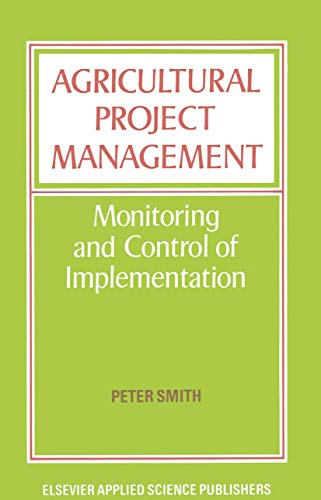
I first became interested in the methods of planning the sequence and timing of jobs on large-scale development projects, as a field officer involved in planning and implementing mechanised farming schemes in Uganda in the mid-sixties. This interest was reinforced by experience of agro-industrial projects in both Nigeria and Iran, when it became obvious that the lax traditional methods of both planning and controll ing the implementation of agricultural and other rural development projects were very ineffective compared with those already in use in other disciplines. An extended spell as Resident Adviser on a World Bank project to strengthen planning and project management services in the agricultural sector in Sind Province, Pakistan, stimulated this interest further, and gave opportunities to develop the use of improved methods on some very complex schemes. This book summarises the experience gained in adapting critical path methods, well established in other fields, to Third World development projects, with their peculiar problems. It would not have been possible to reach this point without the help and stimulation of discussions with a large number of colleagues, includ ing John Joyce (then of Hunting Technical Services), Hatsuya Azumi (World Bank), and-particularly-Zaffar Sohrwardy and Akhtar Ali of Aarkays Associates in Karachi, during our work together. My thanks are also due to Yasin Mohammed, who typed most of the original draft; Anwar Mohammed and Irene Mills for final typing; and to my wife, Jill, for drawing the original figures.
Le informazioni nella sezione "Riassunto" possono far riferimento a edizioni diverse di questo titolo.
Contenuti
1. The Scope of Project Management.- 1.1. Introduction.- 1.2. Requirements of an Effective Project Management System.- 1.3. Traditional Methods of Controlling Agricultural Projects.- 1.4. Critical Paths—Introduction to an Improved Method.- 1.5. An Example of the Improved Method: Planning the Schedule.- 1.6. CPM and After.- 2. Solving the Critical Path Problem.- 2.1. The Example.- 2.2. The Network.- 2.3. The Main Objective: Finding the Critical Path.- 2.4. Tabulation of the Data.- 2.5. The Forward Pass—Calculating Early Start and Early Finish Dates.- 2.6. The Backward Pass—Calculating Late Start and Late Finish Dates.- 2.7. Float.- 2.8. The Critical Path.- 2.9. Review of the Initial Analysis.- 2.10. Alternative Methods of Network Construction.- 2.11. Note on Terminology.- 3. The Network: Collecting the Data.- 3.1. Introduction.- 3.2. The Initial Session.- 3.3. Specialist Sessions.- 3.4. The Next Step.- 4. Resource Scheduling.- 4.1. Definition of Scheduling.- 4.2. Determination of Resource Requirements of Activities.- 4.3. Determining the Availability of Resources.- 4.4. Assessing the Resource Requirements of the Initial Schedule.- 4.5. Resource Levelling.- 4.6. Consequences of Resource Levelling.- 4.7. Presentation of Results.- 4.8. Alternative Resource Scheduling Method.- 4.9. Multi-Project Scheduling.- 5. Review of Working Methods.- 5.1. Allocation of Extra Resources (Crashing).- 5.2. Adjusting the Specifications of the Job.- 5.3. Changes in Working Methods.- 5.4. Costing Savings on Major Alterations of Schedule.- 5.5. Conversion to Calendar Dates.- 6. Risk and Uncertainty in Project Scheduling.- 6.1. Introduction.- 6.2. Statistics.- 6.3. Expected Duration of Critical Path or Critical Segments.- 6.4. Testing for the Need to Revise Duration Estimates.- 6.5. Choice of Probability Levels.- 6.6. Decision Networks.- 7. Critical Path Methods at the Planning Stage.- 7.1. Introduction.- 7.2. Getting the Framework Right.- 7.3. Problems of Data Gathering at the Planning Stage.- 7.4. Organisational Structure of the Project.- 7.5. Contractual Structure of Projects.- 7.6. Implications.- 7.7. Planning the Planning.- 8. Using the Network.- 8.1. Introduction.- 8.2. The Downward Flow of Information: Instructions and Advice.- 8.3. The Upward Flow of Information.- 8.4. Financial Reporting.- 9. Critical Path Analysis by Computer.- 9.1. Do You Really Need a Computer?.- 9.2. Computer Terms.- 9.3. Requirements of a Good CPA Software Package.- 9.4. Requirements of a Suitable Machine.- 9.5. Examples of Suitable Software.
Le informazioni nella sezione "Su questo libro" possono far riferimento a edizioni diverse di questo titolo.
Risultati della ricerca per Agricultural Project Management: Monitoring and Control...

Foto dell'editore
Agricultural Project Management (eng)
Print on DemandDa: Brook Bookstore On Demand, Napoli, NA, Italia
Valutazione del venditore 5 su 5 stelle

Condizione: new. Questo è un articolo print on demand. Codice articolo RUWHBKFT00
Compra nuovo
EUR 46,22
Spedizione EUR 4,00
Spedito da Italia a U.S.A.
Spedito da Italia a U.S.A.
Quantità: Più di 20 disponibili
Foto dell'editore
Agricultural Project Management (Paperback)
Da: Grand Eagle Retail, Bensenville, IL, U.S.A.
Valutazione del venditore 5 su 5 stelle
Paperback. Condizione: new. Paperback. I first became interested in the methods of planning the sequence and timing of jobs on large-scale development projects, as a field officer involved in planning and implementing mechanised farming schemes in Uganda in the mid-sixties. This interest was reinforced by experience of agro-industrial projects in both Nigeria and Iran, when it became obvious that the lax traditional methods of both planning and controll ing the implementation of agricultural and other rural development projects were very ineffective compared with those already in use in other disciplines. An extended spell as Resident Adviser on a World Bank project to strengthen planning and project management services in the agricultural sector in Sind Province, Pakistan, stimulated this interest further, and gave opportunities to develop the use of improved methods on some very complex schemes. This book summarises the experience gained in adapting critical path methods, well established in other fields, to Third World development projects, with their peculiar problems. It would not have been possible to reach this point without the help and stimulation of discussions with a large number of colleagues, includ ing John Joyce (then of Hunting Technical Services), Hatsuya Azumi (World Bank), and-particularly-Zaffar Sohrwardy and Akhtar Ali of Aarkays Associates in Karachi, during our work together. My thanks are also due to Yasin Mohammed, who typed most of the original draft; Anwar Mohammed and Irene Mills for final typing; and to my wife, Jill, for drawing the original figures. I first became interested in the methods of planning the sequence and timing of jobs on large-scale development projects, as a field officer involved in planning and implementing mechanised farming schemes in Uganda in the mid-sixties. Shipping may be from multiple locations in the US or from the UK, depending on stock availability. Codice articolo 9789401159357
Compra nuovo
EUR 53,18
Spedizione gratuita
Spedito in U.S.A.
Spedito in U.S.A.
Quantità: 1 disponibili
Foto dell'editore
Agricultural Project Management: Monitoring and Control of Implementation
Print on DemandDa: Chiron Media, Wallingford, Regno Unito
Valutazione del venditore 5 su 5 stelle
PF. Condizione: New. This item is printed on demand. Brand new book, sourced directly from publisher. Dispatch time is 6-7 days from our warehouse. Book will be sent in robust, secure packaging to ensure it reaches you securely. Codice articolo 6666-IUK-9789401159357
Compra nuovo
EUR 58,47
Spedizione EUR 5,36
Spedito da Regno Unito a U.S.A.
Spedito da Regno Unito a U.S.A.
Quantità: 20 disponibili
Immagini fornite dal venditore
Agricultural Project Management : Monitoring and Control of Implementation
Da: GreatBookPrices, Columbia, MD, U.S.A.
Valutazione del venditore 5 su 5 stelle
Condizione: New. Codice articolo 21739184-n
Compra nuovo
EUR 63,16
Spedizione EUR 2,35
Spedito in U.S.A.
Spedito in U.S.A.
Quantità: 15 disponibili
Immagini fornite dal venditore
Agricultural Project Management : Monitoring and Control of Implementation
Da: GreatBookPrices, Columbia, MD, U.S.A.
Valutazione del venditore 5 su 5 stelle
Condizione: As New. Unread book in perfect condition. Codice articolo 21739184
Compra usato
EUR 63,58
Spedizione EUR 2,35
Spedito in U.S.A.
Spedito in U.S.A.
Quantità: 15 disponibili
Immagini fornite dal venditore
Agricultural Project Management
Editore:
Springer, Springer Dez 2011, 2011
ISBN 10: 9401159351
ISBN 13: 9789401159357
Nuovo
Taschenbuch
Da: BuchWeltWeit Ludwig Meier e.K., Bergisch Gladbach, Germania
Valutazione del venditore 5 su 5 stelle
Taschenbuch. Condizione: Neu. This item is printed on demand - it takes 3-4 days longer - Neuware -I first became interested in the methods of planning the sequence and timing of jobs on large-scale development projects, as a field officer involved in planning and implementing mechanised farming schemes in Uganda in the mid-sixties. This interest was reinforced by experience of agro-industrial projects in both Nigeria and Iran, when it became obvious that the lax traditional methods of both planning and controll ing the implementation of agricultural and other rural development projects were very ineffective compared with those already in use in other disciplines. An extended spell as Resident Adviser on a World Bank project to strengthen planning and project management services in the agricultural sector in Sind Province, Pakistan, stimulated this interest further, and gave opportunities to develop the use of improved methods on some very complex schemes. This book summarises the experience gained in adapting critical path methods, well established in other fields, to Third World development projects, with their peculiar problems. It would not have been possible to reach this point without the help and stimulation of discussions with a large number of colleagues, includ ing John Joyce (then of Hunting Technical Services), Hatsuya Azumi (World Bank), and-particularly-Zaffar Sohrwardy and Akhtar Ali of Aarkays Associates in Karachi, during our work together. My thanks are also due to Yasin Mohammed, who typed most of the original draft; Anwar Mohammed and Irene Mills for final typing; and to my wife, Jill, for drawing the original figures. 204 pp. Englisch. Codice articolo 9789401159357
Compra nuovo
EUR 53,49
Spedizione EUR 23,00
Spedito da Germania a U.S.A.
Spedito da Germania a U.S.A.
Quantità: 2 disponibili
Foto dell'editore
Agricultural Project Management: Monitoring and Control of Implementation
Da: Ria Christie Collections, Uxbridge, Regno Unito
Valutazione del venditore 5 su 5 stelle
Condizione: New. In English. Codice articolo ria9789401159357_new
Compra nuovo
EUR 68,78
Spedizione EUR 11,19
Spedito da Regno Unito a U.S.A.
Spedito da Regno Unito a U.S.A.
Quantità: Più di 20 disponibili
Foto dell'editore
Agricultural Project Management
Da: Books Puddle, Woodside, NY, U.S.A.
Valutazione del venditore 4 su 5 stelle

Condizione: New. pp. 204. Codice articolo 26134228011
Compra nuovo
EUR 83,15
Spedizione EUR 3,56
Spedito in U.S.A.
Spedito in U.S.A.
Quantità: 4 disponibili
Foto dell'editore
Agricultural Project Management: Monitoring and Control of Implementation
Da: Revaluation Books, Exeter, Regno Unito
Valutazione del venditore 5 su 5 stelle
Paperback. Condizione: Brand New. 204 pages. 8.60x5.60x0.60 inches. In Stock. Codice articolo x-9401159351
Compra nuovo
EUR 79,34
Spedizione EUR 11,94
Spedito da Regno Unito a U.S.A.
Spedito da Regno Unito a U.S.A.
Quantità: 2 disponibili
Foto dell'editore
Agricultural Project Management
Print on DemandDa: Majestic Books, Hounslow, Regno Unito
Valutazione del venditore 4 su 5 stelle
Condizione: New. Print on Demand pp. 204 22:B&W 5.5 x 8.5 in or 216 x 140 mm (Demy 8vo) Perfect Bound on White w/Gloss Lam. Codice articolo 142055412
Compra nuovo
EUR 84,28
Spedizione EUR 7,76
Spedito da Regno Unito a U.S.A.
Spedito da Regno Unito a U.S.A.
Quantità: 4 disponibili