
Articoli correlati a Urban Informatics
Sinossi
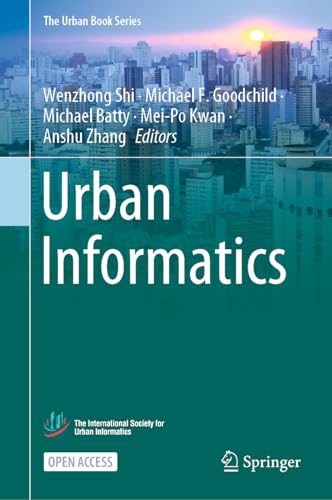
This open access book is the first to systematically introduce the principles of urban informatics and its application to every aspect of the city that involves its functioning, control, management, and future planning. It introduces new models and tools being developed to understand and implement these technologies that enable cities to function more efficiently – to become ‘smart’ and ‘sustainable’. The smart city has quickly emerged as computers have become ever smaller to the point where they can be embedded into the very fabric of the city, as well as being central to new ways in which the population can communicate and act. When cities are wired in this way, they have the potential to become sentient and responsive, generating massive streams of ‘big’ data in real time as well as providing immense opportunities for extracting new forms of urban data through crowdsourcing. This book offers a comprehensive review of the methods that form the core of urban informatics from various kinds of urban remote sensing to new approaches to machine learning and statistical modelling. It provides a detailed technical introduction to the wide array of tools information scientists need to develop the key urban analytics that are fundamental to learning about the smart city, and it outlines ways in which these tools can be used to inform design and policy so that cities can become more efficient with a greater concern for environment and equity.
Le informazioni nella sezione "Riassunto" possono far riferimento a edizioni diverse di questo titolo.
Informazioni sull'autore
Wenzhong Shi is the Head and Chair Professor of the Department of Land Surveying and Geo-Informatics, Director of Smart Cities Research Institute, The Hong Kong Polytechnic University. He has researched in GISci and remote sensing for over 30 years. He received Wang Zhizhuo Award, the International Society for Photogrammetry and Remote Sensing (2012), and State Natural Science Award, the State Council, China (2007). He was elected academician of International Eurasian Academy of Sciences in 2019. He has published more than 400 scientific articles and 15 books.
Michael F. Goodchild is Professor Emeritus of Geography at the University of California, Santa Barbara and Distinguished Chair Professor at the Hong Kong Polytechnic University. Until 2012, he held the Jack and Laura Dangermond Chair of Geography and was Director of UCSB’s Center for Spatial Studies. He was elected member of the US National Academy of Sciences in 2002, Foreign Member of the Royal Society, and Corresponding Fellow of the British Academy in 2010. He has published over 550 books and articles.
Michael Batty is Bartlett Professor of Planning at University College London where he is Chair of the Centre for Advanced Spatial Analysis (CASA), and Distinguished Chair Professor at the Hong Kong Polytechnic University. From 1979 to 1990, he was Professor of City Planning at the University of Cardiff and from 1990 to 1995, Director of the National Center for Geographic Information and Analysis at the State University of New York at Buffalo. He is a Fellow of the British Academy (FBA) and the Royal Society (FRS). His most recent book is Inventing Future Cities (2018), and he is Editor of the journal Environment and Planning B: Urban Analytics and City Science.
Mei-Po Kwan is Choh-Ming Li Professor of Geography and Resource Management at the Chinese University of Hong Kong. She is Editor of the book series entitled SAGE Advances in Geographic Information Science and Technology. She had served as an Editor of Annals of the American Association of Geographers for 12 years. She is a Fellow of the UK Academy of Social Sciences and the John Simon Guggenheim Memorial Foundation. She has received many prestigious honors and awards, including the Distinguished Scholarship Honors and the Stanley Brunn Award for Creativity in Geography from the American Association of Geographers.
Anshu Zhang is a Research Assistant Professor in the Department of Land Surveying and Geo-Informatics, The Hong Kong Polytechnic University. She has participated in multiple governmental funded projects and is the Principle Investigator of a sub-project under the State Key R&D Scheme of China. She received the China Science and Technology Progress Award in Surveying and Mapping (Grand Award) in 2017.
Dalla quarta di copertina
This open access book is the first to systematically introduce the principles of urban informatics and its application to every aspect of the city that involves its functioning, control, management, and future planning. It introduces new models and tools being developed to understand and implement these technologies that enable cities to function more efficiently – to become ‘smart’ and ‘sustainable’. The smart city has quickly emerged as computers have become ever smaller to the point where they can be embedded into the very fabric of the city, as well as being central to new ways in which the population can communicate and act. When cities are wired in this way, they have the potential to become sentient and responsive, generating massive streams of ‘big’ data in real time as well as providing immense opportunities for extracting new forms of urban data through crowdsourcing. This book offers a comprehensive review of the methods that form the core of urban informatics from various kinds of urban remote sensing to new approaches to machine learning and statistical modelling. It provides a detailed technical introduction to the wide array of tools information scientists need to develop the key urban analytics that are fundamental to learning about the smart city, and it outlines ways in which these tools can be used to inform design and policy so that cities can become more efficient with a greater concern for environment and equity.
Le informazioni nella sezione "Su questo libro" possono far riferimento a edizioni diverse di questo titolo.
Risultati della ricerca per Urban Informatics

Foto dell'editore
Urban Informatics (The Urban Book Series)
Da: HPB-Red, Dallas, TX, U.S.A.
Valutazione del venditore 5 su 5 stelle

hardcover. Condizione: Good. Connecting readers with great books since 1972! Used textbooks may not include companion materials such as access codes, etc. May have some wear or writing/highlighting. We ship orders daily and Customer Service is our top priority! Codice articolo S_479150588
Compra usato
EUR 46,95
Spedizione EUR 3,22
Spedito in U.S.A.
Spedito in U.S.A.
Quantità: 1 disponibili
Foto dell'editore
Urban Informatics (eng)
Print on DemandDa: Brook Bookstore On Demand, Napoli, NA, Italia
Valutazione del venditore 5 su 5 stelle
Condizione: new. Questo è un articolo print on demand. Codice articolo 6004e5f1fc797611911bad4d26618d4a
Compra nuovo
EUR 46,22
Spedizione EUR 13,50
Spedito da Italia a U.S.A.
Spedito da Italia a U.S.A.
Quantità: Più di 20 disponibili
Foto dell'editore
Urban Informatics (Hardcover)
Editore:
Springer Verlag, Singapore, Singapore, 2021
ISBN 10: 9811589828
ISBN 13: 9789811589829
Nuovo
Rilegato
Prima edizione
Da: Grand Eagle Retail, Bensenville, IL, U.S.A.
Valutazione del venditore 5 su 5 stelle
Hardcover. Condizione: new. Hardcover. This open access book is the first to systematically introduce the principles of urban informatics and its application to every aspect of the city that involves its functioning, control, management, and future planning. It introduces new models and tools being developed to understand and implement these technologies that enable cities to function more efficiently to become smart and sustainable. The smart city has quickly emerged as computers have become ever smaller to the point where they can be embedded into the very fabric of the city, as well as being central to new ways in which the population can communicate and act. When cities are wired in this way, they have the potential to become sentient and responsive, generating massive streams of big data in real time as well as providing immense opportunities for extracting new forms of urban data through crowdsourcing. This book offers a comprehensive review of the methods that form the core of urban informatics from various kinds of urban remote sensing to new approaches to machine learning and statistical modelling. It provides a detailed technical introduction to the wide array of tools information scientists need to develop the key urban analytics that are fundamental to learning about the smart city, and it outlines ways in which these tools can be used to inform design and policy so that cities can become more efficient with a greater concern for environment and equity. This open access book is the first to systematically introduce the principles of urban informatics and its application to every aspect of the city that involves its functioning, control, management, and future planning. Shipping may be from multiple locations in the US or from the UK, depending on stock availability. Codice articolo 9789811589829
Compra nuovo
EUR 62,86
Spedizione gratuita
Spedito in U.S.A.
Spedito in U.S.A.
Quantità: 1 disponibili
Immagini fornite dal venditore
Urban Informatics
Editore:
Springer Nature Singapore Apr 2021, 2021
ISBN 10: 9811589828
ISBN 13: 9789811589829
Nuovo
Rilegato
Da: BuchWeltWeit Ludwig Meier e.K., Bergisch Gladbach, Germania
Valutazione del venditore 5 su 5 stelle
Buch. Condizione: Neu. This item is printed on demand - it takes 3-4 days longer - Neuware -This open access book is the first to systematically introduce the principles of urban informatics and its application to every aspect of the city that involves its functioning, control, management, and future planning. It introduces new models and tools being developed to understand and implement these technologies that enable cities to function more efficiently - to become 'smart' and 'sustainable'. The smart city has quickly emerged as computers have become ever smaller to the point where they can be embedded into the very fabric of the city, as well as being central to new ways in which the population can communicate and act. When cities are wired in this way, they have the potential to become sentient and responsive, generating massive streams of 'big' data in real time as well as providing immense opportunities for extracting new forms of urban data through crowdsourcing. This book offers a comprehensive review of the methods that form the core of urban informatics from various kinds of urban remote sensing to new approaches to machine learning and statistical modelling. It provides a detailed technical introduction to the wide array of tools information scientists need to develop the key urban analytics that are fundamental to learning about the smart city, and it outlines ways in which these tools can be used to inform design and policy so that cities can become more efficient with a greater concern for environment and equity. 941 pp. Englisch. Codice articolo 9789811589829
Compra nuovo
EUR 53,49
Spedizione EUR 23,00
Spedito da Germania a U.S.A.
Spedito da Germania a U.S.A.
Quantità: 2 disponibili
Foto dell'editore
Urban Informatics
Da: Revaluation Books, Exeter, Regno Unito
Valutazione del venditore 5 su 5 stelle
Hardcover. Condizione: Brand New. 957 pages. 9.25x6.10x1.54 inches. In Stock. Codice articolo __9811589828
Compra nuovo
EUR 53,99
Spedizione EUR 23,30
Spedito da Regno Unito a U.S.A.
Spedito da Regno Unito a U.S.A.
Quantità: 1 disponibili
Foto dell'editore
Urban Informatics (The Urban Book Series)
Da: Books Puddle, New York, NY, U.S.A.
Valutazione del venditore 4 su 5 stelle

Condizione: New. Codice articolo 26384523799
Compra nuovo
EUR 83,85
Spedizione EUR 3,43
Spedito in U.S.A.
Spedito in U.S.A.
Quantità: 4 disponibili
Foto dell'editore
Urban Informatics (The Urban Book Series)
Print on DemandDa: Majestic Books, Hounslow, Regno Unito
Valutazione del venditore 4 su 5 stelle
Condizione: New. Print on Demand. Codice articolo 379380168
Compra nuovo
EUR 82,11
Spedizione EUR 7,57
Spedito da Regno Unito a U.S.A.
Spedito da Regno Unito a U.S.A.
Quantità: 4 disponibili
Foto dell'editore
Urban Informatics (The Urban Book Series)
Print on DemandDa: Biblios, Frankfurt am main, HESSE, Germania
Valutazione del venditore 4 su 5 stelle
Condizione: New. PRINT ON DEMAND. Codice articolo 18384523805
Compra nuovo
EUR 82,85
Spedizione EUR 9,95
Spedito da Germania a U.S.A.
Spedito da Germania a U.S.A.
Quantità: 4 disponibili
Immagini fornite dal venditore
Urban Informatics
Print on DemandDa: moluna, Greven, Germania
Valutazione del venditore 5 su 5 stelle
Gebunden. Condizione: New. Dieser Artikel ist ein Print on Demand Artikel und wird nach Ihrer Bestellung fuer Sie gedruckt. Introduces systematically the principles of urban informatics, including urban system theories, techniques, and tools for urban big data acquisition, infrastructure, and analytics, as well as focusing these new tools on urban problems and possible solu. Codice articolo 400178474
Compra nuovo
EUR 48,37
Spedizione EUR 48,99
Spedito da Germania a U.S.A.
Spedito da Germania a U.S.A.
Quantità: Più di 20 disponibili
Immagini fornite dal venditore
Urban Informatics
Da: AHA-BUCH GmbH, Einbeck, Germania
Valutazione del venditore 5 su 5 stelle
Buch. Condizione: Neu. Druck auf Anfrage Neuware - Printed after ordering - This open access book is the first to systematically introduce the principles of urban informatics and its application to every aspect of the city that involves its functioning, control, management, and future planning. It introduces new models and tools being developed to understand and implement these technologies that enable cities to function more efficiently - to become 'smart' and 'sustainable'. The smart city has quickly emerged as computers have become ever smaller to the point where they can be embedded into the very fabric of the city, as well as being central to new ways in which the population can communicate and act. When cities are wired in this way, they have the potential to become sentient and responsive, generating massive streams of 'big' data in real time as well as providing immense opportunities for extracting new forms of urban data through crowdsourcing. This book offers a comprehensive review of the methods that form the core of urban informatics from various kinds of urban remote sensing to new approaches to machine learning and statistical modelling. It provides a detailed technical introduction to the wide array of tools information scientists need to develop the key urban analytics that are fundamental to learning about the smart city, and it outlines ways in which these tools can be used to inform design and policy so that cities can become more efficient with a greater concern for environment and equity. Codice articolo 9789811589829
Compra nuovo
EUR 63,95
Spedizione EUR 42,80
Spedito da Germania a U.S.A.
Spedito da Germania a U.S.A.
Quantità: 1 disponibili