
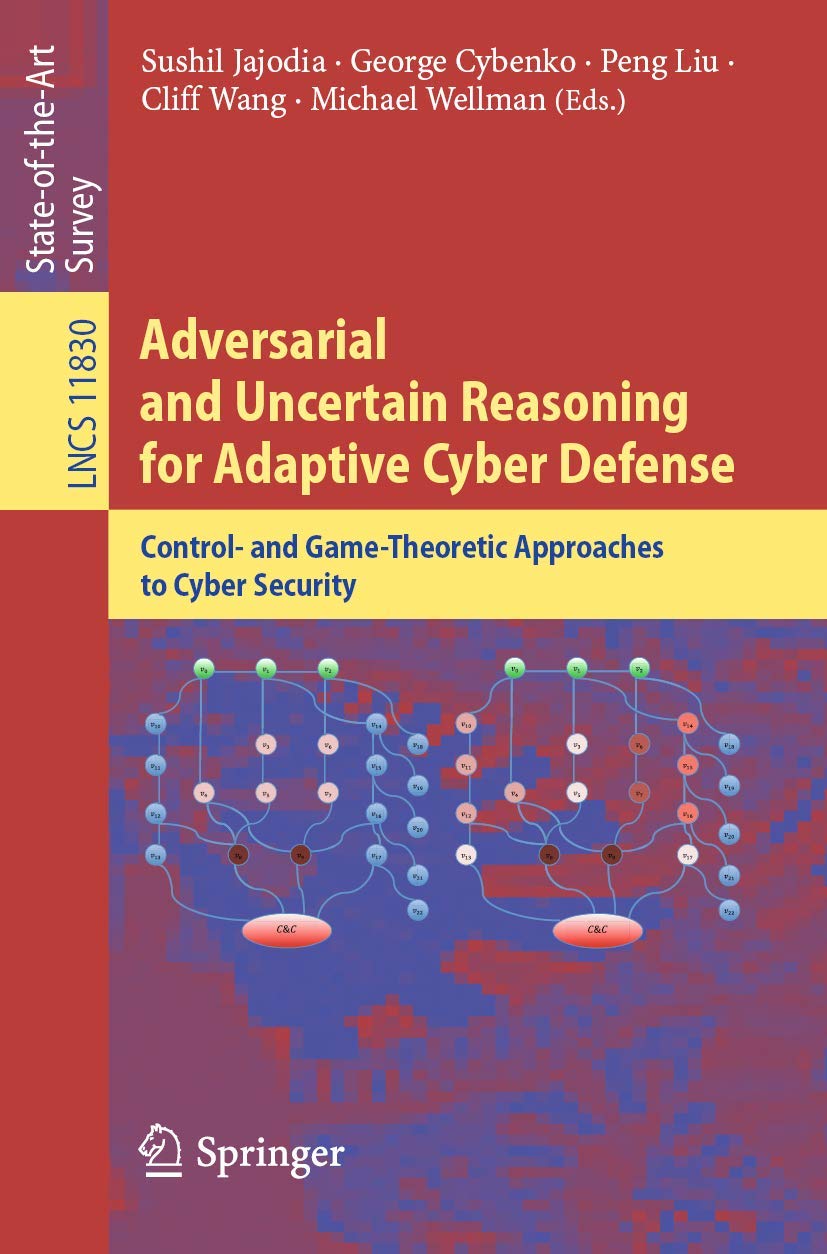

Adversarial and Uncertain Reasoning for Adaptive Cyber Defense: Control- and Game-Theoretic Approaches to Cyber Security (Security and Cryptology)
ISBN 10: 3030307182 ISBN 13: 9783030307189
Editore: Springer, 2019
Usato
Brossura
Da
Big River Books, Powder Springs, GA, U.S.A.
Valutazione del venditore 5 su 5 stelle

Venditore AbeBooks dal 7 giugno 2013
Questo articolo specifico non è più disponibile.
Riguardo questo articolo
Descrizione:
This book is in good condition. The cover has minor creases or bends. The binding is tight and pages are intact. Some pages may have writing or highlighting. Codice articolo 1EYX65000NF9_ns
Riassunto:
Today’s cyber defenses are largely static allowing adversaries to pre-plan their attacks. In response to this situation, researchers have started to investigate various methods that make networked information systems less homogeneous and less predictable by engineering systems that have homogeneous functionalities but randomized manifestations.
The 10 papers included in this State-of-the Art Survey present recent advances made by a large team of researchers working on the same US Department of Defense Multidisciplinary University Research Initiative (MURI) project during 2013-2019. This project has developed a new class of technologies called Adaptive Cyber Defense (ACD) by building on two active but heretofore separate research areas: Adaptation Techniques (AT) and Adversarial Reasoning (AR). AT methods introduce diversity and uncertainty into networks, applications, and hosts. AR combines machine learning, behavioral science, operations research, control theory, and game theory to address the goal of computing effective strategies in dynamic, adversarial environments.
Dalla quarta di copertina:
Today’s cyber defenses are largely static allowing adversaries to pre-plan their attacks. In response to this situation, researchers have started to investigate various methods that make networked information systems less homogeneous and less predictable by engineering systems that have homogeneous functionalities but randomized manifestations.
The 10 papers included in this State-of-the Art Survey present recent advances made by a large team of researchers working on the same US Department of Defense Multidisciplinary University Research Initiative (MURI) project during 2013-2019. This project has developed a new class of technologies called Adaptive Cyber Defense (ACD) by building on two active but heretofore separate research areas: Adaptation Techniques (AT) and Adversarial Reasoning (AR). AT methods introduce diversity and uncertainty into networks, applications, and hosts. AR combines machine learning, behavioral science, operations research, control theory, and game theory to address the goal of computing effective strategies in dynamic, adversarial environments.
Le informazioni nella sezione "Su questo libro" possono far riferimento a edizioni diverse di questo titolo.
Dati bibliografici
Titolo: Adversarial and Uncertain Reasoning for ...
Casa editrice: Springer
Data di pubblicazione: 2019
Legatura: Brossura
Condizione: good