
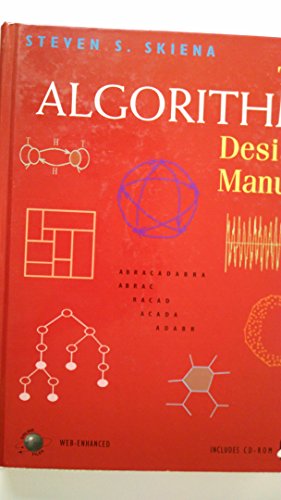
The Algorithm Design Manual
Steve S. Skiena (State University of New York, Stony Brook, NY, USA)
ISBN 10: 0387948600 ISBN 13: 9780387948607
Editore: Springer-Verlag New York Inc., United States, New York, NY, 1997
Usato
Paperback
Da
WorldofBooks, Goring-By-Sea, WS, Regno Unito
Valutazione del venditore 5 su 5 stelle

Venditore AbeBooks dal 16 marzo 2007
Questo articolo specifico non è più disponibile.
Riguardo questo articolo
Descrizione:
This material has been developed over a period of several years in an upper-division course taught to computer science students at SUNY, Stony Brook, by Steve Skiena. A major goal of the author has been to take some of the "mystery" out of identifying and dealing with algorithms which these students will later use in the workplace, drawing heavily on the author's own real-world experiences, the book stressing design and analysis. Thus the work takes on a very practical character, as reflected in its title: "Manual". The Book is divided into two parts, the first being a general guide to techniques for the design and analysis of computer algorithms. The second is a reference section, comprising the catalog of algorithmic resources, implementations, and an extensive bibliography. The primary audience for this book/CD-ROM combination is the working professional who uses algorithms on a daily basis and has need for a handy reference.A major feature of this book is the inclusion of a complete "catalog" of important algorithmic problems.By browsing this catalog, readers can quickly identify what the problem they have encountered is called, what is known about it, and how they should proceed if they need to solve it. Nothing like this catalog exists in the computing literature for general computer algorithms. This work can also readily be used as a course supplement or adjunct text in standard courses on algorithm design, or simply as a "student reference guide", as the author puts it. Pedagogic features include pen-and-paper exercises, "team projects", independent student projects, "take home" lessons (goals) at the beginning of chapters. Other teaching and learning aids reside on the accompanying CD-ROM. The book has been read, but is in excellent condition. Pages are intact and not marred by notes or highlighting. The spine remains undamaged. Codice articolo GOR009998739
Riassunto:
Most professional programmers that I’ve encountered are not well prepared to tackle algorithm design problems. This is a pity, because the techniques of algorithm design form one of the core practical technologies of computer science. Designing correct, efficient, and implementable algorithms for real-world problems requires access to two distinct bodies of knowledge: • Techniques – Good algorithm designers understand several fundamental algorithm design techniques, including data structures, dynamic programming, depth first search, backtracking, and heuristics. Perhaps the single most important design technique is modeling, the art of abstracting a messy real-world application into a clean problem suitable for algorithmic attack. • Resources – Good algorithm designers stand on the shoulders of giants. Rather than laboring from scratch to produce a new algorithm for every task, they can figure out what is known about a particular problem. Rather than re-implementing popular algorithms from scratch, they seek existing implementations to serve as a starting point. They are familiar with many classic algorithmic problems, which provide sufficient source material to model most any application. This book is intended as a manual on algorithm design, providing access to combinatorial algorithm technology for both students and computer professionals.
Recensione: "...the book is an algorithm implementation treasure trove, and putting all of these implementations in one place was no small feat. The list of implementations, an extensive bibliography, and the CD-ROM make the book an invaluable resource for everyone interested in the subject." --ACM Computing Reviews
Le informazioni nella sezione "Su questo libro" possono far riferimento a edizioni diverse di questo titolo.
Dati bibliografici
Titolo: The Algorithm Design Manual
Casa editrice: Springer-Verlag New York Inc., United States, New York, NY
Data di pubblicazione: 1997
Legatura: Paperback
Condizione: Very Good