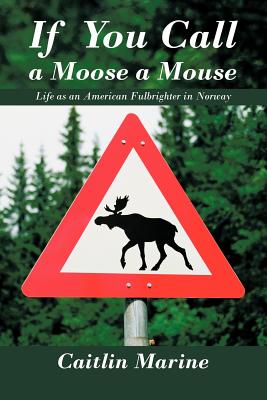
Starting in Oslo, the adventures of a Minnesota girl on a year long scholarship to Norway increase in hilarity and insightfulness as the year goes on. From tracking wolverines to walking miles in wet ski boots and learning how to cook campfire coffee, the
If You Call a Moose a Mouse
Life as an American Fulbrighter in NorwayBy Caitlin MarineAuthorHouse
Copyright © 2012 Caitlin Marine
All right reserved.ISBN: 978-1-4685-8137-9Contents
1. Dørnene lukkes (Doors closing) in Oslo.................................12. Fadderuke (Freshman first week) in Steinkjer................................213. Ut på tur (Out on a hike/ski) in Norway and Sweden.....................374. Kultursjokk! (Culture shock) in Steinkjer...................................705. Oppsummering (Summary)......................................................104
Chapter One
Dørnene lukkes (doors closing)
The sunset blazed over my left shoulder as Avatar played on the seat back screen. Elfish-sounding Icelandic announcements made the scene even more surreal. I had condensed my life into a 72-pound suitcase and a ski bag and I was completely prepared, or so I naively thought. Launching across the Atlantic was like running with my eyes closed, feeling stomach-tightening, exhilarating freedom.
Six weeks of adventures and misadventures in Oslo taught me the ins and outs of transportation, population dynamics, culture, and natural areas in the first place abroad I called home. It was a green city, with few skyscrapers, which was part of the reason why it didn't seem so intimidating. Early in my blog I wrote:
There are two directions in Norway: up and down, which is actually pretty helpful for navigation in that you are always aware of it
Directional awareness was priority number one as I was keen on exploring and tended to be alone. Not many were excited about running, biking, or rollerskiing for hours, down dead end streets, up steep hills, in and around any interesting neighborhood. I usually set out with a general direction or goal, but found that the best way to get to know a place was by always going somewhere new, whether it be via bike, ski, or `by feets' as the Norwegians say. This turned the workout into a game with the goal of getting back in time for dinner (or breakfast!).
To facilitate my lack of a bike, I bought a yearlong City Bike subscription for $10 and proceeded to learn geography. Riding my bike up to Sognsvann and beyond the outer ring highway raised some eyebrows, but it was much kinder to my body and nerves than exploring by rollerskis. It wasn't until the week before I left that I finally found out that Maridalsvannet was where people of Oslo went to rollerski. Before that I just endured the train tracks, abrupt dead end sidewalks, and cross streets as a part of living in a city. For the uninitiated, rollerskis are an outrageous invention that allow for Nordic ski training on pavement. Poles in hands, boots on feet and two narrow 18" planks mounted on wheels with no brakes, the sport is a crazy cousin of rollerblading.
I went up to Maridalsvannet, a large natural area, for the first time on a bike. I blinked hard, twice. After two months of fjords, forests, and seagulls, suddenly I was back in Northfield, Minnesota, surrounded by barley and hay. Satisfied that I had found a haven, there was only one distressing sign that I saw along the road. It read, "NO swimming, NO boating, NO fishing" in pictures and words with red x's all over them. In a country of rights of free public access, I figured there must be a strong reason for them to disallow these activities. Being an ecology and environmental studies student, I thought that there was some toxin or pollutant in the water. Instead, I found out that Maridalsvannet was not for swimming, boating or fishing as it was a source of drinking water for the city of Oslo!
* * *
You are so lucky to be free
I shared a room with one girl from Ukraine and a girl from Chechnya, a region in Eastern Europe that used to be part of the Soviet Union. We were the same age and we were in Norway for the first time. The similarities between our lives ended there. My roommate from Chechnya lived through two wars, through broken governments, through lapses in education, and through incredible restrictions on lifestyle.
In talking with my Chechnyan roommate, I discovered simple freedoms I never fully understood: I can hug, play basketball, and shake hands with boys who are not related to me or who won't become my husband. I grew up in a democracy. Gender discrimination in the workplace is legally prohibited and women have the right to the same jobs as men. I can act independently and it isn't considered wrong, or detrimental to me, or society. I can express opinions regarding government or social issues. I am so lucky to be free.
* * *
Forget the fire extinguisher
Blindern dormitories, classic Norwegian, bold, yellow, wooden buildings at the University of Oslo, were the launching point for exploration. These old buildings were also quite a fire hazard. As a fire marshal for my floor, I was privy to details about the old wood. Approximately eight minutes would reduce a two story building to ashes. Thus, in evacuation, there was not a lot of room for error.
We passed the fire drill, but the experience had students from many countries baffled. As the name suggested, the International Summer School had all regions of the world represented. This was a microcosm of diversity in a city that was otherwise well-segregated. People sat outside playing guitars, overtones blending Swahili, Russian, Spanish and Norwegian into linguistic music. Cultural exchange abounded, from the food in the dining hall to the demonstration of Norwegian traditional dance.
After the Norwegian cultural evening, all nationalities were given the opportunity to share foods or talents with the student body. To represent the USA, we chose apple pie, rice krispie treats, and chocolate chip cookies. The lack of true Rice Krispies™ cereal, made the rice krispie treats trickier than expected, but we managed.
Food, dancing and games aside, there was serious studying going on at Blindern. As a student in Norwegian Level II, three hours of lecture each day was combined with several hours of reading and writing assignments. I squeaked my way into the class due to bombing the placement test (a fill-in-the-blank story that I still find impossible to completely decode ...). I spent the first day with furrowed brows, thinking, "THIS is what Norwegian is supposed to sound like?" The comparison to the Norwegian that I had learned previously would be like someone learning American English suddenly finding themselves in Australia.
Pronunciation of the language was the most difficult aspect, especially with three extra vowels: å, ø, and æ. Language lab repetition of "bør, bor" "farlig, ferdig" repeated for several minutes wore on even the most enthusiastic soul. Though it was the most tedious part of language learning, it made a difference in learning to speak without an accent, creating new muscle memory for lips, tongue, cheeks, and throat.
I practiced like a mad woman for the final exam, which was 100% of our grade. The written portion was like any college final, but the oral portion, consisting of a five minute speech on a topic drawn at random, was enough to put my hairs on end. It was also the most relevant thing I did as it was true practice for my new life in a small town with a difficult dialect.
* * *
Odd looks and expectations
Significant adventure number one in Oslo was to investigate a way to Sognsvann, the large natural area on the west side of the city. With rollerskis and a backpack full of swimming gear, I started up, telling the others that I would race them to the opening barbeque. Half an hour later, I rolled up ready to jump into the lake.
There were many jogs in and around the lakes in Nordmarka, where my definition of trail running was substantially reworked. I noticed that there seemed to be a prohibition on running without a shirt. This was strange as no one had anything to hide and Europeans in general seemed more comfortable with exposed skin.
The other rarity was the way runners greeted each other. Instead of the friendly nod, smile, small wave, or hello, there was an awkward silence as people passed. However, despite the lack of communication, people seemed to be `checking each other out' a lot more than would have been appropriate in Minnesota.
* * *
A typical hard-core Norwegian
A free Sunday found a group from summer school hiking to the cabins scattered around in the Nordmarka wilderness. We had just started back down after marveling at the world's oldest ski hytte (built in 1885), enjoying saft (a Kool Aid™ like drink), and cooling off after the almost vertical wall we climbed to get there. Sheep grazed around us as we approached the fence. A woman who looked to be in her thirties then crested the pitch in front of us, running with two dogs strapped to her waist. She was breathing hard, but I couldn't even manage a `god morn' as my mouth hung open in awe.
* * *
Exploring by sea
Switching from terrestrial to aquatic mediums, I thought it would be fun to kayak in the Oslo fjord. After researching rental places, I found that it was not the most popular tourist activity. My friend Drew and I biked down to check on our options and found an abandoned trailer with kayaks and a camper in a parking lot. Unimpressed, we investigated another kayaking club, but they didn't do rentals. After calling to confirm that the trailer rack of kayaks was actually a business, I reserved four boats for Sunday.
We were outfitted with life jackets and paddles and only then did I find out that I was the only one of the four of us who had been kayaking before. At that point, however, we were looking out at the harbor that was as smooth as glass, so I wasn't too worried. The trouble began when we stuck our bows outside of the sheltered harbor. Suddenly we were see-sawing over three foot waves and blowing cross winds. The easy paddle out to the islands in the fjord did not seem as straight forward as planned. After stopping briefly at a beach to gather our sense of equilibrium and bravery, we turned around. Encouragement and a few choice words later, everyone was laughing by the time we got back.
* * *
Late night conversations
My Ukrainian roommate was a romantic at heart and the world had a rosy glow in her eyes. She loved talking about love, the future, change, weddings, families, and dreams. I connected with her on some level, but it was difficult to stay there. I wasn't accustomed to being a skeptical realist—more cautious, less confident, and much less imaginative.
In contrast to these optimistic conversations, one day I asked my Chechnyan roommate what her best day was. She told me that she has never had a best day. She has had a best hour, but that was the best she could think of. In looking at the pictures on my computer, she was enthralled. She wanted to go to the US, and to Las Vegas, of all places. Anyway, she didn't want to show me any of her pictures because she said that compared to me her life was boring, that she didn't have any "real" pictures. Then she asked me what my best day was. I had trouble answering the question as well but for the opposite reason—I had too many best days to consider.
One could say that the reaction to this question was a matter of perspective, but beliefs are shaped by experiences and environment. In reflecting on our interactions, the differences in our cultures translated to beliefs about individualism and gender stereotypes, of values and equality. It seemed to me that her culture was very judgmental and there were rules that were not to be trifled with unless you wanted to be labeled a "bad girl" (in her words, as English was difficult for her). She also told me almost every day that she wished she knew more English so that she could talk to me. She was always telling me I was a "cool girl." Not only was I lucky, but I had the freedom to define myself.
* * *
The doors are closing!
The phrase "dørnene lukkes" was an ongoing joke within the summer school because it was announced loudly when the doors closed after every stop on the metro trains. Even the students who weren't taking language classes mastered this phrase within the first week. The combination of new sounds and sing song pitches brought smiles and laughs to public transportation adventures as most of the other announcements were a mystery.
* * *
Return to Oslo and going UP NORTH
The darkness that surrounded the flytoget on the way to Oslo Sentralstasjonen was a reminder that the midnight sun of summer was fading, signaling the end of vacations and the beginning of fall. Again there was that familiar tension of adrenaline and excitement, of starting something new. I was headed to Steinkjer, the town that would be my home for the next nine months and a place I knew very little about.
Springing off the train into cool, night air, the lightness of two backpacks interlocking across my chest was reinforced by thoughts of the cumbersome and heavy baggage I was frantically searching for. Without getting cell phones to work, I finally spotted the black ski bag sticking out above the crowd. Mark and Susan had been scanning the crowds just as closely and I could see their smiles of relief as I reached them. The race had started. My nerves rose as the minutes passed, knowing that I needed to catch the last train back to the airport and spend the night or risk missing my train in the morning.
"You could just put the one backpack inside the other," said Susan with concern as she watched the reorganization of my luggage in the middle of the floor of the train station.
"Perfect!" I exclaimed, as I start fastening buckles, belts, and straps around appendages. "Thank you. Thank you, so much," I said as I hugged the very first set of host parents I met in my travels.
"Take care of yourself, young lady," Mark said as I ran off again to get on the 11:30 pm train.
Returning to the airport on the same flytoget, I realized for the first time what I was setting out to do. Soon midnight, I had eight hours until the next train going north was due to depart. Mark and Susan offered to let me stay at their place, but the tight turn around combined with reduced public transportation hours on Sundays eliminated staying in Oslo for the night. I couldn't justify booking a hotel for just seven hours and I had seen that overnighting in the airport was not rare.
The atmosphere in the airport was tense and always buzzing. Drifting in and out of movies on my laptop, people frequenting the `smoking shack' outside, it was like an airport with a power outage. At seven a.m., the shops started opening and it was time to get moving again.
Turning to face the board of departures, I saw an unfamiliar, red word, AVLYST behind the number of my train and many of those around it. My heart dropped. As if in answer to my question, I turned to my left and there was a woman looking at the same board. She told me casually, in Norwegian, "Yes, just go out to the blue pole and wait for the bus."
So I did. Because I had no better information and because I was banking on the fact that she had done this before. There was no bus yet, but a girl about my age was standing just next to a blue pole, looking more nervous than I felt. I asked her where she was going in Norwegian. She responded, "I speak English." My subconscious was tickled and I couldn't figure out why, until a few more sentences were exchanged and I shook my head fervently. She was speaking with a Spanish accent! Wow, it really had been a while I suppose. Spanish was the language I started learning in kindergarten and almost majored in. I switched languages immediately and her smile turned into a jaw drop and then frenetic Spanish.
For the next two hours on the bus, Ana and I shared stories of the night in the airport and contact information since we would be living just 2 hours away from each other. I pulled out some paper and tried to give her a Norwegian crash course in Spanish, after which my brain was so boggled I had trouble making any sort of coherent speech. This was broken by an announcement by the bus driver: take all of your belongings with you from the bus and board the train as quickly as possible. It will be leaving as soon as all passengers are aboard.
I took this message literally and jumped off the bus, throwing myself and all of my luggage into the first compartment with an open door. Looking left, I discovered that there were extra wide seats and people with strollers sitting in this compartment. I scanned my ticket again. Coach: B. Seat: 52. A long way from coach F. But my big bag wouldn't fit through the small doors between coaches and my skis were likely to decapitate someone as I tried to turn corners. Making a split second decision, I ran out of the car with my rolling suitcase and my backpack. RAN, literally as fast as I could, to Coach B. Dumping my stuff while panting, I turned around and ran outside the train all the way back. The passengers on the five intervening compartments were treated to the ski-carry sprint as I sped by again. Settling finally in my seat, I now waited for a full 10 minutes as more taxis, buses and passengers continued to arrive. The girl sitting next to me was completely weirded out and I declined trying to start a conversation just to avoid questioning. Ana and I lost contact as we were now in separate cars.
The country was literally eyeball-poppingly beautiful no matter where I traveled. I spent the seven hours on the train glued to the window, thoughts of sleep far from my mind as I couldn't even DREAM this scenery!
(Continues...)
Excerpted from If You Call a Moose a Mouseby Caitlin Marine Copyright © 2012 by Caitlin Marine. Excerpted by permission of AuthorHouse. All rights reserved. No part of this excerpt may be reproduced or reprinted without permission in writing from the publisher.
Excerpts are provided by Dial-A-Book Inc. solely for the personal use of visitors to this web site.