'Retailers today are able to generate the critical customer information on traffic and conversion rates that turn from their traditional anecdotal reflections . . . in Conversion Mark Ryski tells us all that we need to know to make that shift a reality. A true find for any retailer looking for dramatic improvements in business outcomes!''
- Len Schlesinger President, Babson College
former Vice Chairman and COO, Limited Brands
''A retail brand is built from the cumulative effects of its shoppers' experiences over time, making learning from these experiences a strategic priority for retailers in order to drive business value. Converting customers into buyers is the first step in creating a sustained partnership that results in value for all. The strategies introduced in this book will help retailers of all sizes and categories convert their customers' experiences into future buyers.''
- Pat Conroy Vice Chairman, Deloitte LLP
& Consumer Products Practice Leader
''Half the battle is finding the right things to measure for your business and industry. Ryski is right that conversion is a critical metric for retailers who care about revenue, profits, and growth.''
- Thomas H. Davenport President's Distinguished Professor,
Babson College & Author of Competing on Analytics and
Analytics at Work
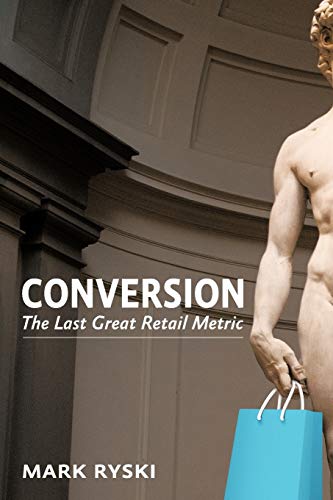
CONVERSION
The Last Great Retail MetricBy Mark Ryski AuthorHouse
Copyright © 2011 Mark Ryski
All right reserved.ISBN: 978-1-4634-1422-1Contents
INTRODUCTION: The Last Great Retail Metric...........................................1CHAPTER 1.1 What this tells you that you don't already know..........................15CHAPTER 1.2 Conversion champions.....................................................27CHAPTER 1.3 Living & dying by "Comp" sales...........................................69CHAPTER 1.4 Conversion takes the mystery out of mystery shopping.....................95CHAPTER 1.5 Why traffic counters can be a pain.......................................119CHAPTER 2.1 Calculating Conversion...................................................141CHAPTER 2.2 Finding the missed sales opportunities...................................165CHAPTER 2.3 Why good advertising can look bad........................................183CHAPTER 2.4 Staffing for conversion..................................................213CHAPTER 3.1 Driving sales performance with conversion................................241CHAPTER 3.2 Consumption is key: creating a conversion culture........................275CHAPTER 3.3 Implications round the executive table...................................303CHAPTER 3.4 Why some retailers get it – and others don't.......................325CONCLUSION: Chief Conversion Officer.................................................359ACKNOWLEDGEMENTS.....................................................................365END NOTES/APPENDIX/INDEX.............................................................371
Chapter One
What this tells you that you don't already know What will this tell me I don't already know? This is what many retailers ask me. They simply don't believe that counting traffic and measuring customer conversion will tell them anything they don't already know. Or, I guess, anything else worth knowing.
The answer lies in the basic dynamics of retail. Consider: Every day customers visit your stores intending to make a purchase. Your advertising was successful – it got prospects to your store despite the myriad of choices they have. Congratulations. These prospects wandered the store, looked at products, engaged one of your sales associates, and they may have even made it all the way to your check-out, but then, for some reason, decided not to buy. The sale is lost. And worse, you will never even know.
To repeat: Every hour of every day, prospects visit your stores but leave without making a purchase – despite the fact that they intended or were predisposed to buy. Over the course of weeks, months and years, these lost prospects add up. Customer "leakage" can represent hundreds of thousands, even millions of lost sales opportunities. These "unconverted" prospects are not captured in your POS data they rarely ll out your customer service surveys – they just leave. And you will never know.
And worse: Not only do these lost prospects represent an immediate lost sale, but even more insidiously, you'll never know how many other people they tell about their unsuccessful trip to your store.
Traffic and conversion analytics fundamentally answer two very simple but critical questions: How many people visit your stores? And what percent of these visitors actually makes a purchase?
For some of you, this might seem a little underwhelming – how can knowing the answers to these two simple, innocuous questions possibly make any difference in your business? If you have never tracked traffic and conversion in your stores, you have no idea just how profoundly these basic but truly great metrics will transform you and your company. Not only will they make a difference, they will change the way you measure performance, make decisions and generally, run your business.
As one retailer put it, "I couldn't image running my retail operation without traffic and conversion data." What does he know that most retailers don't?
It seems to me that in the over-analyzed world of business today, the simple has been overlooked. Traffic counts and conversion rates are simple measures, and that's in part what makes them so useful and essential "Sophisticated" and "important" have somehow come to mean that the data must be incomprehensible and voluminous. This insane thinking has caused retailers to lose focus on what's truly important and what they intuitively know – driving prospects into the store and then serving them in a way that translates into a sale is what retailing is all about.
Why, how and where this basic message got lost, I cannot tell. But it has, and retailers of every size, shape and description are starting to rediscover traffic and customer conversion, the "corn akes" of retail analytics.
Decision making – the glut and the gut
Retailers are awash in data. As information systems have evolved, retailers have embraced technology and the multitude of systems that provide better, faster information. With a cornucopia of information at your ngertips, the theory goes, you will be able to make better decisions, run your businesses better and deliver better performance.
While the technological advances in information systems used by retailers and the resultant ability to produce mountains of data are irrefutable (and no doubt have had a positive impact on retailers' ability understand their businesses), the downside has been a torrent of data and information owing into the executive suite. So prolific and continuous is the amount of data available to retail executives today that the problem has evolved from how to get the data to what to do with all the data. To which I would add – is this even the right data?
Despite the unprecedented penetration of technology and the flood of data available to retailers, decision making still largely depends on an executive's gut rather than the information glut. While gut will always naturally play a role in executive decision making, retailers need the right data to help guide and validate decisions.
Retail metrics – the critical few vs. irrelevant many
What are the critical metrics that retail executives rely upon to make decisions? With data dashboards brimming with a dizzying array of indices and stats, all presented in massive PowerPoint decks, with screen transitions that create a kaleidoscope of curious, colorful and important looking graphs and charts, what is the executive (and the cascade of functional and front-line managers, for that matter) to rely upon?
One way to solve the `meaningfulness' problem of having too much data has been, perversely, to summarize it and package it in an interesting and engaging way, in the hope of making it somehow more relevant. In many cases, to the detriment of all stakeholders, style prevails over substance. While it would be entirely heretical to advocate the elimination of the mass of "quant-metrics" that retail executives have become addicted to, it is completely rational and reasonable to propose a distillation of the multitude of metrics to a critical few.
Traffic and Customer Conversion, two of the most fundamental and insightful metrics in retailing – great metrics, in fact – should be given their rightful place on the dashboards and in the collective consciousness of retail executives.
Improving your average
In his seminal work, Why We Buy—The Science of Shopping, Paco Underhill perfectly relates conversion rate to batting average. I have not found a better metaphor than this. As Underhill rightly pointed out, you can know that a batter averages 100 hits, but did he achieve this from 100 at bats or 1,000?
Excellent question.
Traffic and conversion analysis are to retailing what at-bats are to baseball – they're fundamental. This notion of batting average (or as I like to refer to it, performance versus opportunity), is, at a very fundamental level, what traffic and customer conversion analysis is all about. How did you do relative to the sales opportunity you had?
To the many retail executives who have asked me, "What does this tell me I don't already know?" I always start with performance vs. opportunity for three reasons: first, it's tremendously thought provoking second, it's mildly antagonistic and, third, measuring traffic and customer conversion is the only way to tell how you're performing against opportunity. All thoughtful retailers who are serious about their business should know how the business is performing and what's driving the results. So, when I ask a retail executive how his stores are performing compared to the sales opportunity, I often get a long glare, like a schoolmaster trying to stare down a petulant student.
The Framework
Store sales performance is relative. How does anyone know what good or great performance is, without a comparison to what was possible? You can't. But every day retailers do ask, "How are sales today?" Well, at the most basic level, sales are simply a function of three variables: (1) the number of prospects who visit your store, (2) the percentage of these visitors who make a purchase and (3) how much each one buys. That's it.
Prospect Traffic x Conversion Rate x Average Sale = Sales
The absolute simplicity of this formula is dif cult for some retailers to fully accept. For example, when the above formula was presented to the CEO of a large chain of men's clothing stores, his reaction was curious: "This stuff is too basic for us, we're a sophisticated operation, and we have PhDs on staff ... this might be fine for a small retailer, but not a company like mine."
I've learned not to be surprised by what I hear from retail executives, but I mean, come on! How can a notion like performance versus opportunity apply only to small retailers and not "sophisticated" ones? It didn't make any sense and still doesn't. The epilogue to this story is that I did eventually conduct a study for this chain, and the executive was blown away by the insights.
The simple framework in the diagram below is a good visual representation of the essence of this book. The whole process starts with some form of traffic stimulus, like advertising. If your advertising is effective, it will deliver prospects to the store – a measurable traffic response. Once at the store, these prospects will have an experience of some kind, and if it's a positive one, the result will be a sale. The point is, there's a lot of stuff that happens between the moment a prospect first crosses your store's threshold and the consummation of the sale, and it behooves you to understand it.
While it would be an overstatement to say that no retail executives understand the importance of traffic and customer conversion as critical performance metrics, the evidence strongly suggests that the majority of you either don't appreciate the true greatness of these metrics or significantly underestimate their value. In any event, you need to take another look at these two performance metrics and what they can help you learn about your business's performance.
Business Intelligence has become Unintelligible
While I have no argument with the Business Intelligence industry, the problem seems to be that for many retailers, the sophisticated tools and systems offered by the purveyors of these systems are fundamentally beyond what most can put to practical use.
Transaction data that comes from your point-of-sale (POS) system is the primary fuel that drives the business intelligence engine. These powerful tools enable you to slice and dice your transactional data in a multitude of ways to help you manage inventory, optimize distribution, and even deploy your staff – the value is undeniable. However, there's one glaring aw: a reliance on sales transaction data as the primary input. What can our business intelligence systems tell us of the sales we lost, when the only data it has at its disposal is the sales we made?
The pressure to be smarter, faster and better has never been more intense. Investing in business intelligence seems ... intelligent. According to recent industry surveys business intelligence is the number one technology investment priority for retailers, and it's estimated that by 2014, retailers will spend in excess of $20 billion on this and other retail technologies.
But the mere fact that you invest a huge sum in information systems and business intelligence doesn't mean you're seeing the value. In fact, more often than not, you don't. According to one survey of retailers, there was a huge gap between the value retailers expected to get from these systems and the actual value realized. Given the money, time and attention the retail industry is collectively devoting to business intelligence and analytics, why aren't retailers getting more value?
Traffic and Customer Conversion – meat and potatoes analytics
Analytics is a hot topic. Businesses across the board are turning to analytics to look for ways to perform better and gain a competitive edge. But don't take my word for it: investigate it for yourself. I highly recommend two books: Competing on Analytics: The New Science of Winning by Thomas H. Davenport and Jeanne G. Harris and Analytics at Work: Smart Decisions, Better Results by Davenport, Harris and Robert Morison.
While your head will spin excitedly as you read about all the great ways analytics can be leveraged in your organization (mine did), I am merely suggesting that, for retailers, analyzing traffic and customer conversion should be at the very top of your analytics wish list.
Traffic and customer conversion analytics focus on what happens before the transaction is recorded in your POS system – if it ever is. That's what is especially powerful about traffic and conversion: Together, they tell us something about the sale we almost had; they give us a perspective on what might have been.
It all starts with traffic. If prospects don't visit your store, you have no chance at making a sale, so understanding prospect visitation is vital to understanding the opportunity. If you rely on advertising as a primary traffic catalyst, then your advertising impact can and should be largely measured by its ability to drive prospect traffic into your stores.
Once these prospects have arrived, then what happens? If they have a successful customer experience, then the end result should be a sale. But, if for whatever reason, the prospect does not buy, you will never know. What makes customer conversion truly great is that it is the only measure that can quantify your sales potential. It measures what your POS can't see – your missed opportunities, about which most retailers have almost no information.
The idea of measuring store traffic is not new. Electronic traffic counters have been available since the 1970's; terms like "conversion rate" and "close rate" have been part of the retail lexicon for decades. So why, then, are they the most misunderstood and underused analytics in retailing today? For retailers who take great pride in their sophisticated information systems, analytical prowess, and ability to regurgitate vast quantities of data, I have two simple questions: how many prospects visited your stores yesterday and what percentage of the visitors actually made a purchase? Even the most brilliant analyst cannot script a query to extract answers to these fundamental questions if the system doesn't contain traffic and conversion data.
What online retailers always knew
Without the physicality of the store environment to rely upon for insights, it seems that online retailers had no choice but to focus on the data they capture from the website – their virtual store. So perhaps it's not surprising that when it comes to analytics, brick-and-mortar retailers are playing catch-up.
Two of the most fundamental metrics in online retailing are website traffic and conversion rate. If your chain has a website (seriously, does anyone not?), you have likely seen a dashboard with a stat or KPI referring to website traffic and conversion. If your chain has a call center, again, calls received will undoubtedly be a KPI that is very familiar to you. Traffic and conversion play such key roles in understanding the performance of these e-channels, so why do they get so little attention as measures for the brick and mortar businesses? These great metrics are at least as important, if not more so, for brick and mortar stores.
Ironically, even the most computer illiterate retail executive can recite website traffic and conversion statistics like a Google pro, but when it comes to measuring traffic and conversion in his own stores, somehow the logic doesn't apply — or at least doesn't seem as compelling.
During a meeting I had with a major department store chain, the CEO was absolutely gushing with pride about a recent press acknowledgement listing his chain's website as one of the most visited retail websites in the country. At the time, his website was getting about 30,000 visits a month. This may not seem like a big number today, but at the time it was truly impressive.
Then I showed him the results of a traffic study we conducted for his marketing team. On the basis of the traffic counts logged in a sample of his stores, we estimated that chain-wide, his brick and mortar stores received hundreds of millions of visits annually. You tell me: which is more important?
Measuring store traffic is essentially the same as measuring website traffic: we're measuring the number of people who "hit" the front door instead of the main page on the website. And just as there can be mis-hits to the website when people make a wrong keystroke and end up on your website unintentionally, there are mis-hits to your storefront as well. These mis-hits are traffic counts that don't represent true prospects, e.g., children visiting the store with their parents. The fact that there are mis-hits doesn't mean you shouldn't measure them, just as you do for
your website. It's funny — executives will often question the accuracy of the electronic store traffic counts, but they never seem to question the validity of the hits to their websites – obviously, every web hit is legitimate. Not!
(Continues...)
Excerpted from CONVERSIONby Mark Ryski Copyright © 2011 by Mark Ryski. Excerpted by permission of AuthorHouse. All rights reserved. No part of this excerpt may be reproduced or reprinted without permission in writing from the publisher.
Excerpts are provided by Dial-A-Book Inc. solely for the personal use of visitors to this web site.