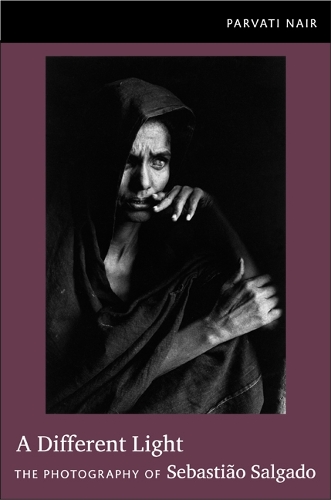
A Different Light
THE PHOTOGRAPHY of SEBASTIÃO SALGADO By PARVATI NAIRDuke University Press
Copyright © 2011PARVATI NAIR
All right reserved. ISBN: 978-0-8223-5048-4Contents
ACKNOWLEDGMENTS.......................................................................ixINTRODUCTION Photo-Trajectory.........................................................11 The Moving Lens Abiding Concerns and Photographic Projects.........................492 Engaging Photography Between the Aesthetic and the Documentary.....................1193 Eye Witness On Photography and Historiography......................................1674 Just Regard On Photography, Aesthetics, and Ethics.................................2175 The Practice of Photography Toward a Polity of the Planet..........................264NOTES.................................................................................315BIBLIOGRAPHY..........................................................................341INDEX.................................................................................351
Chapter One
The Moving Lens
Abiding Concerns and Photographic Projects
In the end I discovered that the stories that gave me the most pleasure were the same stories I did before, not as a photographer, but as an economist, as a student. SEBASTIÃO SALGADO, in interview with the author, Gallery 32, London, September 10, 2007
INTERVIEWS AND CONVERSATIONS with Salgado tend to shift seamlessly from a focus on his photography to the global economic picture. Salgado will often talk in terms of statistics, facts, and figures, revealing a pragmatic mode of thinking that directs his practices as a photographer. Underpinning all his major projects is a concern with the changes and displacements to mankind, to land, and to communities that are brought about in the course of modernity. The focus of his work is most often on those who survive on the peripheries and underbelly of such major processes. In representing such displacement, Salgado's work brings to the fore major questions about modernity as lived in terms of industrialization and globalization.
In this chapter, I outline, analyse, and contextualize his major photographic projects to highlight their main features and uncover the links that connect them. In the process, both the diversity of his photographic work and the singularity of his ideological impetus as a photographer will become clear. An understanding of the concerns, methodology, and impact of Salgado's work is necessary for a consideration of his photography in the light of the theoretical frameworks contained in the chapters that follow. Equally important is an understanding of the connections between each of the major photographic projects and larger social contexts, as well as of the abiding concerns that link the different projects together. My aim here is also to bring into view the wide canvas of Salgado's work, so that its relevance—theoretical, ethical, and political—as photography of and from the global south can come into focus.
Salgado's work is massive in volume, spanning principally Asia, Africa, and Latin America and highlighting key aspects of the social, economic, and political histories of the twentieth century and early twenty-first as experienced beyond the boundaries of the Western hegemony. To date, Salgado's work can be said to cover seven major themes: rural Latin America; the famine in the Sahel of the mid-1980s; workers and the modern displacement from natural means of production that has accompanied industrialization; landlessness in Brazil; global migrations triggered by economic and political forces; children affected by forced migrations, poverty, and other social problems; and the campaign against polio. Connecting these themes is the underlying concern with man's alienation from nature and the environment, a preoccupation that comes into distinct focus in his latest project, Genesis.
Salgado has undertaken these themes through a series of long-term photographic projects, typically involving extensive travel and several years in the making. The worldwide tours of Salgado's photographs take place periodically, and often, as with the Exodus exhibition in 2003, simultaneously in diverse global capitals. In travelling exhibitions, his photographs have been shown in most of Europe's main cities, as well as in North America and Latin America. He has also exhibited in Asia. On a smaller scale, his work can be viewed at any time in the numerous volumes that have been published mainly with Phaidon, Aperture, and other major photography presses. Most of these photo-essays have appeared in dedicated volumes of photography, such as Workers, Terra, Migrations, The Children, and The End of Polio, while An Uncertain Grace, published by Aperture in 1990, brings together photographs from the different thematic projects that Salgado was concerned with in the 1970s and 1980s. His current project, Genesis, said to be the last major photo-essay of his career, was initially released in parts every three months or so in the Guardian newspaper's Saturday review and continues to feature either in small-scale exhibitions or else in the press.
This chapter considers Salgado's major photographic projects in considerable detail and in the order in which he undertook them. It does not, however, dwell on his commissioned work done for commercial purposes, although this work shares many stylistic, aesthetic, political, and other aspects with the projects that he has embarked on personally. Of course, this is a somewhat arbitrary line that I am drawing: Salgado's images of Parma ham or of Malpensa airport in Milan, for example, share tonality and visual style with the rest of his work. Such endeavours also help to sustain financially what he calls his "personal projects." Moreover, in considering the work of an engaged photographer, such as Salgado, it is impossible to demarcate personal projects that reflect such engagement from commercial work that supports the former; it is also impossible to make such demarcations within the field of photography as a whole, for photography is at once commercial, documentary, and aesthetic. Yet, Salgado's commercial projects are too many and too dispersed to consider in close detail here. Suffice it to say that commercial work has provided Salgado with key financial means of pursuing those projects that he holds closer to heart and for which he is best known. Also, many of his commercial images share the tonality, the compositional structures, and the aesthetic of his personal projects. Indeed, all of Salgado's work is mutually implicated, in style as well as in content.
This is a reminder that photography as a medium straddles and connects economic, cultural, ethical, and political circuits. Furthermore, such is the fluidity and versatility of still photography that any single image can, of course, be slotted into diverse contexts. Salgado's work also appears often in collections, and as such is widely disseminated and often dispersed. Collections of Salgado's work, such as An Uncertain Grace, are well known and easy to locate, but I shall not analyse them specifically, although interesting readings can be made from the juxtaposition of images found therein. Nor shall I consider, save in passing, photographic volumes that juxtapose his work with that of other photographers with similar concerns. Overall, there is little doubt that only a small number of Salgado's photographs have been made public. The possibility of editing his numerous images from across his career into thematically linked collections is already under way: L'homme et l'eau is one such project, as is Africa. The possibilities for photographic exhibitions, editions, and readings remain no doubt endless. This book can at best touch on a few of them. Instead, I shall focus on the major photographic projects for which he is best known.
Visualising Alterity
The trilingual appearance (in French, Spanish, and English) of Other Americas in 1986 marked the public culmination of the first of several long-term photographic projects. This collection of photographs, taken on travels around Latin America between 1977 and 1984, underlines the alienation of peasants from their natural environment. Many of the images in this photo-essay were taken in some of the most remote villages of Latin America. In them, Salgado records a disturbing decline in rural life. The alterity deliberately evoked in the title emphasizes the alienation of indigenous communities for whom a natural relation between man and land has become disrupted. It also stresses an America that dwells in a different temporal frame from the one so dominated and appropriated by the United States. Equally, through their contemplation of the silence and solitude of the indigenous Latin American peasant, the images reveal the abandonment experienced by those left behind in the heady rush toward modernization.
This early collection of images introduces and brings to the fore several key areas of focus sustained throughout Salgado's work. A reiterated attention to landscape, bodies, and nature forms recurrent motifs in Salgado's work, which both collude with and contest the ways in which these very concepts have been conceived of in the larger scheme of modernity. However, in this collection of images, there is also a deep silence, a voicelessness perceived in the subjects, as if they had been rendered mute in a historical void. The lack of detailed information in the volume about the particulars of those photographed also accentuates the silence that surrounds these images. The subjects appear suspended in time and space, abandoned by the course of history. The sole information available is the name of the country and the year in which each picture was taken. There is no text that provides contextualization. The images are thus bare, stripped to the bone and forlorn beyond description.
A wedding in northeastern Brazil exemplifies the stark poverty of the people. The bride, in her wedding dress, grips a lone flower with work-worn hands as she sits waiting in a rundown car (fig. 1). Her lips are tightly set, her tanned face already lined and weary, in stark contrast to the apparently absurd festivity of her white dress. The wedding party gather around a dining table in the open air where the plates are turned face down (fig. 2). Perhaps this is to protect them from flies, but the metaphor extends nevertheless to remind us of the poverty of the arid, Bahian sertão, one of the most economically disadvantaged places on earth.
Implicit in the images, though never directly presented, is the sharply uneven modernization of the Latin American continent, resulting in urban migratory patterns that have left the countryside bereft. In his critique of Other Americas, John Mraz makes the point that the singular focus in this collection on peasant alienation, without an attempt to contextualize the latter in terms of the larger effects of modernization, such as the overcrowding of urban areas, for example, strips this volume of historical relevance. The result, Mraz argues, is a representation that devolves into the historically enigmatic, the morbid, and the grotesque, as peasants are seen as part of an impoverished, abandoned, and moribund landscape. Mraz thus makes the accusation that "the book neglects both political and class struggle," a criticism made more acute by the juxtaposition of Other Americas with Salgado's subsequent projects on Latin America, most significantly Terra. However, in this context, Mraz underlines the fact that Terra itself is composed of different parts; the early part of this volume consists of images from Other Americas while the latter part focuses specifically on the struggle of the landless. Thus, he concedes that this second Latin American volume succeeds in historicizing the very photographs stripped of historical significance in Other Americas and lends them a political force that they previously lacked by inserting them in a larger narrative of Latin American dispossession. Mraz's critique of Other Americas rests largely on his specifically Latin American geopolitical focus. While it is true that no clear Marxist narrative emerges from these images of rural Latin America, nevertheless, they do reveal a perspective of Latin American life—namely, the impoverishment and the displacement afflicting the indigenous—that does not always make itself readily accessible to Western viewers.
The photographic critic Fred Ritchin, in his essay "The Lyric Documentarian" (this title derives from that of a lecture given by Walker Evans in 1964), foregrounds instead the spirituality that emerges from these images. They are, he states, an attempt by Salgado to present his first-world viewers with a glimpse of the spiritual richness that defies material poverty in Latin America. Ritchin also points to a certain spiritual unrest in Salgado himself, arising from his own dislocation from Latin America. If the subjects of these images are exiled from historical development, then the photographer too was exiled, from his homeland. Salgado speaks to this in his introduction to a Brazilian edition of Other Americas: "In 1977, when I began this project after some years of travel in Europe and Africa, my sole desire was to return to my beloved land, to my Latin America that is so dear and so profound, to my Brazil from which a somewhat forced exile had obliged me to stay away."
The project on rural Latin America was tied, Ritchin argues, to a personal unrest in the photographer himself—namely, a need to reclaim the self, especially as Salgado had previously been forced into the position of exile, as a political dissenter. Furthermore, the images can be seen as a gesture by a Latin American, now resident in the West, toward reclaiming his roots in the face of personal dislocation. Indeed, Salgado often mentions the fact that much of Other Americas was shot in countries neighbouring his native Brazil, so that on occasion the land he stood on was indistinguishable from the one from which he was barred. The silence of this collection is in some ways, then, that imposed by exile.
Whatever the reasons, it is nevertheless clear that the twin themes of displacement and exile emerge in Other Americas. The exile experienced by the Latin American peasant is not one of being forced outside borders but rather that of being left stranded in the wake of a mass, rural exodus toward the urban promise of modernization. In the stolid and resolute silence of the peasants, in their stubborn rootedness to the land, the precariousness of their existences comes into view, revealing the traditional communities of Latin America to be, indeed, victimized and forced into dispersal by the capitalist dream of a better life. In light of Ritchin's lyrical reading of Salgado's photography, it is possible to connect the photographer's focus on a declining way of life with the nostalgia evoked by the Portuguese-derived word saudades, a term conventionally applied to poetry or music. This lyrical longing for things past or passing, a nostalgia for an irretrievable past, which Ritchin identifies as lyrical in Salgado's work, has previously been associated with Brazil. In his Retrato do Brasil, Paulo Prado states that the Brazilians are a melancholic people, prone to dwelling on a sense of nostalgia. The temporal loss associated with saudades is indeed well represented by the medium of photography, as the photograph too proclaims the loss of a past time.
The images of Other Americas bring to mind works such as Claude Lévi-Strauss's Tristes tropiques, a masterpiece of structuralist anthropology that at once confirms the historical stasis imposed upon indigenous peoples in Brazil through the phasing out of their ways of life and the anthropologist's own, very modern, navigation through space and time in his pursuit of knowledge. Perhaps even more relevant in this context is Lévi-Strauss's other work, Saudades do Brasil, a photographic memoir of a people in passing. Taken between 1935 and 1939, these images attempt to shape an anthropology of an indigenous way of life in decline due to the spread of modernization in Brazil. In this context the photograph, a key documentary tool for structural anthropologists thanks to the apparent realism of the medium, underlines the temporal horizon closing in on traditional ways of life in the face of an encroaching modernity. So too can Other Americas be viewed as a lament for what is passing and a portrait of the isolation of man in his stubborn attachment to land and tradition; a hopeless, if admirable, resistance to the sweeping onslaught of more modern, and profit-centred, ways of life.
(Continues...)
Excerpted from A Different Lightby PARVATI NAIR Copyright © 2011 by PARVATI NAIR . Excerpted by permission of Duke University Press. All rights reserved. No part of this excerpt may be reproduced or reprinted without permission in writing from the publisher.
Excerpts are provided by Dial-A-Book Inc. solely for the personal use of visitors to this web site.