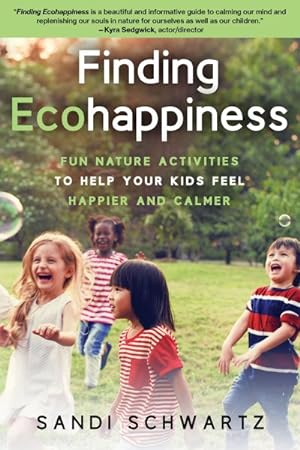
Raise calmer, happier, healthier children with these fun, hands-on nature activities for parents and kids to enjoy together.
Gold Winner, Nonfiction Authors Association Book Awards
Are your kids stressed? Are they feeling a bit down? Do your children—and you—need a break from screens? Nature can help. What we all suspected intuitively for generations, science has now confirmed: spending time connecting to nature is a safe, effective tool to help improve our health and happiness.
In Finding Ecohappiness, author Sandi Schwartz guides families in building regular habits of experiencing nature to reduce stress and boost mood. She explores key positive psychology tools from a nature-loving perspective. You will learn simple, practical tips for incorporating these tools—awe and gratitude, mindfulness, creative arts, outdoor play and adventure, volunteering, food, and animals—into your daily routine to help your children thrive and live a happy, balanced life.
Finding Ecohappiness will introduce you to all kinds of engaging nature activities you can do with your kids, from hiking and bike rides to visiting nature centers and science museums to volunteering outdoors to embarking on ecotourism adventures. In addition, you will discover unique nature relaxation activities like cow cuddling, animal yoga, forest bathing, float therapy, and earthing. Nature isn’t just for kids, either—doing these activities with your children will tremendously improve your own well-being, too.
A must-read for all families, Finding Ecohappiness will help you protect your children from feeling stressed and overwhelmed; manage your children’s current issues regarding stress, anxiety, and mood; and improve family togetherness.
A common symptom of stress and anxiety is feeling like we cannot breathe. It can be very frightening, and lead to more panic. On the other hand, the breath is central to a mindfulness practice and can instantly help calm us down. Having a breathing practice has been scientifically proven to minimize stress and anxiety, and is a simple tool to teach our children to use in times of stress.60 Best of all, it is portable so they can access it whenever they need.
Fortunately, there are a multitude of breathing exercises that can slow our breathing and mitigate unsettling emotions. Some involve breathing in a particular pattern while others are all about visualization. The most important thing is to teach children how to breathe from their diaphragm; this is when the belly expands and fills up with air. Small, shallow chest breathing only exacerbates anxiety. It is also recommended to breathe in through the nose and out through the mouth for the most relaxing effect.
We can pass along this important instrument to our kids by using some fun, playful approaches that relate to nature:
- Dandelion breath. Either get a real dandelion or ask your children to use their imagination. While holding it about an arm’s length out in front, have them take in a big inhalation through their nose, hold for a few seconds, and then slowly blow the dandelion so the seeds disperse through the air.
- Wave breathing. If you have access to a beach nearby, you can have your kids breathe in and out to the rhythm of the waves cresting and crashing. You can also use a video to create the same effect.
- Sunrise breath. Invite your children stand up tall with their arms by their sides. Tell them to raise both arms high above their head until their fingers touch and their arms are in a round shape like the sun. Hold for a few seconds and then exhale strongly, allowing the arms to gently fall back down.