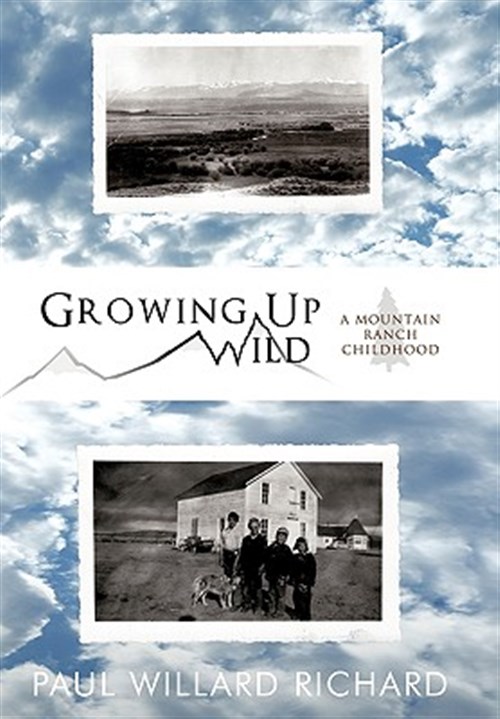
GROWING UP WILD
A Mountain Ranch ChildhoodBy Paul Willard RichardTrafford Publishing
Copyright © 2010 Paul Willard Richard
All right reserved.ISBN: 978-1-4269-3302-8Contents
Chapter One: Returnin'..........................1Chapter Two: Ridin'.............................21Chapter Three: Pettin'..........................51Chapter Four: Springin'.........................73Chapter Five: Movin'............................93Chapter Six: Riverin'...........................119Chapter Seven: Protectin'.......................143Chapter Eight: Roamin'..........................165Chapter Nine: Raidin'...........................191Chapter Ten: Hayin'.............................211Chapter Eleven: Doin'...........................239Chapter Twelve: Helpin'.........................261Chapter Thirteen: Gettin'.......................281Chapter Fourteen: Schoolin'.....................309Chapter Fifteen: Exertin'.......................329Chapter Sixteen: Winterin'......................347Chapter Seventeen: Changin'.....................369Chapter Eighteen: Realizin'.....................389
Chapter One
RETURNIN' "This isn't just a ranch."
Snowcapped mountain peaks surrounded me in all directions as I skirted sleepy Walden, Colorado, on the rutted dirt road and turned into the lane toward the Two-Bar Ranch. Everything in my heart seemed to be falling apart. Come hell or high water, I didn't want to give up the past by losing the ranch. As I had driven back to our home ranch, I had overwhelming thoughts of my boyhood, pondering why everything had to now suddenly change.
I stopped the car just inside the big square gate that framed the buildings and captured the looming snowy mountains sixteen miles beyond.
"Oh my God in heaven, I thought it would never happen," I muttered aloud, as I stepped from the rusty Plymouth and stared at the ranch buildings across the barren dirt yard. For years my folks had talked of selling. Dad had often said, "When someone comes along that wants to pay more than this place is worth, then we'll sell." I thought it had just been talk.
This isn't just a ranch. It holds my life, and childhood, the bones of our great Smokey, and a thousand memories of brave deeds along its pristine rivers, bluffs, and willowed meadows. We Richard boys explored every inch of the 2,029 acres of the Two-Bar and found mysteries and adventure in our realm. Now it's to belong to someone else, just for money?
I gazed at the huge old barn where the thick logs had been cut in the settlement days of hardships. Each section of fence at the pole corrals surrounding it was burned into my brain with events from fence walking on rainy evenings to a mad cow's escaping. Who I was and what I believed were tied up here.
"We have to be off the Two-Bar in thirty days," Mom had said on the phone to me yesterday in Greeley, where I was attending college. She seemed so calm about it, adding, "Your Dad is happy with the deal." How could that be, and how could she allow such a black deed to happen? The Two-Bar had been in the family since my great grandparents (the Monroes) had purchased it during World War One.
I had always assumed that the Two-Bar would remain in the family with one of us boys taking over in a deal of some kind as ranch people usually arrange. But no! It was to be sold to strangers from Nebraska, who didn't know the secrets of its haunts or truly appreciate our history and who probably didn't even care about those things. We were to be estranged from our home, probably even have to ask permission to visit it in the future, good God in heaven!
A walk after the long drive from Greeley would loosen my legs and help my mind clear before I faced them in the big log house. Maybe I could come up with some great reasons for them to back out of the deal and to keep the Two-Bar. Somehow this place, which had shaped my life, had to be held onto.
For decades my parents had struggled to build what was here. They overcame the Great Depression, the dirty thirties, family financial disasters, deaths, and even stolen ranches. Everything they had worked for all of their lives was tied up in the cattle, in the horses, and in this fertile land. I trodded on. I crossed the yard and moved by the towering red barn and acres of gray wooden poled corrals that were surrounded by wind-breaking high-board fences.
I had never swapped stories with anyone who wouldn't have traded his boyhood for mine. Why had growing up on this particular ranch made my experiences more unique and richer than that of my peers?
* * *
I thought back with fondness on one of the many solo river quests of my boyhood. Seeking the unexpected, I often spent my spare non-school September time along those willow-lined river bottoms. Although on such wanderings I usually carried my bow and arrows, as if hunting, I had no set boundaries or goals. Sometimes my brothers were along, but not this time. They were hard asleep under wool blankets made from our own flock in the big ranch house. Always, Smokey, my "god" spelled backwards, was at my heels.
Prior to sunrise the river was pure, peaceful, and new. Steam in a waist-high cloud rose above it, showing that its water was warmer than the hovering air. The rippling of the stream sent reassuring messages to me and my dog.
As I scurried along in the frosty pre-dawn light, excitement welled up in me. My sacred river was untouched and pristine. The ice was frozen in the back eddies and outward from the shore in uneven toothed plates, and broken only by the slow moving black water slipping by in dank silence. Black tangled and twisted willows lined the creek shores.
I had entered a golden era of childhood when we exchanged our prairie ranch for one in the towering Rocky Mountains of Colorado. Two willowed rivers rich in trout ran through our new place. Lush hay meadows spread on each side of our house, a slow train snaked across the Two-Bar, and a small town of 500 souls bordered our ranch to the south. Opportunities abounded for a kid.
Moving along the river, I felt kin to a Ute brave. I absorbed all the sounds and scenes as Smokey, my dog, explored with me. As the welcome sun brightened the sky above the mountains, magpies squawked in many voices, gadwall quacks echoed up the river, and crow calls could be heard far across the damp meadows. Five times in the early day mist the river bottom resounded with the thumping hollow jug sounds of a bittern's mournful voice somewhere far down the river. That morning I saw a mule deer in the meadow, black crows on the wing, a sneaking badger on a nearby ridge, and a lone red fox. In the early dawn, I loved to move in close before these wary animals bolted or flew.
What to expect on such mornings was as difficult to know as was the future. The thrill was in the surprise of what was around the next river bend. When I was alone in these wilds of our meadows with Smokey, I felt unequaled. I was born under the water sign of the Pisces fish, feeling strong in the wilds with the rivers and Smokey at my side.
Because I was also small for my age, this confidence seemed to collapse when I was with people. Not knowing about my life, my future seemed more of a threat than a thrill. I questioned who I was, how I fit in, and what I was going to become. I worried about making a living someday for I knew full well that there wasn't room on our Two-Bar for five ranching sons, and I had two older bigger brothers.
* * *
Now I walked on and reminisced. To the left of the barn, a sagebrush flat extended to the west edge of Walden's shanty fringe of tiny low-roofed houses. Walden's courthouse towered, as if it were the cathedral above a tiny Mexican village. Far beyond, mountains of the Never No Summer and Rabbit Ear Ranges dwarfed the courthouse. Gray-topped sagebrush leading to the town's edge rekindled a memory of a spring long ago with my two younger brothers, Larry and Jimmy.
Between the slumbering town and the stately set of ranch buildings, we three crouched in the blackish sagebrush between low scattered islands of the winter's half-melted snowdrifts. Cattle were bawling beyond the buildings, and a lone coyote yapped in the far distance as night lifted slowly. None of these had to fear boys hunting birds before sunrise.
"Are we close enough to shoot yet?" whispered energetic Larry, who, two years my junior, was always impatient. At ten he was unafraid, bold, and totally stubborn.
"Not quite," I replied, as I looked ahead at the dozen dark figures moving across a rocky hillcrest into the gray-green sagebrush.
"I think we can crawl across that little clearing and head them off," said Jimmy, keeping his head low to avoid detection. Jimmy, an eager, action lad, had a zest for adventure far beyond his eight years. Always chattering with enthusiasm, he was as difficult to hold back as a young Cheyenne warrior.
"Yes, if we do'er fast and keep down, we can blast those leaders when they hit the next open place," whispered Larry breathlessly as he checked the arrow notched to his taut bowstring. I could see his nearly solid freckled cheeks and dark hair even in the pale light and knew his sense of determination.
The three of us crawled on wet knees through icy standing water, mud, patches of crusted snow, and beds of rocks. After about fifty yards we stopped against a bunch of giant sagebrush. Rising to the kneeling position, we readied our arrows. Our position was perfect. Straining our eyes, we waited. For weeks we had been shooting arrows at them at dawn and dusk, but we had never been this close.
As the first one walked silently into the opening ahead of us Larry murmured, "You say when, Paul."
I whispered, "Wait until at least five are in the open. Don't move."
With numb fingers, in the early morning light we held our arrows as the two leaders strolled into the opening.
Like a flash, a huge dark object swooped in from our right. It plucked the leader from the clearing amid the wing beats of the other rising birds. We rose to our feet and loosed our arrows in vain at the airborne golden eagle that was clutching one of the sage grouse.
"Stupid eagle!" yelled Jimmy, after the vanishing giant as it gained altitude and banked southeast toward sleepy Walden.
We stood silent in the small clearing and watched the eagle climb skyward over the town's square courthouse and disappear. The eleven sage grouse had flown eastward over Walden's north edge and headed across the Hanson Place toward the Woolover Ranch beyond.
"That was really something," I said. "Never knew an eagle could just grab one like that."
"Sure spoiled our shootin'. We had 'em perfect," grunted a dejected Larry. He never wanted to lose at anything.
"Let's find our arrows and get home. I'm hungry" said Jimmy. "Huntin's over for today."
"We'll get those sage hens tomorrow if you guys want," replied Larry as he searched for his arrow.
"You bet," I said.
Discouraged, we returned to the big ranch house to tell our tale of the morning's hunt. Jay, our oldest brother, listened attentively, even though he didn't have a lot of interest in hunting with bows and arrows. Our parents just listened.
Across the table Bob, black-haired and handsome, expressed disinterest. He made fun of our failed efforts and doubted that it was an eagle. He was the self-centered brother who was interested in his own doings. Two years my senior, he was my rival who sometimes sought to influence our younger brothers and to pull them into doing his bidding.
Larry was as stubborn as he was tough and independent. He vacillated between "bein'" with Bob or with me. He was four years younger than Bob.
Jimmy sported sandy hair and flashing dark eyes. He was the youngest of the tribe. He had enthusiasm to burn and was easy to influence. Full of life and burning with energy, he had an inborn yearning for adventure. Jimmy was ready to happily do anything at the drop of a hat.
As an older brother, I worked hard to lead and boss my little brothers around and to do my bidding during our ranch quests, just as my older brothers worked me. Yet when I pressed too hard for my own way, Larry and Jimmy would walk away and do something else. On a big ranch, I couldn't be a total tyrant.
Way back in 1936 when I was born, Joseph Stalin had started the Great Purges in Russia and killed millions he considered different. On this side of the Atlantic, economic pressures were denying those Americans who lacked wealth the basics of life. In Colorado, however, even in the darkest of times there was no denying life itself the right to come forth naturally.
My dynamic mother told and re-told the story of my birth. On the evening when I was born, a gray-brown dust blizzard had departed. The night cleared as the choking powder settled on the barren short grass prairie that surrounded Genoa, Colorado, a tiny town along lonely railroad tracks.
"It's about time you got back here; this baby is half born now," snapped Mrs. Jones at Doctor Kessinger across the room dimly lit with a coal oil lamp. He tossed his black coat onto a chair and quickly washed his dusty hands in a waiting basin of steamy water.
"Guess I shouldn't have gone back home to Limon."
"Things happened real fast after you left, and I've almost got this kid delivered. Get over here and finish!"
"OK, for heaven's sakes keep your shirt on."
"My job is taking care of Edith and this baby after birth, not during."
"You're right. Looks like its a boy, and not a membrane or sack is broken. Never had one of these before, Mrs. Richard. He is extremely rare, a Caul Child." He held the baby aloft and inspected it, then caused its first cries of life.
"My God, you've got an easy delivery here, Doc. You're not going to charge her much for this are you?"
My mother, Edith, interrupted, "Holy cow, I'm just glad it's here; we wanted a girl so bad, and the bill is already paid." Edith was on snow-white sheets in an otherwise dusty room where she had sweated and groaned a new son into the world.
"This child came easier than any I've seen in all my years as a nurse," said Mrs. Jones in a low and serious tone.
"What is this, your fifth, Edith?" asked Doctor Kessinger.
"Heavens to Pete, no! The fourth son. We lost the second one to dust pneumonia, so this makes three boys and no girls yet," whispered Edith from the bed where she would be confined for ten days of recovery while Mrs. Jones cared for me.
"Maybe the next one will be the girl you want."
"For heaven sakes, let's hope so. Who needs all boys? But they run in Willard's side of the family."
My birth, much like that of my four brothers, was on the flat shortgrass prairie east of Denver. I was thus born the middle son in a poverty-stricken ranch family struggling to survive during the depths of the Great Depression on the flat and barren plains of dust-bowl eastern Colorado. I was the great-grandson of a Son-of-the-Confederacy speculator, the grandson of a cattle-speculating millionaire, and the son of a destitute working rancher.
From my earliest recollection Mother always had great expectations. "Paul, you can do better than that," she'd say. It was as if I had to behave better, think more, and help more around the house than the others. I often thought that I was supposed to have been the daughter she and Dad sought.
A small kid, I was also the only blond in the family. From the age of five, I wore glasses because of my poor eyesight and roving left eye. I seemed to be out of place with my darker complexioned parents. My tall, handsome, older brothers, Jay and Bob, often said, "Paul isn't part of the family because he's a blond tow-head" or " He's adopted" or "They found you under a big rock someplace." How could I ever compete with them, let alone excel or do something special?
My father, Willard, a good and quiet man, never took time to play with me nor with any of my brothers. His father and grandfather hadn't played with him either. They assumed no major roles in child raising. Dad's grandfather, Ben, was a proud member of the Sons of the Confederacy since his father, Henry, had been involved in the Civil War. Ben Richard, who had been a terrible penny-pinching tyrant in Virginia, had directly clouded his son Charlie's skills as a parent. Dad also grew up not really knowing his father or feeling close to him. Charlie, too, had taken a distant hands-off approach with my dad. No man on the Richard side of the family, in the straight-laced Victorian Age when the man brought home the bacon and left the kids to his wife, had known how to be a good father. A father was called on to deal with a kid mostly when discipline was needed. Then the fathers, down through the generations, were quick with the stick.
Mother, Edith, an outspoken, frank woman with a soft and caring heart, had been an only child. Unwanted by her own mother, Evelyn, she grew up as a semi-orphan cast about between boarding schools in Denver and Fort Collins. She stayed with other people during most of her growing years. She survived because her father, Jay, and her grandmother, Lindy, helped at critical times in her wretched growing years and saved her from becoming a street urchin or even worse.
(Continues...)
Excerpted from GROWING UP WILDby Paul Willard Richard Copyright © 2010 by Paul Willard Richard. Excerpted by permission.
All rights reserved. No part of this excerpt may be reproduced or reprinted without permission in writing from the publisher.
Excerpts are provided by Dial-A-Book Inc. solely for the personal use of visitors to this web site.