Da
Books Puddle, New York, NY, U.S.A.
Valutazione del venditore 4 su 5 stelle
Venditore AbeBooks dal 22 novembre 2018
Codice articolo 26398558239
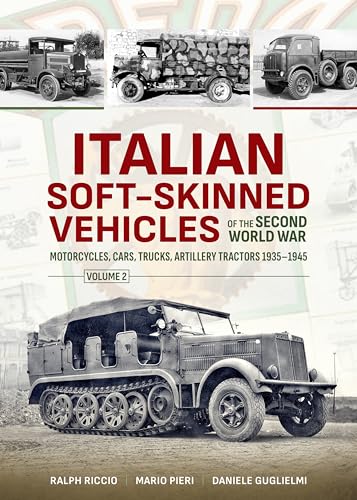
The importance of land transport vehicles within an armed force is often underestimated by the average reader, attracted by more ‘martial’ subjects such as tanks and artillery. Nevertheless, it was thanks to motorcycles, cars, trucks and tractors that – since the early years of the twentieth century – men, weapons, ammunition, provisions, fuel, equipment and orders were transported, all elements without which AFVs, guns and infantry are unable to fight. Volume 2 examines medium and heavy trucks, artillery tractors, special purpose vehicles and trailers. The main text is complemented with appendices on vehicle coloring and markings, manufacturers, production facts and further details.It is a common opinion that the Italian Army was beaten above all because of the poor quality of its combat vehicles. Impartial and in-depth studies, made since the end of the war, have revealed that the main problem was the shortage of vehicles, as well as an entirely insufficient logistics chain. The tank crews were able to compensate with bravery and experience for the fact that their tanks were, from a certain point on, inferior to those of their enemies, but the inadequate number of AFVs and other materiel was impossible to remedy. The same problem plagued the entire sector of military soft-skinned vehicles, a sign of Italy’s limited industrial capacity (and of procurement of raw materials and components) compared, for example, to its ally Germany. There were too few factories, too few skilled workers, and poor management skills within the armed forces.models of efficient, robust and resistant vehicles were produced, especially in the sector of the so-called ‘standardized’ motor vehicles. These vehicles allowed the Italian troops to move and fight in the large and difficult territories of North Africa, the Balkans and the Soviet Union and brought home what was left of the defeated soldiers.This is the first English-language study describing the soft-skinned vehicles of the Italian Armed Forces, starting from the 1930s, when Mussolini’s Italy faced some colonial conflicts and participated - albeit unofficially - in the Spanish Civil War, and throughout the Second World War. For each vehicle there is a file describing its evolution and the main technical aspects, accompanied by one or more photographs and, for the most significant examples, line drawings. The work is enriched by a historical introduction, various appendices and color profiles.
Titolo: Italian Soft-Skinned Vehicles of the Second ...
Casa editrice: Helion and Company
Data di pubblicazione: 2023
Legatura: Brossura
Condizione: New
Da: Paul Meekins Military & History Books, Stratford upon Avon, Regno Unito
Paperback. Condizione: New. New paperback copies at a reduced price. ; Volume 2: includes medium and heavy trucks, artillery tractors, special-purpose vehicles and trailers. Pictorial study featuring contemporary b/w photographs and illustrations, with brief background history and data. Includes several pages of colour profiles. ; 226 pages. Codice articolo 79641
Quantità: 1 disponibili
Da: CitiRetail, Stevenage, Regno Unito
Paperback. Condizione: new. Paperback. The importance of land transport vehicles within an armed force is often underestimated by the average reader, attracted by more 'martial' subjects such as tanks and artillery. Nevertheless, it was thanks to motorcycles, cars, trucks and tractors that - since the early years of the twentieth century - men, weapons, ammunition, provisions, fuel, equipment and orders were transported, all elements without which AFVs, guns and infantry are unable to fight. Volume 2 examines medium and heavy trucks, artillery tractors, special purpose vehicles and trailers. The main text is complemented with appendices on vehicle coloring and markings, manufacturers, production facts and further details. It is a common opinion that the Italian Army was beaten above all because of the poor quality of its combat vehicles. Impartial and in-depth studies, made since the end of the war, have revealed that the main problem was the shortage of vehicles, as well as an entirely insufficient logistics chain. The tank crews were able to compensate with bravery and experience for the fact that their tanks were, from a certain point on, inferior to those of their enemies, but the inadequate number of AFVs and other materiel was impossible to remedy. The same problem plagued the entire sector of military soft-skinned vehicles, a sign of Italy's limited industrial capacity (and of procurement of raw materials and components) compared, for example, to its ally Germany. There were too few factories, too few skilled workers, and poor management skills within the armed forces. models of efficient, robust and resistant vehicles were produced, especially in the sector of the so-called 'standardized' motor vehicles. These vehicles allowed the Italian troops to move and fight in the large and difficult territories of North Africa, the Balkans and the Soviet Union and brought home what was left of the defeated soldiers. This is the first English-language study describing the soft-skinned vehicles of the Italian Armed Forces, starting from the 1930s, when Mussolini's Italy faced some colonial conflicts and participated - albeit unofficially - in the Spanish Civil War, and throughout the Second World War. For each vehicle there is a file describing its evolution and the main technical aspects, accompanied by one or more photographs and, for the most significant examples, line drawings. The work is enriched by a historical introduction, various appendices and color profiles. 489 b/w photos & illustrations, 13 colour photos & illustrations, 6 colour profiles The second volume includes the remaining chapters dealing with medium and heavy trucks, artillery tractors, special-purpose vehicles and trailers. The main text is complemented with appendices on vehicle colouring and markings, manufacturers, production facts and further details. Shipping may be from our UK warehouse or from our Australian or US warehouses, depending on stock availability. Codice articolo 9781804514917
Quantità: 1 disponibili
Da: Speedyhen, Hertfordshire, Regno Unito
Condizione: NEW. Codice articolo NW9781804514917
Quantità: 2 disponibili
Da: Chiron Media, Wallingford, Regno Unito
paperback. Condizione: New. Codice articolo 6666-GRD-9781804514917
Quantità: 2 disponibili
Da: PBShop.store UK, Fairford, GLOS, Regno Unito
PAP. Condizione: New. New Book. Shipped from UK. Established seller since 2000. Codice articolo GB-9781804514917
Quantità: 2 disponibili
Da: Ria Christie Collections, Uxbridge, Regno Unito
Condizione: New. In. Codice articolo ria9781804514917_new
Quantità: 2 disponibili
Da: Kennys Bookshop and Art Galleries Ltd., Galway, GY, Irlanda
Condizione: New. 2024. hardcover. . . . . . Codice articolo V9781804514917
Quantità: 2 disponibili
Da: THE SAINT BOOKSTORE, Southport, Regno Unito
Paperback / softback. Condizione: New. New copy - Usually dispatched within 3 working days. Codice articolo B9781804514917
Quantità: 3 disponibili
Da: Revaluation Books, Exeter, Regno Unito
Paperback. Condizione: Brand New. 226 pages. 11.25x8.00x0.50 inches. In Stock. Codice articolo __1804514918
Quantità: 2 disponibili
Da: Rarewaves.com UK, London, Regno Unito
Paperback. Condizione: New. The importance of land transport vehicles within an armed force is often underestimated by the average reader, attracted by more 'martial' subjects such as tanks and artillery. Nevertheless, it was thanks to motorcycles, cars, trucks and tractors that - since the early years of the twentieth century - men, weapons, ammunition, provisions, fuel, equipment and orders were transported, all elements without which AFVs, guns and infantry are unable to fight. Volume 2 examines medium and heavy trucks, artillery tractors, special purpose vehicles and trailers. The main text is complemented with appendices on vehicle coloring and markings, manufacturers, production facts and further details.It is a common opinion that the Italian Army was beaten above all because of the poor quality of its combat vehicles. Impartial and in-depth studies, made since the end of the war, have revealed that the main problem was the shortage of vehicles, as well as an entirely insufficient logistics chain. The tank crews were able to compensate with bravery and experience for the fact that their tanks were, from a certain point on, inferior to those of their enemies, but the inadequate number of AFVs and other materiel was impossible to remedy. The same problem plagued the entire sector of military soft-skinned vehicles, a sign of Italy's limited industrial capacity (and of procurement of raw materials and components) compared, for example, to its ally Germany. There were too few factories, too few skilled workers, and poor management skills within the armed forces.models of efficient, robust and resistant vehicles were produced, especially in the sector of the so-called 'standardized' motor vehicles. These vehicles allowed the Italian troops to move and fight in the large and difficult territories of North Africa, the Balkans and the Soviet Union and brought home what was left of the defeated soldiers.This is the first English-language study describing the soft-skinned vehicles of the Italian Armed Forces, starting from the 1930s, when Mussolini's Italy faced some colonial conflicts and participated - albeit unofficially - in the Spanish Civil War, and throughout the Second World War. For each vehicle there is a file describing its evolution and the main technical aspects, accompanied by one or more photographs and, for the most significant examples, line drawings. The work is enriched by a historical introduction, various appendices and color profiles. Read more Continue reading Read less ABOUT THE AUTHORRalph Riccio was born in Bridgeport, Connecticut and is a retired US Army officer who has been interested in military history and military equipment since his youth. He has written and co-authored a number of books on Italian small arms, armor and artillery, as well as several books on aspects of Irish military history. He has also written numerous magazine articles both in English and Italian dealing with a broad spectrum of military subjects. He has a native Italian langu. Codice articolo LU-9781804514917
Quantità: 1 disponibili