
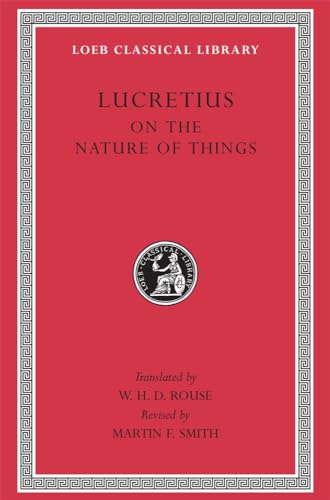
Lucretius: On the Nature of Things (Loeb Classical Library No. 181) (Bks. 1-6)
Titus Lucretius Carus, W.H.D. Rouse, M.F. Smith
ISBN 10: 0674992008 ISBN 13: 9780674992009
Editore: Harvard University Press, 1924
Usato
Hardcover
Da
HPB-Ruby, Dallas, TX, U.S.A.
Valutazione del venditore 5 su 5 stelle

Venditore AbeBooks dal 15 settembre 2017
Questo articolo specifico non è più disponibile.
Riguardo questo articolo
Descrizione:
Connecting readers with great books since 1972! Used books may not include companion materials, and may have some shelf wear or limited writing. We ship orders daily and Customer Service is our top priority! Codice articolo S_473247402
Riassunto:
Lucretius (Titus Lucretius Carus) lived ca. 99?ca. 55 BCE, but the details of his career are unknown. He is the author of the great didactic poem in hexameters, De Rerum Natura (On the Nature of Things). In six books compounded of solid reasoning, brilliant imagination, and noble poetry, he expounds the scientific theories of the Greek philosopher Epicurus, with the aim of dispelling fear of the gods and fear of death and so enabling man to attain peace of mind and happiness.
In Book 1 he establishes the general principles of the atomic system, refutes the views of rival physicists, and proves the infinity of the universe and of its two ultimate constituents, matter and void. In Book 2 he explains atomic movement, the variety of atomic shapes, and argues that the atoms lack colour, sensation, and other secondary qualities. In Book 3 he expounds the nature and composition of mind and spirit, proves their mortality, and argues that there is nothing to fear in death. Book 4 explains the nature of sensation and thought, and ends with an impressive account of sexual love. Book 5 describes the nature and formation of our world, astronomical phenomena, the beginnings of life on earth, and the development of civilization. In Book 6 the poet explains various atmospheric and terrestrial phenomena, including thunder, lightning, earthquakes, volcanoes, the magnet, and plagues.
The work is distinguished by the fervour and poetry of the author.
L'autore:
About the Author:
"Titus Lucretius Carus (ca. 99 BC- ca. 55 BC) was a Roman poet and philosopher. His only known work is the epic philosophical poem De Rerum Natura, On the Nature of Things.
Very little is known about Lucretius' life. One source of information (generally considered unreliable) is St. Jerome, who mentions Lucretius in the Chronica Eusebii. Here we find the following notice: "Titus Lucretius the poet is born. Later he was driven mad by a love potion, and when, during the intervals of his insanity, he had written a number of books, which were later emended by Cicero, he killed himself by his own hand in the 44th year of his life." In most manuscripts this notice is entered under the year 94 BC, but in others under 93 or 96. This gives us the following alternative dates for Lucretius' life and death: 96-53/52, 94-51/50, and 93-50/49.
In the Oxford World's Classics edition of "On the Nature of the Universe," the editors, Don and Peta Fowler, note that the story told by St. Jerome is unlikely. The Fowlers state that Lucretius was most likely an aristocrat and his poem "shows familiarity with the luxurious life-style of great houses in Rome."" (Quote from wikipedia.org)
Le informazioni nella sezione "Su questo libro" possono far riferimento a edizioni diverse di questo titolo.
Dati bibliografici
Titolo: Lucretius: On the Nature of Things (Loeb ...
Casa editrice: Harvard University Press
Data di pubblicazione: 1924
Legatura: Hardcover
Condizione: Very Good
Edizione: seconda edizione