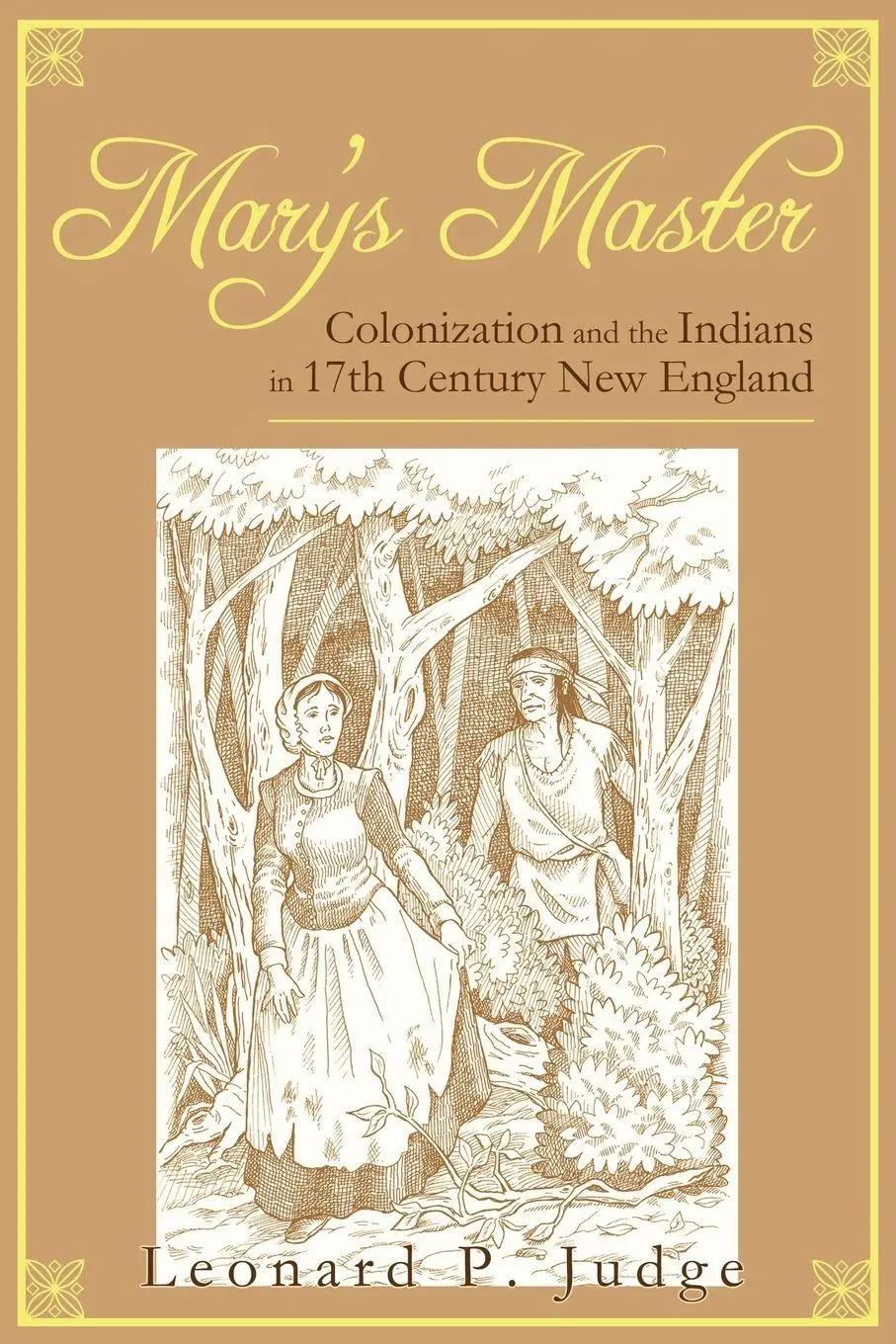
Mary's Master
Colonization and the Indians in 17th Century New EnglandBy Leonard P. JudgeiUniverse, Inc.
Copyright © 2010 Leonard P. Judge
All right reserved.ISBN: 978-1-4401-8817-6Contents
Map of Tribal Domains & Significant Native Locations.....................ixChapter 1 Mary Rowlandson and Her Captors................................1Chapter 2 The War Begins.................................................6Chapter 3 Puritan and Narragansett Relations.............................11Chapter 4 The Preemptive Plans...........................................16Chapter 5 The Great Swamp Fight..........................................21Chapter 6 Lancaster Attacked.............................................24Map of the Removes of Mary Rowlandson....................................27Chapter 7 The Removes Begin..............................................29Chapter 8 Mary Jamison...................................................34Chapter 9 Land Acquisitions..............................................38Chapter 10 Mary Meets Philip.............................................43Chapter 11 Careless Captors..............................................45Chapter 12 "he shewed me the way"........................................47Chapter 13 Abuses of Captives............................................50Chapter 14 Decent Captors................................................54Chapter 15 Injustice Recognized - But Used...............................60Chapter 16 Slavery.......................................................72Chapter 17 Pretense Assailed.............................................76Chapter 18 Indian Hospitality............................................79Chapter 19 Fauna and Flora...............................................82Chapter 20 Nutrition, Health and Disease.................................84Chapter 21 Quanapin Returns..............................................90Chapter 22 Elliot's Disciples............................................96Chapter 23 Advantages and Disadvantages..................................99Chapter 24 Praying Indians...............................................105Chapter 25 The Discouraging Victory......................................107Chapter 26 A "General Court".............................................110Chapter 27 Wampanoag Sachems.............................................114Chapter 28 Strengths.....................................................122Chapter 29 Redemption....................................................132Chapter 30 The Collapse..................................................139Chapter 31 How Far They Fell.............................................150Chapter 32 Possible Lessons..............................................152Glossary.................................................................161Sources..................................................................165
Chapter One
Mary Rowlandson and Her Captors
On Feb. 10th, 1676, old style calendar, the English town of Lancaster was attacked at the break of dawn by a body of Nipmuck and Narragansett fighters. This town was well fortified, as were most English towns, by buildings built extra strong called garrisons, whereto the English in other homes could flee in an attack. Lancaster had six garrisons. Lancaster was then on the fringe of Massachusetts Bay colony about 45 miles west northwest of Boston.
(England had not yet adopted the new calendar until 1752 when the date was advanced ten days and the first of the year made January 1 instead of March 21st as it was in the old calendar.)
Lancaster was settled in 1643 in territory occupied, time out of mind, by natives called Nipmuck. This attack was one of dozens that occurred in the conflict later called King Philip' War. The attackers set about burning the non garrisoned buildings and killing or taking captive English caught outside. With difficulty they, after two hours, set one of the garrisons ablaze. Within that garrison were 37 or more including Mary Rowlandson and her three children. It is Mary's narrative ''penned by the gentlewoman her self''', according to the anonymous writer of this narrative's Preface that gives us some insight into the character of the natives. {Rowlandson passim}
Mary White Rowlandson was born about 1637 in England of John and Joan White who came to Mass. Bay Colony and settled in Lancaster. {1Green p.24} They were said to be the largest landowners there. {2 Drake J.p123}
Mary married Rev. Joseph Rowlandson, probably in 1656 based on the date of their first child's birth in Lancaster records which was Jan. 11 1658. That child named Mary, died on Jan. 20, 1661. They had three more children: Joseph, born Mar. 7, 1661/2; a second Mary born Aug. 12, 1665; and Sarah born Sept. 15,1669. Mary's (Sr.) age of death had always been assumed to have been about 41 because the name Mary Rowlandson disappeared from any records with only a few allusions that might indicate her living beyond 1678. However, a great research paper produced by David L. Green found that Mary remarried just nine months after the Reverend Joseph died, as recorded, on Nov. 24, 1678, at the age of 47. The Rev. and his family had moved to Wethersfield, Conn., in Apr. 1677. It was there Mary married the widower Capt. Samuel Talcott, father of eight, on Aug. 6, 1679. Mary Rowlandson became Mary Talcott on that day and thus disappeared to historians. {3Green p.31}
"According to the Wethersfield Vital Records, Mary Talcott, widow [Samuel died Nov.11, 1691] died on Jan. 5, 1710/11, age of about 73, having outlived the death usually given her by nearly 33 years." [4Green p.31}
The attack at that time was reportedly led by two Nipmuck sachems, Monoco (called by the English One-Eyed John) and Uskutugun (called Sagamore Sam), so we know Nipmunks were there. Mary says she was taken captive by a Narragansett as the English fled the burning garrison, so some of the attackers were Narragansetts.
The protagonist of the whole war was the Wampanoag sachem Pometacomet (called by the English Philip, and later King Philip). Early English writers called the sachem of the Pocanoket village of Montaup/ Sowams, the "Supreme Wampanoag Sachem." The designation supreme here is an English concept. Just how much power, authority, persuasion etc. any such sachem had with other Wampanoag villages is still not known.
Philip (we will use the better known name) was at the time located somewhere near Albany N.Y., usually thought to be at a Mahican village called Schagticoke. He apparently was trying to get other tribes to help him against the English. He may not have been aware of what was happening back to the east.
One thing that occurred while Philip was near Albany was that the Narragansetts, who had stayed out of any known involvement in the conflict going on between Philip and his allies and the Puritan Colonies, had been preemptively attacked by those Puritan colonies. The Colonies of Mass. Bay, Connecticut, and Plymouth were dominated by the religious sect called by their detractors, Puritans, a name the sect members themselves disliked. Those colonies had formed a defensive/ offensive pact they called the United Colonies shortly after the Pequot War of 1637.
The Narragansetts had, since the conquest of the Pequot Tribe, been considered by the English as the most powerful tribe in New England that they would have to deal with. This and several other reasons seemed to have made the leaders of the Puritan colonies antagonistic toward the Narragansetts. Firstly, the Narragansett homeland or territory was almost the same land on which the non-Puritan colony of Providence Plantations and Rhode Island had planted, a place fled to by many English who rejected Puritanism or were rejected by the same. This made Rhode Island almost an enemy to its three neighbors, which also made it harder for the Puritan colonies to manipulate the Narragansetts. Secondly, the Mohegan tribe led by sachem Uncas became close allies or indeed lackeys of Connecticut and disputes between the Narragansetts and the Mohegans put Connecticut and the Narragansetts at odds. Thirdly, Plymouth feared Rhode Island was limiting it's own expansion to the west and making the Narragansetts part of that perceived problem. Fourthly, Conn. and Mass. Bay felt they should possess some of the land in the southern part of present Rhode Island. Attempts to gain such land went on until the Crown halted the disputes, at least temporarily, with the seemingly noble ruling that colonies could not gain land by war, in this case King Philip's War. Fifthly, in 1644 Samuel Gorton and Randall Holden dwellers of the Warwick area of Rhode Island and enemies of Mass. Bay convinced the Narragansett sachems that they could get the protection of the King if they produced and presented a letter of submission to the King. The letter was produced and accepted by the King. Mass. Bay then had to lay back in its' oppression of the tribe; however, Mass. Bay's anger was probably heightened by that. Fortunately for Mass. Bay, King Charles was in a civil war where the opposition was gaining and would in time defeat the royalty. Charles was defeated and in that war and beheaded in 1649. While he was so occupied in 1645, the United Colonies declared war on the Narragansetts, mobilized an army and sent for the sachems to parley. The sachems submitted to a so-called "treaty" requiring them to pay to the U.C. 2000 fathoms of good white wampum plus a tribute in wampum for each Pequot captive living with them. Payment of the tribute was often a problem for the Narragansetts. Also they were required to give up whatever former Pequot country they had been using since the Pequot war with such land going to the United Colonies.
This was but one of many extortions pressed upon the natives, some to be mentioned later. The English had acted aggressively against the natives several times, in the short time they had been in New England. In the development of the Pequot conflict, of 1636 the Pequots essentially had reacted to English aggression. The first fatal hostility of that war occurred when an Indian of the Massachusetts tribe, guiding a coercive English army through Pequot country, shot and presumably killed a Pequot. The reason for the incursion into that place goes back to the murder of one Captain Stone two years before the war. He was a free-lance trader from the West Indies, (an apparent scoundrel, threatened by both Mass. Bay and Plymouth with execution) who was killed, probably by Indians, when he sailed up the Connecticut river for trade. The Pequots were assumed to be the killers. Captain John Mason, however, leader of the attack on the Pequot fort at Mystic, wrote years later that the murdering Indians were not Pequots, and he should know as well as anyone. Mason in his history of the Pequot War, written some thirty years after that war, notes "these Indians [who supposedly killed Stone] were not native Pequots, but had frequent recourse to them, to whom they tendered some of those goods ..." goods stolen from Stone's barque. Further he states, Stone "sailing into the Conn. River about 2 leagues [about 6 miles] from the Entrance cast Anchor ... [he] procured some of those ... Indians belonging to that place ... to go as Pilots ..." {5 Mason p.16} these he indicated were the killers. Even at that we can't know the circumstances of Stone's death; his own behavior might have gotten him into trouble with any Indian. Six miles up the river was territory of one of the so-called Connecticut River tribes and not the Pequots, although some of the Pequots might have also been there at the time.
Another killing was that of one John Oldham, done off the coast of Block Island in July 1636. This was attributed, by the English, to the Block Island Indians, and the island was attacked by Mass. Bay for that reason. {6 Jennings p.206} The Commander of that attack says, conveniently, those Indians fled to the Pequots. That is very unlikely, since it would be a row of 33 miles over rough water to the closest known Pequot village at Mystic. The row to the southern shore of Rhode Island is about 13 miles, still difficult, and how many trips by a limited number of canoes would be needed to take all the natives from the island? That the natives hid-out somewhere on the island seems far more likely, just as the Commander said they had done the very day before. However, the English choose to blame the Pequots for both deaths, which helped to justify the attack upon them.
There is no evidence of any serious plan by any Indian group against the English (who were spreading everywhere) from 1620 until 1674 or 1675 when Philip did indeed seem to plot.
Chapter Two
The War Begins
It was June 20th, 1675 when some of Philip's tribe began pilfering from abandoned homes in the town of Swansea, abandoned because of alarm over the continuing stories of Indian troubles. At one house with English still there, an Indian pilferer was shot and killed. This seems to have occurred on June 24th. As quickly as June 26 Mass. Bay sent Capt. Henchman with foot soldiers, Capt. Prentice with troops and Capt. Mosely with buccaneers to Swansea. Plymouth had sent soldiers even sooner than that.
On July 4, Capt. Hutchinson came from Boston to the headquarters of the assembled army at Swansea or Rehoboth with orders to depart from there with a force and to proceed to the Narragansett country. Official historian Hubbard wrote- "The next Morning was spent in Consultation how to carry on the Treaty ... [they] ... to make a Peace with a Sword in their Hands ... all the Massachusetts Forces [went] over into the Narragansett country, to fight them, if ... be need ... as they passed, they found the Indians in Pomham's Country [Warwick R.I. area, the Shawomet/Narragansett village] all fled ...". {7 Hubbard p.74} The army did venture further south in the direction of the supreme sachem's village, but for some reason, did not actually reach that village. At Pettaquamscott (about 15 miles south of present Warwick R.I.) they managed to get the names of four Indians onto the treaty composed by the English. Hubbard claims they were "Councellors and Attornies to Canonicus", the supreme sachem. Only one name, Corman, is a recognizable one, and he was associated with Ninigret, the Niantic/Narragansett sachem. The treaty was dated "July 15, 1675 Pettaquamscot" {ibid}
Although Mass. Bay had not sent forces to Swansea until June 26th, Plymouth may have sent a force there even before "mischief" by Pokanoket/Wampanoag occurred in Swansea. The deputy governor of Rhode Island John Easton in his "... Relacion ..." noted that after a conference between six Rhode Islanders including Sam Gordon and himself with a group of Wampanoags including Philip, that he received a letter in Rhode Island from Plymouth "... sudingly ..." after that conference. The conference was held "about a wecke before ..." the outbreak of hostilities. That letter informed R.I. that they, Plymouth "intended in arems to Conforem philip ... and in a weckes time after we had bine with the Indians the war thus begun. Plymouth soldiers were Cum to have ther head quarters within 10 mile of philip then most of the English there about left ther houses ... in this time sum indians fell a pilfering sum houses that the English had left ...". {8 Easton p.11} If Easton is correct Plymouth would seem to have had soldiers at Swansea before the pilfering of the Swansea homes, whereas most accounts indicate Plymouth only sent soldiers after Indian provocations.
A very telling letter Philip had had written for him in reply to one John Borden "a friend of Philip ..." found in the Foster papers, gives a version of Philip's position on the interactions between the English and himself cir. 1675. In part it says - "At length a line of division was agreed upon between the English and my people, [specifically, he may be referring to a line set up by Plymouth in what the English called Swansea that was to preserve some Pokanoket land from English expansion] and I myself was to be responsible. Sometimes the cattle of the English would come into the fields of my people, for they did not make fences like the English. [Philip seems to have omitted what the Indians did to those cattle.] I must then be seized and confined till I sold another tract of my country for satisfaction of all damages and costs. Thus tract after tract is gone. But a small part of the dominion of my ancestors remains. I am determined not to live till I have no country".
While several skirmishes went on between Wampanoag and Plymouth forces at Rehoboth, Pocasset and Dartmouth, those of Mass. Bay and Connecticut were directed to bring the Narragansetts to submission and cooperation and their forces were sent into the Narragansett country. This led to the so- called treaty previously mentioned which was drawn up at the place called Pettaquamscutt (south of present day Saunderstown R.I.). No known sachem was there present. It was a demeaning set of demands, that is the wording was, but what was presented and how it was understood by the four Narragansetts contacted there could have been different. By the treaty terms, they were to seek out and kill any of Philip's subjects, male or female, that might enter Narragansett country and bring the slain to the English. They were to use the utmost of their ability in acts of hostility against their neighbors the Wampanoag. They were promised one coat for every dead Wampanoag brought in, but two coats for every live Wampanoag. Live Wampanoags could be sold into slavery.
Plymouth would soon sell "eight score" (160) Indians who had agreed to surrender at Dartmouth on about July 16-20,1675 on terms of some sort of security from the fray, terms that were overturned by authority at Plymouth. {10 Church p.50} Selling of captives was a diabolical way of getting rid of Indians who might be troublesome, eliminating the need to maintain the captives and gaining financially.
In noting previous English methods used in Ireland historian Slotkins sees a repetition in New England - Cromwell's "wholesale slaughter of the Irish and of his selling of many into West Indian slavery parallels exactly the policy adopted by the American Puritans in King Philip's War two decades later." {10b Slotkins p. 42}
After taking four Narragansetts, hostage to supposedly insure compliance with the treaty, the English force hurriedly left the area without ever meeting any of the well known Narragansett sachems.
The Mass. Bay forces then needed to get back to the opposite side of Narragansett Bay where the Wampanoag were assaulting several towns. The Conn. force was recalled to Connecticut because of a threat posed by Gov. Sir Edmond Andros of New York. Andros had sailed from New York, with troops on July 7, arriving at Old Saybrook fort located at the mouth of the Conn. River, in an attempt to assert authority over western Connecticut, long claimed by Andros' boss, James, the Duke of York. The attempt was disguised as protection for the people of that area from the Indians by New York but Connecticut leaders were almost as clever as Andros and blocked his landing with their own troops. The frustrated Andros didn't dare land and eventually sailed back to New York {11 Jennings p.307}.
(Continues...)
Excerpted from Mary's Masterby Leonard P. Judge Copyright © 2010 by Leonard P. Judge. Excerpted by permission.
All rights reserved. No part of this excerpt may be reproduced or reprinted without permission in writing from the publisher.
Excerpts are provided by Dial-A-Book Inc. solely for the personal use of visitors to this web site.