
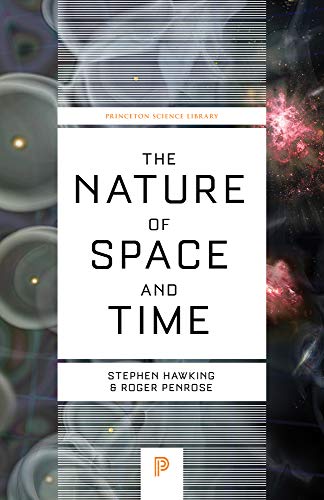
The Nature of Space and Time (Princeton Science Library)
Hawking, Stephen,Penrose, Roger
ISBN 10: 0691145709 ISBN 13: 9780691145709
Editore: Princeton University Press, 2010
Usato
paperback
Da
Open Books, Chicago, IL, U.S.A.
Valutazione del venditore 5 su 5 stelle

Venditore AbeBooks dal 14 ottobre 2016
Questo articolo specifico non è più disponibile.
Riguardo questo articolo
Descrizione:
Open Books is a nonprofit social venture that provides literacy experiences for thousands of readers each year through inspiring programs and creative capitalization of books. Codice articolo mon0000793214
Riassunto:
Einstein said that the most incomprehensible thing about the universe is that it is comprehensible. But was he right? Can the quantum theory of fields and Einstein's general theory of relativity, the two most accurate and successful theories in all of physics, be united in a single quantum theory of gravity? Can quantum and cosmos ever be combined? On this issue, two of the world's most famous physicists-Stephen Hawking (A Brief History of Time) and Roger Penrose (The Emperor's New Mind and Shadows of the Mind)-disagree. Here they explain their positions in a work based on six lectures with a final debate, all originally presented at the Isaac Newton Institute for Mathematical Sciences at the University of Cambridge. How could quantum gravity, a theory that could explain the earlier moments of the big bang and the physics of the enigmatic objects known as black holes, be constructed? Why does our patch of the universe look just as Einstein predicted, with no hint of quantum effects in sight? What strange quantum processes can cause black holes to evaporate, and what happens to all the information that they swallow? Why does time go forward, not backward? In this book, the two opponents touch on all these questions. Penrose, like Einstein, refuses to believe that quantum mechanics is a final theory. Hawking thinks otherwise, and argues that general relativity simply cannot account for how the universe began. Only a quantum theory of gravity, coupled with the no-boundary hypothesis, can ever hope to explain adequately what little we can observe about our universe. Penrose, playing the realist to Hawking's positivist, thinks that the universe is unbounded and will expand forever. The universe can be understood, he argues, in terms of the geometry of light cones, the compression and distortion of spacetime, and by the use of twistor theory.
Informazioni sull'autore: Stephen Hawking is the Lucasian Professor of Mathematics Emeritus at the University of Cambridge. Roger Penrose is the Rouse Ball Professor of Mathematics Emeritus at the University of Oxford.
Le informazioni nella sezione "Su questo libro" possono far riferimento a edizioni diverse di questo titolo.
Dati bibliografici
Titolo: The Nature of Space and Time (Princeton ...
Casa editrice: Princeton University Press
Data di pubblicazione: 2010
Legatura: paperback
Condizione: Good