

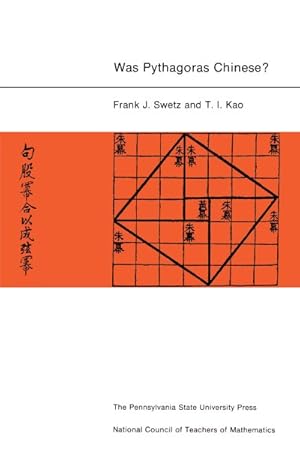
Was Pythagoras Chinese? : An Examination of Right Triangle Theory in Ancient China
Swetz, Frank J.; Kao, T. I.
ISBN 10: 0271012382 ISBN 13: 9780271012384
Editore: Penn State University Press, 1977
Usato
Brossura
Da
GreatBookPricesUK, Woodford Green, Regno Unito
Valutazione del venditore 5 su 5 stelle

Venditore AbeBooks dal 28 gennaio 2020
Questo articolo specifico non è più disponibile.
Riguardo questo articolo
Descrizione:
May show signs of wear, highlighting, writing, and previous use. This item may be a former library book with typical markings. No guarantee on products that contain supplements Your satisfaction is 100% guaranteed. Twenty-five year bookseller with shipments to over fifty million happy customers. Codice articolo 651560-5
Riassunto:
The title of this monograph, while intended to intrigue and attract the otherwise unresponsive reader, is not whimsically conceived. Of course, the historical figure of mathematical fame known as Pythagoras, born on the island of Samos in the 6th century B.C., was Greek, not Chinese. But there is another "Pythagoras" equally deserving fame. He is the man who first proved the proposition that "the sum of the squares of the legs of a right triangle is equal to the square of the hypotenuse."For hundreds of years this theorem has borne the name of Pythagoras of Samos, but was he really the first person to demonstrate the universal validity of this theorem? The issue is controversial. Seldom are mathematical discoveries the product of a single individual's genius. Often centuries and thousands of miles separate the appearance and the isolated reappearance of the same mathematical or scientific theory.It is now acknowledged that the "Pascal Triangle" method of determining the coefficients of a binomial expansion was known in Sung China 300 years before Pascal was born, and that the root extraction algorithm credited to the 19th-century British mathematician W.G. Homer was employed by Han mathematicians of the 3rd century A.D. If, then, these mathematical processes. are to bear the names of the persons who devised them, surely "Pascal" and "Homer" were Chinese. So too might such an argument be posed for the Pythagorean. Theorem on the basis of evidence contained in ancient Chinese mathematics texts.It is the purpose of this monograph to present and examine this evidence.This is a joint publication of the Penn State Press and the National Council of Teachers of Mathematics.Penn State Study No. 40
Informazioni sull'autore:
Frank J. Swetz, a member of the Department of Mathematics-and Education at The Pennsylvania State University, Capitol Campus, received his Ed.D. from Columbia University. He is the author of Mathematics Education in China and numerous articles.
T.I. Kao, an engineer with the Pennsylvania Department of General Services, took his graduate work at the New Mexico State University.
Le informazioni nella sezione "Su questo libro" possono far riferimento a edizioni diverse di questo titolo.
Dati bibliografici
Titolo: Was Pythagoras Chinese? : An Examination of ...
Casa editrice: Penn State University Press
Data di pubblicazione: 1977
Legatura: Brossura
Condizione: good