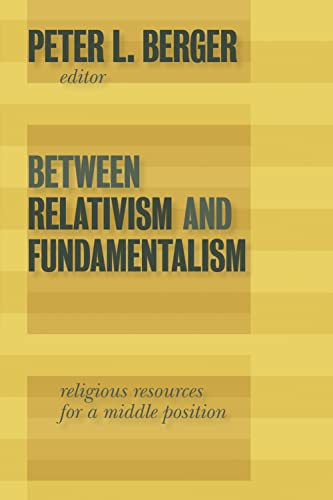
The current religious scene is dominated by two extremes -- relativism and fundamentalism. Neither is desirable: relativism claims that all questions of truth are irrelevant, whereas fundamentalism insists on sole possession of absolute truth. Internationally renowned sociologist of religion Peter Berger has gathered a group of scholars to consider how, from out of different traditions, one can define a middle position between both extremes. After an extensive introductory overview, three essays ("sociological descriptions") give an objective picture of how relativism and fundamentalism play out in today's world. In the second part ("theological directions") authors from several different Christian traditions and one conservative Jewish tradition flesh out a normative middle ground that is neither relativist -- they affirm specific truth claims -- nor fundamentalist -- their affirmations include tolerance of the claims of others.
Between Relativism and Fundamentalism
Religious Resources for a Middle PositionWilliam B. Eerdmans Publishing Company
Copyright © 2010 Wm. B. Eerdmans Publishing Co.
All right reserved.ISBN: 978-0-8028-6387-4 Contents
Contributors..................................................................................................................................viiPreface.......................................................................................................................................ixIntroduction: Between Relativism and Fundamentalism Peter L. Berger..........................................................................1Fundamentalism and Relativism Together: Reflections on Genealogy James Davison Hunter........................................................17An English Example: Exploring the Via Media in the Twenty-First Century Grace Davie..........................................................35Evangelicals in Search of a Political Theology Craig M. Gay..................................................................................56Religious Conviction in a Diverse World: A Jewish Perspective on Fundamentalism and Relativism David M. Gordis...............................105Christianity in an Age of Uncertainty: A Catholic Perspective Ingeborg Gabriel...............................................................124A Lutheran Approach Peter L. Berger..........................................................................................................152Pilgrim at the Spaghetti Junction: An Evangelical Perspective on Relativism and Fundamentalism Os Guinness...................................164Relativism and Fundamentalism: An Eastern Church Perspective from the "Paris School" and Living Tradition Michael Plekon.....................180
Chapter One
Fundamentalism and Relativism Together: Reflections on Genealogy
James Davison Hunter
No one predicted what is now commonplace. And for several decades, as history has unfolded and evidence has mounted, a generation of intellectuals has been in denial, hoping against hope, that it was a grotesque abnormality and that it would quickly disappear. Even at present, many believe it to be anomalous and thus the best strategy is to just wait it out until it disappears.
Yet now it is plain to see that the emergence and persistence of fundamentalist movements globally is an established reality of our time, unlikely to go away anytime soon. The reason is that the emergence of fundamentalism is intrinsic to the late modern world. In this, fundamentalism does not represent a resurgence of traditional religion but is, rather, a distinct variant of traditional religion; one that emerges out of the dynamics of its encounter with the modern and late modern world and the discontents the contemporary world generates. Fundamentalism, at its core, is defined and shaped by the present world order; it is a natural expression of the very world it rejects.
To be more specific, fundamentalism is a phenomenon that is rooted in the epistemic dynamics of late modernity. Whatever else fundamentalism may be — and it is a very complex and multidimensional phenomenon — it is a defensive reaction to the fragmentation, pluralization, and relativization of knowledge and understanding that are part and parcel of our time. In this way, fundamentalism and relativism are at least partially symbiotic — one feeds off of the other. The central contention here then can be restated this way: the tensions between fundamentalism and relativism are an enduring and perhaps permanent structural feature of the present and emerging global order and as such, the dynamic between these polarizing tendencies provides one of the dominant narratives of culture and civilization for our time. In this essay, I want to explore how and why this has come to be and the quandary it presents for those who are neither fundamentalists nor relativists.
The Conceptual Challenge
As a historical phenomenon, the concept "fundamentalism" should generate some pause. Religious historians and area specialists are rightly annoyed by the cavalier usage of the word. The term originally came to life in the first decade of the twentieth century to describe a movement of conservative Protestants who believed that the core doctrines of their faith were being undermined by higher criticism. They reacted by publishing twelve volumes, written by a range of scholars, all defending the central elements of historic Christian orthodoxy. These were "The Fundamentals," and they contained the arguments by which historic Christian (Protestant) orthodoxy would stand its ground against the corrosive forces of theological liberalism. Those who embraced these doctrines were, naturally, "fundamentalists." Rightly understood, then, fundamentalism is bound by a particular context, within a particular tradition, and given expression by a particular group of social actors. What often goes under the name of fundamentalism in Islam, Judaism, Sikhism, and Hinduism, at best has family resemblances to the original. The word has become a synonym for reactionary religious dogmatism of whatever historical manifestation.
At least Protestant fundamentalism was a recognizable social movement in history. Relativism is not a social movement at all. It is most recognizable as theory of truth, beauty, and the good; namely, a theory that states or implies that these qualities are not in any way grounded or universal but, rather, are dependent upon time, place, context, and other factors. In the history of ideas, it has been implicit in some forms of romanticism, in existentialism, and postmodernism — all of which valorize subjectivity in the apprehension of reality and in the attribution of meaning. Each of these claims, in effect, that relativism is reality; that absence is all there is.
In our own day, then, both concepts have lost historical specificity and analytical usefulness by virtue of being overused or misused. One even finds these concepts employed as shibboleths, the function of which is to caricature and discredit enemies. Even when used honestly and without political purpose, they reflect a social analysis with cleaver rather than scalpel.
Making matters worse, fundamentalism and relativism are also related to a range of other paired opposites in contemporary discourse that range from psychology (authoritarianism vs. libertarianism), lifestyle (rigidity vs. permissivism), aesthetics (traditionalism vs. modernism/postmodernism), and worldview (religion vs. secular), to politics (conservative vs. liberal), cultural politics (orthodox vs. progressive), foreign affairs (Islam vs. the West), and globalizing ambitions (jihad vs. McWorld). Needless to say, these too are all ham-fisted in similar ways.
Thus, we have inherited concepts that at best lack parity and worse, are clumsy and tendentious to the point of uselessness. Still, the concepts survive. They do so in part because they point to something meaningful and enduring about the world in which we live. The question is, in what way might the concepts of fundamentalism and relativism be most useful in cultural analysis?
I would suggest that today the concepts of fundamentalism and relativism may be most useful when descriptive of epistemic propensities (or orientations in the way knowledge and understanding are grounded) that are at the root of opposing and competing cultural systems. There are several aspects of this conceptual approach that need unpacking.
First, when speaking of epistemic propensities, I am speaking of cultural dynamics that exist within social groups as habits of thinking and practices of moral reasoning that assume that knowledge and understanding are, in character, either absolute in the one case or arbitrary in the other. Needless to say, these propensities can only be thought of as ideal types that, as with all ideal types, rarely exist in perfect form but rather as approximations — people, communities, and religious faiths are more or less oriented by or committed to one or the other.
If fundamentalism and relativism might be best thought of as epistemic propensities at the root of opposing and competing cultural systems, it means that by their very nature they have profound implications for the ordering of both individual and collective life. In this way, knowledge and politics, art, family, and social life generally are inseparable.
Importantly, in social life, neither fundamentalism nor relativism is normative for the majority of people precisely because no social order can be sustained on the terms established by either one. Both extremes depend upon a social world and the cultural systems that sustain it that is less utopian than the fundamentalist's and more grounded in the hard and consistent realities of everyday life than the relativist's. And yet the late modern world is characterized by conditions that evoke and accentuate these polarities.
What follows in this essay is, at best, a rough outline that makes no pretense of being a full-fledged description of the social, cultural, and political relationship between fundamentalism and relativism. This is in part because I am trying to cover too much ground in too little space, in part because I have no formal expertise in intellectual history and comparative religion, and in part because these reflections are only in their formative stages. This is like a sketch an artist would make on the back of a scrap of paper long before committing paint to canvas. First, some reflections on genealogy.
Genealogy
Skepticism has a long and illustrious history in the Western tradition, and even in antiquity it took expression in a range between mere antidogmatism and dissolutionist cynicism. Yet the story I want to tell is one that ironically traces the sources of contemporary relativism through the Enlightenment quest for certainty. Needless to say, the modern history of ideas has been told countless times, but it may be useful to review a few highlights for the purposes of bringing into relief dynamics relevant to this argument.
Though often a symbol of the Enlightenment's nave aspirations, Descartes was struggling to make sense of a world whose fabric was torn and whose future was vague and in doubt. The Reformation had divided Europe in two. Indeed, in the early seventeenth century, Descartes had been a young soldier in the bloody Thirty Years War, a religious war that made him and many others skeptical of the possibilities that religion could completely underwrite a stable social order. A century before, scientists had begun to challenge Aristotelian notions of the universe. Vesalius's On the Fabric of the Human Body in Seven Books and Copernicus's On the Revolutions of the Celestial Spheres both came out in 1543. When taken together, the stories of political theory, religious understanding, and scientific authority exposed a fundamental philosophical crisis of doubt. John Donne, one of the great poets of the early seventeenth century, wrote, "New philosophy calls all in doubt." Pascal may have summed up the anxiety of the age best when he wrote, "We have an idea of happiness, but we cannot attain it. We perceive an image of the truth and possess nothing but falsehood, being equally incapable of absolute ignorance and certain knowledge."
In this context, thinkers were longing for new certainties; for an absolutely dependable basis of knowledge. Stephen Toulmin has shown how the Enlightenment project was grounded in reaction to these political, cultural, and social uncertainties and the need to find an alternative way forward. Descartes himself embarked on a quest for truth and certainty by way of systematic doubt. As he wrote in his Discourse on Method, "Since I desire to pay attention to the search for truth, I thought it necessary that I reject as absolutely false everything in which I could imagine the least doubt, so as to see whether after this process anything in my set of beliefs remains that is entirely beyond doubt." This is, in nuce, the quest for certainty. It established the methodological basis for his famous dictum, "I think, therefore I am." Descartes can doubt his body, and doubt the world, but could not doubt his doubting self. There had to be something that was itself doing the doubting. The character of this proof seemed to be incontrovertible. It followed then that any other truth, including the truth of God's existence, needed to be established in the same way.
Leibniz, born a generation after Descartes at the end of the Thirty Years War, also made it his life's work to deduce an entire system of know edge starting from a few fundamental principles of certainty. His family had witnessed much of Germany destroyed and nearly a third of the population killed in these wars. It is no wonder that he felt the urgency to create a foundation of knowledge and method of logic upon which all people could agree and no longer need to fight. Within a century, people had gained a great deal of confidence in these methods. The scientism of the Enlightenment worked remarkably well on many levels, and so it only made sense that the astonishing increase of human mastery over nature would be extended to all aspects of society and culture.
All of that said, by the end of the seventeenth century the project was beginning to show fissures. Both Hume and Kant, while still champions of reason, pointed to the limitations of reason and to the emptiness to which it seemed to lead. Kant, for example, demonstrated the inability of autonomous rationality to come to certainties on some of the most crucial matters: God's existence, the efficacy of morality, and other issues central to everyday life. Musing famously about the absence of vitality in reason, Hume wrote:
But what have I here said, that reflections very refined and metaphysical have little or no influence upon us? ... The intense view of these manifold contradictions and imperfections in human reason has so wrought upon me, and heated my brain, that I am ready to reject all belief and reasoning, and can look upon no opinion even as more probable or likely than another. Where am I, or what? From what causes do I derive my existence, and to what condition shall I return? Whose favour shall I court, and whose anger must I dread? What beings surround me? And on whom have I any influence, or who have any influence on me? I am confounded with all these questions, and begin to fancy myself in the most deplorable condition imaginable, environed with the deepest darkness, and utterly deprived of the use of every member and faculty.
The Romantics echoed these complaints. Though they shared the Enlightenment's suspicion of tradition, its optimism concerning human possibilities and the priority of the individual, they too argued that the deep things of life could not be grounded in rational reflection or the natural sciences. Kierkegaard, for instance, had pointed out the potential for tyranny in Hegel's attempt at a comprehensive philosophy. Hegel's view of reason, Kierkegaard claimed, actually excluded real human beings from his philosophy. When one's own rationality was equated with reality, Hegel's philosophical method could be dangerous.
The assault on autonomous rationality continued through the nineteenth and early twentieth century. Though Marx and Freud understood themselves as champions of the scientific method, each contributed in their own ways to undermining the confidence in modern rationality. In Marx's case, it was his suspicion of the vested interests underneath the bourgeois remaking of the social order, an order largely underwritten by modern rationality. In Freud's case, it was the recognition of the radical irrationality of the unconscious and thus his skepticism of the Enlightenment idea of the rational subject and the possibilities of rational civilization. Marx and Freud both provided a hermeneutics for understanding the modern world, including the nature and the ends of rationality, through a lens of systematic suspicion.
There were many other players in this drama, of course, but the sum and substance of their inquiry has led us to see an end to which the cultural logic of modernity leads: a place where everything is possible but nothing is necessary and, therefore, nothing certain. This has become apparent not only to a few intellectuals but to many others as well. In short, the modern hope was that by reason alone we could attain truth that was beyond the reach of doubt and free from the prejudices of subjectivity. Yet what was supposed to have been reason's ability to achieve certainty, John Patrick Diggins noted, has turned out to be "the ability to question everything and the capacity to affirm nothing." What was supposed to have been the ability of reason to identify truths that would be necessary and inescapable has turned out to be the ability always to deny necessity and to develop endless possibilities for thinking and living differently. In other words, the quest for certainty has led us to the conclusion that there is only one necessary or essential truth, and it is that there is no such thing as necessary or essential truth. In the end, reason has turned out to be the ability always to negate necessity, introduce doubt, and uncover subjectivity.
Thus, certainty has dissolved into doubt, objectivity absorbed into subjectivity, and certainty into the spinning out of imaginative possibilities fueled not simply by the powers of reason but by the force of passion, will, and faith. What is more, there is no assurance that any one of these different possibilities actually makes a difference. Where reason has been overthrown and passion or taste enthroned, a rationalist form of individualism gives way to subject-centered emotivism or voluntarist individualism. Where a leap of faith has been embraced, a subjective spirituality follows. In each case the cultural logic of modernity remains intact. All roads of modernity, it turns out, lead into the same subjectivist cul-de-sac, as reason becomes indistinguishable from passion or will, and the notion of a unifying truth about humanity becomes indistinguishable from the opinions, inclinations, and preferences of individuals.
(Continues...)
Excerpted from Between Relativism and Fundamentalism Copyright © 2010 by Wm. B. Eerdmans Publishing Co.. Excerpted by permission of William B. Eerdmans Publishing Company. All rights reserved. No part of this excerpt may be reproduced or reprinted without permission in writing from the publisher.
Excerpts are provided by Dial-A-Book Inc. solely for the personal use of visitors to this web site.