


Smart STEM-Driven Computer Science Education | Theory, Methodology and Robot-based Practices
Vytautas ¿Tuikys (u. a.)
ISBN 10: 3030087107 ISBN 13: 9783030087104
Editore: Springer, 2019
Nuovi
Taschenbuch
Da
preigu, Osnabrück, Germania
Valutazione del venditore 5 su 5 stelle

Venditore AbeBooks dal 5 agosto 2024
Questo articolo specifico non è più disponibile.
Riguardo questo articolo
Descrizione:
Smart STEM-Driven Computer Science Education | Theory, Methodology and Robot-based Practices | Vytautas ¿Tuikys (u. a.) | Taschenbuch | xvii | Englisch | 2019 | Springer | EAN 9783030087104 | Verantwortliche Person für die EU: Springer Verlag GmbH, Tiergartenstr. 17, 69121 Heidelberg, juergen[dot]hartmann[at]springer[dot]com | Anbieter: preigu. Codice articolo 116826221
Riassunto:
At the centre of the methodology used in this book is STEM learning variability space that includes STEM pedagogical variability, learners’ social variability, technological variability, CS content variability and interaction variability. To design smart components, firstly, the STEM learning variability space is defined for each component separately, and then model-driven approaches are applied. The theoretical basis includes feature-based modelling and model transformations at the top specification level and heterogeneous meta-programming techniques at the implementation level.
Practice includes multiple case studies oriented for solving the task prototypes, taken from the real world, by educational robots. These case studies illustrate the process of gaining interdisciplinary knowledge pieces identified as S-knowledge, T-knowledge, E-knowledge, M-knowledge or integrated STEM knowledge and evaluate smart components from the pedagogical and technological perspectives based ondata gathered from one real teaching setting. Smart STEM-Driven Computer Science Education: Theory, Methodology and Robot-based Practices outlines the overall capabilities of the proposed approach and also points out the drawbacks from the viewpoint of different actors, i.e. researchers, designers, teachers and learners.
Dalla quarta di copertina:
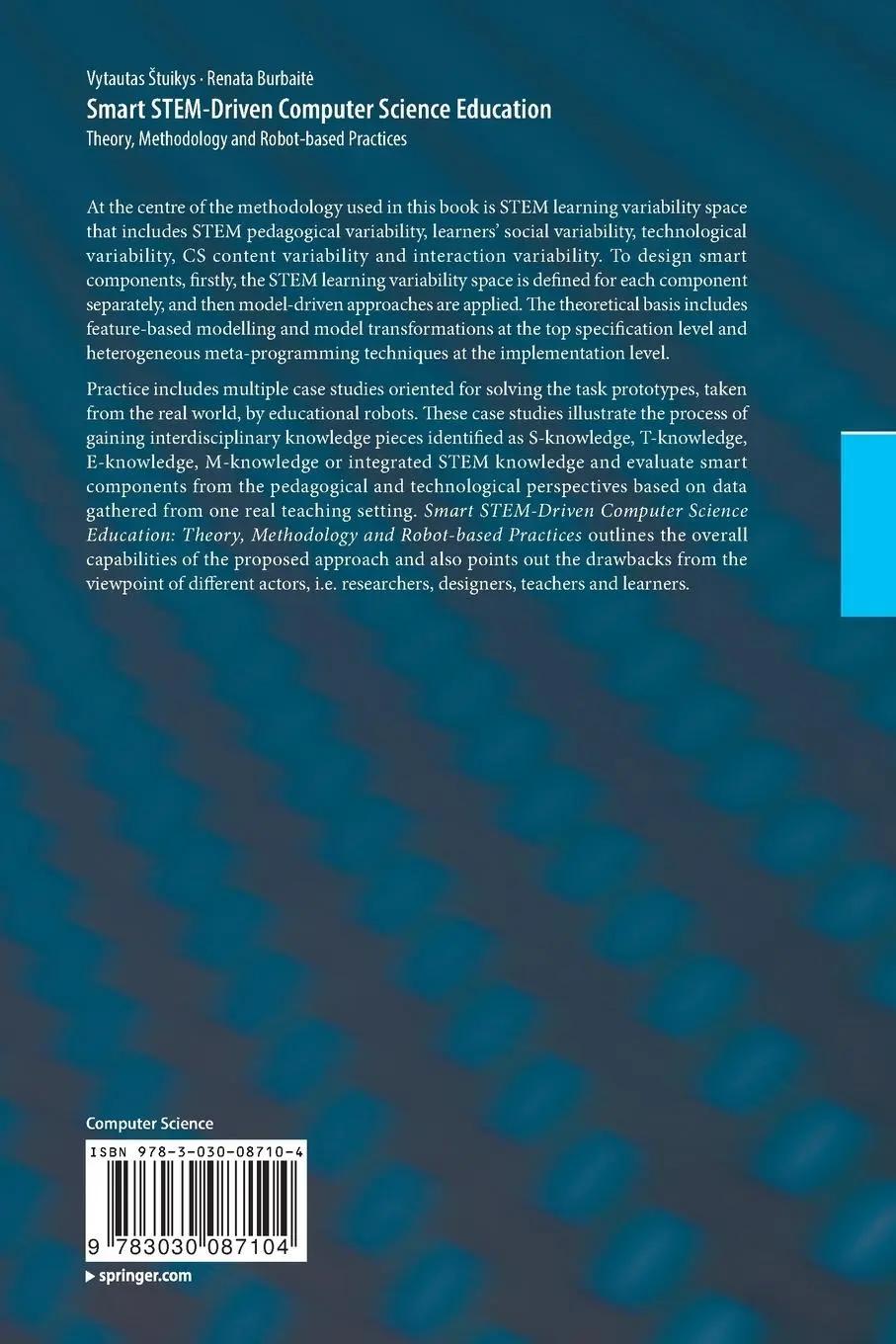
At the centre of the methodology used in this book is STEM learning variability space that includes STEM pedagogical variability, learners’ social variability, technological variability, CS content variability and interaction variability. To design smart components, firstly, the STEM learning variability space is defined for each component separately, and then model-driven approaches are applied. The theoretical basis includes feature-based modelling and model transformations at the top specification level and heterogeneous meta-programming techniques at the implementation level.
Practice includes multiple case studies oriented for solving the task prototypes, taken from the real world, by educational robots. These case studies illustrate the process of gaining interdisciplinary knowledge pieces identified as S-knowledge, T-knowledge, E-knowledge, M-knowledge or integrated STEM knowledge and evaluate smart components from the pedagogical and technological perspectives based on data gathered from one real teaching setting. Smart STEM-Driven Computer Science Education: Theory, Methodology and Robot-based Practices outlines the overall capabilities of the proposed approach and also points out the drawbacks from the viewpoint of different actors, i.e. researchers, designers, teachers and learners.
Le informazioni nella sezione "Su questo libro" possono far riferimento a edizioni diverse di questo titolo.
Dati bibliografici
Titolo: Smart STEM-Driven Computer Science Education...
Casa editrice: Springer
Data di pubblicazione: 2019
Legatura: Taschenbuch
Condizione: Neu