
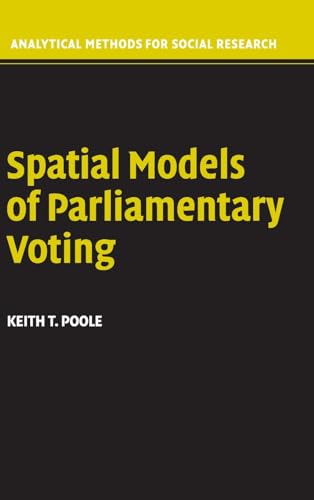
Spatial Models of Parliamentary Voting
Poole Keith T.
ISBN 10: 0521851947 ISBN 13: 9780521851947
Editore: Cambridge University Press, 2005
Nuovi
Rilegato
Da
Majestic Books, Hounslow, Regno Unito
Valutazione del venditore 4 su 5 stelle

Venditore AbeBooks dal 19 gennaio 2007
Questo articolo specifico non è più disponibile.
Riguardo questo articolo
Descrizione:
Print on Demand pp. 248. Codice articolo 7686329
Riassunto:
This book presents a simple geometric voting model for analyzing parliamentary roll call data.
Informazioni sull?autore: Keith T. Poole is a Professor of Political Science at the University of California, San Diego. He is the author or coauthor of over 40 articles as well as the coauthor of Congress: A Political-Economic History of Roll Call Voting and Income Redistribution and the Realignment of American Politics.
Le informazioni nella sezione "Su questo libro" possono far riferimento a edizioni diverse di questo titolo.
Dati bibliografici
Titolo: Spatial Models of Parliamentary Voting
Casa editrice: Cambridge University Press
Data di pubblicazione: 2005
Legatura: Rilegato
Condizione: New
I migliori risultati di ricerca su AbeBooks

Foto dell'editore
SPATIAL MODELS OF PARLIAMENTARY VOTING
Da: Speedyhen, Hertfordshire, Regno Unito
Valutazione del venditore 5 su 5 stelle

Condizione: NEW. Codice articolo NW9780521851947
Compra nuovo
EUR 84,62
Spedizione EUR 47,30
Spedito da Regno Unito a U.S.A.
Spedito da Regno Unito a U.S.A.
Quantità: 1 disponibili
Foto dell'editore
Spatial Models of Parliamentary Voting (Analytical Methods for Social Research)
Da: Ria Christie Collections, Uxbridge, Regno Unito
Valutazione del venditore 5 su 5 stelle
Condizione: New. In. Codice articolo ria9780521851947_new
Compra nuovo
EUR 97,82
Spedizione EUR 13,82
Spedito da Regno Unito a U.S.A.
Spedito da Regno Unito a U.S.A.
Quantità: Più di 20 disponibili
Foto dell'editore
Spatial Models of Parliamentary Voting
Print on DemandDa: Revaluation Books, Exeter, Regno Unito
Valutazione del venditore 5 su 5 stelle
Hardcover. Condizione: Brand New. new title edition. 248 pages. 8.75x6.00x0.75 inches. In Stock. This item is printed on demand. Codice articolo __0521851947
Compra nuovo
EUR 101,58
Spedizione EUR 11,54
Spedito da Regno Unito a U.S.A.
Spedito da Regno Unito a U.S.A.
Quantità: 1 disponibili
Immagini fornite dal venditore
Spatial Models of Parliamentary Voting
Da: moluna, Greven, Germania
Valutazione del venditore 4 su 5 stelle
Condizione: New. Presents a geometric voting model for analyzing parliamentary roll call data. The model can be used to study various topics related to legislative voting, including how political parties evolve over time, the existence of sophisticated voting, the represent. Codice articolo 594765019
Compra nuovo
EUR 105,28
Spedizione EUR 48,99
Spedito da Germania a U.S.A.
Spedito da Germania a U.S.A.
Quantità: 1 disponibili
Foto dell'editore
Spatial Models of Parliamentary Voting
Print on DemandDa: THE SAINT BOOKSTORE, Southport, Regno Unito
Valutazione del venditore 5 su 5 stelle
Hardback. Condizione: New. This item is printed on demand. New copy - Usually dispatched within 5-9 working days. Codice articolo C9780521851947
Compra nuovo
EUR 105,58
Spedizione EUR 17,94
Spedito da Regno Unito a U.S.A.
Spedito da Regno Unito a U.S.A.
Quantità: Più di 20 disponibili
Immagini fornite dal venditore
Spatial Models of Parliamentary Voting
Da: AHA-BUCH GmbH, Einbeck, Germania
Valutazione del venditore 5 su 5 stelle
Buch. Condizione: Neu. Druck auf Anfrage Neuware - Printed after ordering - This book presents a simple geometric model of voting as a tool to analyze parliamentary roll call data. Each legislator is represented by one point and each roll call is represented by two points that correspond to the policy consequences of voting Yea or Nay. On every roll call each legislator votes for the closer outcome point, at least probabilistically. These points form a spatial map that summarizes the roll calls. In this sense a spatial map is much like a road map because it visually depicts the political world of a legislature. The closeness of two legislators on the map shows how similar their voting records are, and the distribution of legislators shows what the dimensions are. These maps can be used to study a wide variety of topics including how political parties evolve over time, the existence of sophisticated voting and how an executive influences legislative outcomes. Codice articolo 9780521851947
Compra nuovo
EUR 108,57
Spedizione EUR 62,81
Spedito da Germania a U.S.A.
Spedito da Germania a U.S.A.
Quantità: 1 disponibili
Foto dell'editore
Spatial Models of Parliamentary Voting (Hardcover)
Editore:
Cambridge University Press, Cambridge, 2005
ISBN 10: 0521851947
ISBN 13: 9780521851947
Nuovo
Rilegato
Da: CitiRetail, Stevenage, Regno Unito
Valutazione del venditore 5 su 5 stelle
Hardcover. Condizione: new. Hardcover. This book presents a simple geometric model of voting as a tool to analyze parliamentary roll call data. Each legislator is represented by one point and each roll call is represented by two points that correspond to the policy consequences of voting Yea or Nay. On every roll call each legislator votes for the closer outcome point, at least probabilistically. These points form a spatial map that summarizes the roll calls. In this sense a spatial map is much like a road map because it visually depicts the political world of a legislature. The closeness of two legislators on the map shows how similar their voting records are, and the distribution of legislators shows what the dimensions are. These maps can be used to study a wide variety of topics including how political parties evolve over time, the existence of sophisticated voting and how an executive influences legislative outcomes. Presents a geometric voting model for analyzing parliamentary roll call data. The model can be used to study various topics related to legislative voting, including how political parties evolve over time, the existence of sophisticated voting, the representation of ethnic minorities in the legislature, and constituency interests and legislative behavior. This item is printed on demand. Shipping may be from our UK warehouse or from our Australian or US warehouses, depending on stock availability. Codice articolo 9780521851947
Compra nuovo
EUR 108,72
Spedizione EUR 42,69
Spedito da Regno Unito a U.S.A.
Spedito da Regno Unito a U.S.A.
Quantità: 1 disponibili
Foto dell'editore
Spatial Models of Parliamentary Voting (Hardcover)
Editore:
Cambridge University Press, Cambridge, 2005
ISBN 10: 0521851947
ISBN 13: 9780521851947
Nuovo
Rilegato
Da: AussieBookSeller, Truganina, VIC, Australia
Valutazione del venditore 5 su 5 stelle
Hardcover. Condizione: new. Hardcover. This book presents a simple geometric model of voting as a tool to analyze parliamentary roll call data. Each legislator is represented by one point and each roll call is represented by two points that correspond to the policy consequences of voting Yea or Nay. On every roll call each legislator votes for the closer outcome point, at least probabilistically. These points form a spatial map that summarizes the roll calls. In this sense a spatial map is much like a road map because it visually depicts the political world of a legislature. The closeness of two legislators on the map shows how similar their voting records are, and the distribution of legislators shows what the dimensions are. These maps can be used to study a wide variety of topics including how political parties evolve over time, the existence of sophisticated voting and how an executive influences legislative outcomes. Presents a geometric voting model for analyzing parliamentary roll call data. The model can be used to study various topics related to legislative voting, including how political parties evolve over time, the existence of sophisticated voting, the representation of ethnic minorities in the legislature, and constituency interests and legislative behavior. This item is printed on demand. Shipping may be from our Sydney, NSW warehouse or from our UK or US warehouse, depending on stock availability. Codice articolo 9780521851947
Compra nuovo
EUR 109,33
Spedizione EUR 31,84
Spedito da Australia a U.S.A.
Spedito da Australia a U.S.A.
Quantità: 1 disponibili
Foto dell'editore
Spatial Models of Parliamentary Voting (Analytical Methods for Social Research)
Da: Kennys Bookshop and Art Galleries Ltd., Galway, GY, Irlanda
Valutazione del venditore 5 su 5 stelle
Condizione: New. This book presents a simple geometric voting model for analyzing parliamentary roll call data. Series Editor(s): Alvarez, R. Michael; Beck, Nathaniel L.; Wu, Lawrence L. Series: Analytical Methods for Social Research. Num Pages: 248 pages, 62 b/w illus. 8 tables. BIC Classification: JPQ. Category: (P) Professional & Vocational. Dimension: 228 x 152 x 23. Weight in Grams: 450. . 2005. hardcover. . . . . Codice articolo V9780521851947
Compra nuovo
EUR 111,70
Spedizione EUR 10,50
Spedito da Irlanda a U.S.A.
Spedito da Irlanda a U.S.A.
Quantità: 1 disponibili
Foto dell'editore
Spatial Models of Parliamentary Voting (Hardcover)
Editore:
Cambridge University Press, Cambridge, 2005
ISBN 10: 0521851947
ISBN 13: 9780521851947
Nuovo
Rilegato
Da: Grand Eagle Retail, Bensenville, IL, U.S.A.
Valutazione del venditore 5 su 5 stelle
Hardcover. Condizione: new. Hardcover. This book presents a simple geometric model of voting as a tool to analyze parliamentary roll call data. Each legislator is represented by one point and each roll call is represented by two points that correspond to the policy consequences of voting Yea or Nay. On every roll call each legislator votes for the closer outcome point, at least probabilistically. These points form a spatial map that summarizes the roll calls. In this sense a spatial map is much like a road map because it visually depicts the political world of a legislature. The closeness of two legislators on the map shows how similar their voting records are, and the distribution of legislators shows what the dimensions are. These maps can be used to study a wide variety of topics including how political parties evolve over time, the existence of sophisticated voting and how an executive influences legislative outcomes. Presents a geometric voting model for analyzing parliamentary roll call data. The model can be used to study various topics related to legislative voting, including how political parties evolve over time, the existence of sophisticated voting, the representation of ethnic minorities in the legislature, and constituency interests and legislative behavior. This item is printed on demand. Shipping may be from multiple locations in the US or from the UK, depending on stock availability. Codice articolo 9780521851947
Compra nuovo
EUR 114,63
Spedizione gratuita
Spedito in U.S.A.
Spedito in U.S.A.
Quantità: 1 disponibili