Riassunto
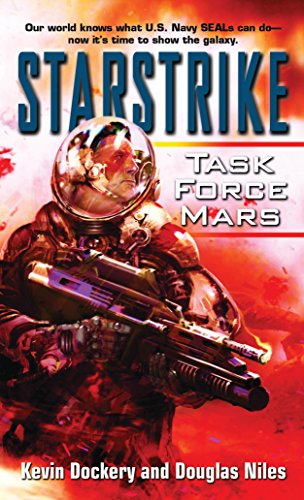
An elite squadron of space commandos battles against the deadliest dangers the galaxy has to offer, in this second novel of an action-packed, military science fiction series.
Estratto. © Ristampato con autorizzazione. Tutti i diritti riservati.
One: Weigh Out
Master Chief Petty Officer Rafael Ruiz was more than mildly irritated by the need to conduct another six-hour training regimen without even a break for a hot meal, let alone a catnap. After all, he had been outside the SATSTAR1 station for the last ten hours, enclosed in his suit, breathing bottled air and watching his men go through the paces of a weightless/vacuum survival drill. The six SEALS had passed with flying colors and were floating toward the mess hall and then their bunks, but the chief had to take one more man outside and check him off the list.
But verbal displays of selfish displeasure were for lesser mortals than master chiefs, and so Ruiz carefully replenished the air supply for his breather and the mobility jets on his suit again, double-checking all the connections for his life support pod. The Mark III Survival Suit/Vacuum/Military was a marvel of engineering, but it wasn’t exactly a pair of silk pajamas. It weighed more than a hundred pounds at 1 G—and though they were working in a weightless environment, the suit, like everything else up here, retained every ounce of mass when it came to moving it or stopping it from moving.
The suit was triple-lined with layers of rubber, plastic, and metal foil. Even so, it was thin and supple, riding close to the skin and not restrictive of movement. The gloves allowed the fingers an amazing degree of dexterity so that a man could flip a coin or—more to the point with SEALS training—operate the trigger and reload the magazine of a small handheld weapon without fumbling. A utility belt around the waist offered attachment points for a dozen tools and weapons, and the helmet was titanium around the back of the skull but had a full hemisphere of transparent Plexiglas at the front, allowing for complete peripheral vision.
The suit had plenty of high-tech augmentation, too. It had a self-contained breather, of course, with enough air for some twelve hours of sealed operation. Also, the air bottles could be changed easily without removing the suit; they could even be swapped out in a vacuum environment without danger to the wearer. There were several sensors built into the suit, including full life support readouts that provided the wearer’s blood pressure, heart rate, and other vital signs. It could detect external radiation, analyze air quality and pressure (or the lack thereof), and provide all the data on a heads-up display (HUD) that projected onto the interior of the visor for easy reading. The data also could be accessed by someone else and was reported on a small LED on the chest. A full-function computer was worn on the wrist, with a link to the HUD and a small screen and keyboard on the unit.
An additional and innovative feature of the suit was the individual mobility system, which allowed the wearer to move through a weightless environment. The IMS consisted of small adjustable nozzles at the hips, shoulders, and feet. By bleeding off a very small amount of the air supply, the wearer could use that released pressure as propulsion. If he began to drift away from his ship, for example, he theoretically could shoot himself right back with a few bursts of air. Of course, an inherent liability of that system was the fact that the more moving around a SEALS did with the IMS, the less air he had to breathe. All SEALS needed to check out with this controlled personal space suit, but Ruiz was not a big fan of the system. Several times during training it had resulted in dangerous leaks that had required a trainee to make a quick return to the station air lock before his emergency backup tank ran out of air. Ten minutes may sound like a lot of time, but not when a SEALS was doing zero-G maneuvers with a faulty IMS.
The military suits were a new design and featured an innate autotourniquet feature at the ankles, knees, elbows, hips, and shoulders. That feature was intended to save the life of the wearer if the suit was breached by attack or other damage in one of the limbs. Though in a vaccum the cost was the loss of the isolated limb, it was hoped that a tight seal would allow the wounded SEALS to reach a pressurized environment while he was still alive.
Chief Ruiz was not entirely sure the thing would work as advertised, but he had seen enough near accidents in training that he was willing to give it a try. Space was full of tiny objects moving at very high speeds, and any one of them could puncture a suit before the wearer even had a clue that he was in danger.
The most important thing about his suit to Master Chief Ruiz and to any other of the few men who currently had the privilege of wearing it was the golden trident he was entitled to wear as his shoulder patch. Ruiz and his platoon commander, Lieutenant Jackson, had been the first to be awarded the new spacefaring SEALS trident. Ensign Sanders, if he completed the final drill regimen, would be the sixteenth.
After Ruiz was satisfied that his own suit checked out, he did the same for the young officer who was the cause of this inconvenient outing.
Ensign Dennis Sanders was a bright-eyed newbie to space, though—like all members of the elite SEALS Teams—he had been through the rigors of BUD/S training in Coronado. Also, he recently had completed the even more extreme program at McMurdo Station on Antarctica. The Alien Environment School was a requirement for any SEALS who aspired to add the newly coveted “S” to the end of his rating, and Ensign Sanders obviously had survived and completed that course.
After all, he was here, wasn’t he? And it wasn’t his fault that he’d arrived after Ruiz had checked out the rest of his Teammates in their vacuum suits and gone through the paces of the final exterior drill. In fact, he’d even offered to wait until Ruiz was ready to go, but the master chief had simply said, “Let’s do it.”
Sanders was so grateful, he looked almost giddy, an expression that seemed natural on his boyish features. With Sanders’s dusting of freckles, sand-colored hair, and light blue eyes, Ruiz had no trouble imagining him as a twelve-year-old, though he was in fact twenty-five. At an avuncular thirty-five, the master chief was the old man of the outfit and a contrast to Sanders in every other way as well. Dark of complexion and black-haired, befitting his Puerto Rican ancestry, Ruiz was fond of saying, “I’m too old for this shit.” But he and his Teammates knew it was a lie. In fact, here in space, with the unlimited vistas and the hostile but thrilling environment, Master Chief Rafael Ruiz was having the time of his life.
He paid particular attention to the back of the ensign’s suit, visually confirming that all the connections were secure and that the helmet was properly seated in the collar, with no creases or obvious flaws in the material. He checked the LED on Sanders’s chest while the ensign did the same with his HUD; both showed that his blood pressure and temperature were normal, with his heart rate only slightly elevated—just what one would expect from a guy about to make his first untethered space walk.
“All checked out, Enswine,” Ruiz declared, his voice tinny and mechanical within the confines of his Plexiglas helmet.
“Thanks, Chief,” Sanders replied. If he’d heard the mispronunciation of his rank, he knew better than to comment. Although ensigns technically outranked petty officers, even master chief petty officers, any young officer with a pretense of wisdom knew that he needed to earn the master chief’s respect, not simply demand it by virtue of the single gold bar of rank he wore.
Ruiz turned and allowed Sanders to inspect the back of his suit; then they repeated the drill of comparing the LED and HUD data.
“Looks like we’re good to go,” the ensign finally concluded, giving the chief a pat on the shoulder.
The two SEALS moved down the passage to the air lock, using the handles in the bulkheads to pull themselves along. Quickly easing themselves into the spacious compartment—it could hold six suited SEALS in close quarters—they waited only a few minutes for the pumps to draw the air out. Checking his HUD, Ruiz watched the air pressure drop. In the first minute it went from the atmospheric pressure of Earth at sea level to that near the summit of Mount Everest. In another ninety seconds, the sensor read “0 PSI.”
Each man attached a tether line to his utility belt. The thin filament would reel out as they moved and would keep them secured to the station until they determined that their IMS was working properly.
Only then did Ruiz nod toward the wheel on the exterior hatch. It was a design familiar to anyone who had ever served on a submarine or any other navy ship, which included all SEALS. “You want to do the honors, Enswine?”
Sanders nodded and quickly, even eagerly, spun the wheel.
When the outer hatch opened, they were confronted by the full infinite vastness of space. The sun was on the other side of the station, and Earth, half-illuminated, was brilliant and beautiful just “overhead.” In shadow, they moved away from the air lock.
Ruiz, as he always did upon emerging from the air lock, took a second just to stare. He never got over the wonder of seeing the whole world in one look. The Atlantic Ocean was blue and dazzling except where the spidery outline of a tropical storm moved toward the Caribbean. Ruiz’s wife was safe in Coronado, but he crossed himself and whispered a prayer for his mother’s safety in San Juan. He could see England and the Bay of Biscay, but the east coast of the United States was obscured by clouds. Farther to the west, the Great Lakes stood out in vivid azure relief.
Le informazioni nella sezione "Su questo libro" possono far riferimento a edizioni diverse di questo titolo.