
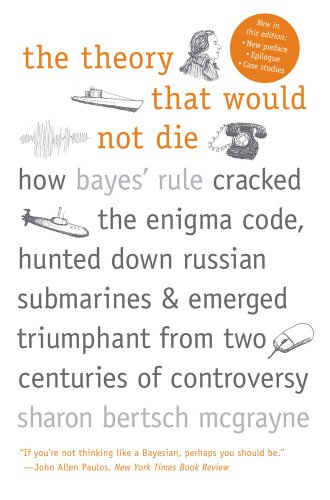
The Theory That Would Not Die: How Bayes' Rule Cracked the Enigma Code, Hunted Down Russian Submarines, and Emerged Triumphant from Two Centuries of Controversy
McGrayne, Sharon Bertsch
ISBN 10: 0300188226 ISBN 13: 9780300188226
Editore: Yale University Press, 2012
Usato
Brossura
Da
More Than Words, Waltham, MA, U.S.A.
Valutazione del venditore 5 su 5 stelle

Venditore AbeBooks dal 30 novembre 2010
Questo articolo specifico non è più disponibile.
Riguardo questo articolo
Descrizione:
A sound copy with only light wear. Overall a solid copy at a great price! Codice articolo BOS-P-10g-01471
Riassunto:
A New York Times Book Review Editor’s Choice: A vivid account of the generations-long dispute over Bayes’ rule, one of the greatest breakthroughs in the history of applied mathematics and statistics
“An intellectual romp touching on, among other topics, military ingenuity, the origins of modern epidemiology, and the theological foundation of modern mathematics.”—Michael Washburn, Boston Globe
“To have crafted a page-turner out of the history of statistics is an impressive feat. If only lectures at university had been this racy.”—David Robson, New Scientist
Bayes’ rule appears to be a straightforward, one-line theorem: by updating our initial beliefs with objective new information, we get a new and improved belief. To its adherents, it is an elegant statement about learning from experience. To its opponents, it is subjectivity run amok.
In the first-ever account of Bayes’ rule for general readers, Sharon Bertsch McGrayne explores this controversial theorem and the human obsessions surrounding it. She traces its discovery by an amateur mathematician in the 1740s through its development into roughly its modern form by French scientist Pierre Simon Laplace. She reveals why respected statisticians rendered it professionally taboo for 150 years—at the same time that practitioners relied on it to solve crises involving great uncertainty and scanty information (Alan Turing’s role in breaking Germany’s Enigma code during World War II), and explains how the advent of off-the-shelf computer technology in the 1980s proved to be a game-changer. Today, Bayes’ rule is used everywhere from DNA de-coding to Homeland Security.
Drawing on primary source material and interviews with statisticians and other scientists, The Theory That Would Not Die is the riveting account of how a seemingly simple theorem ignited one of the greatest controversies of all time.
Informazioni sull?autore:
Sharon Bertsch McGrayne is the author of numerous books, including Nobel Prize Women in Science: Their Lives, Struggles, and Momentous Discoveries and Prometheans in the Lab: Chemistry and the Making of the Modern World. She lives in Seattle.
Le informazioni nella sezione "Su questo libro" possono far riferimento a edizioni diverse di questo titolo.
Dati bibliografici
Titolo: The Theory That Would Not Die: How Bayes' ...
Casa editrice: Yale University Press
Data di pubblicazione: 2012
Legatura: Brossura
Condizione: Good