
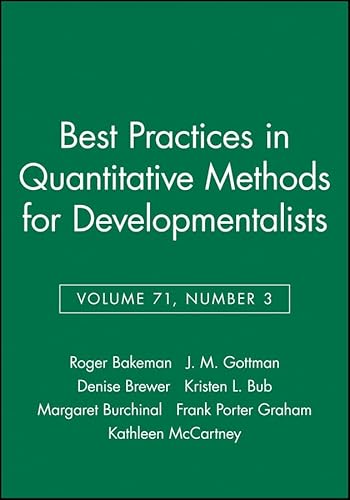
Best Practices in Quantitative Methods for Developmentalists, Volume 71, Number 3
ISBN 10: 1405169419 ISBN 13: 9781405169417
Editore: Wiley & Sons, Incorporated, John, 2006
Usato
Brossura
Da
Better World Books, Mishawaka, IN, U.S.A.
Valutazione del venditore 5 su 5 stelle

Venditore AbeBooks dal 3 agosto 2006
Questo articolo specifico non è più disponibile.
Riguardo questo articolo
Descrizione:
Former library copy. Pages intact with possible writing/highlighting. Binding strong with minor wear. Dust jackets/supplements may not be included. Includes library markings. Stock photo provided. Product includes identifying sticker. Better World Books: Buy Books. Do Good. Codice articolo 13441023-75
Riassunto:
The role of quantitative methods in testing developmental hypotheses is widely recognized, yet even very experienced quantitative researchers often lack the knowledge required for good decision-making on methodology. The end result is a disconnect between research and practice in methods. The purpose of this monograph is to fill a gap in the literature by offering a series of overviews on common data-analytic issues of particular interest to researchers in child development. Our hope is that this monograph will make already developed methods accessible to developmentalists so they can understand and use them in their research. We start at the beginning with chapters on data management and measurement, two neglected topics in methods training despite the fact that every investigation should begin with proper consideration of each. We follow with two important topics for developmental research, missing data and growth modeling. Missing data can plague developmental work because participants sometimes miss one or more assessment points. Growth modeling methods offer researchers a true means to assess change over time as compared with cruder methods like difference scores and residualized change scores. Then comes a discussion of mediation and moderation, two tools that can be used to elucidate developmental processes. Because so much developmental science is non-experimental, we include a chapter on selection bias that compares five modeling strategies. Proper attention to data management, measurement, missing data, growth modeling (whenever possible), mediation and moderation, and potential selection bias is guaranteed to result in greater precision in inference-making. Even when researchers make good decisions about methods, it is critical for them to use good judgment about the practical importance of findings, so we conclude with this important discussion. We view this monograph as a first step to getting quantitative researchers started and we believe this reference will help researchers make better-informed decisions about methodology.
Informazioni sull?autore:
Roger Bakeman (Ph.D., University of Texas at Austin) is professor of psychology
at Georgia State University, Atlanta, Georgia. He is the author, with
J. M. Gottman, of Observing Interaction: An Introduction to Sequential Analysis
(2nd ed.; 1997), and, with V. Quera, of Analyzing Interaction: Sequential
Analysis With SDIS and GSEQ (1995). His interests include observational
methodology and sequential analysis of observational data.
Denise Brewer (Ph.D., University of North Carolina at Charlotte) is currently
an Assistant Professor at Appalachian State University in the Child
Development Department. She earned her Ph.D. in special education. She
also received her master’s degree from the University of North at Carolina
Chapel Hill in early intervention and family support and her undergraduate
degree from Appalachian State University in birth through kindergarten.
Research interests and background include assessment issues with
young children.
Kristen L. Bub (M.Ed., Harvard Graduate School of Education) is a fifth
year doctoral student in Human Development and Psychology. She earned
her master’s degree in human development, with a concentration in research
methods, from the Harvard Graduate School of Education. Her
research focuses on the role that early education experiences play in children’s
social and academic development.
Margaret Burchinal (Ph.D., University of North Carolina) is a Senior Scientist
and director of the Data Management and Analysis Center at the
Frank Porter Graham Center and Research Professor of Psychology at the
University of North Carolina at Chapel Hill. She is a methodologist who is
best known for her methodological work on longitudinal modeling as well
as for her substantive work on child care.
Le informazioni nella sezione "Su questo libro" possono far riferimento a edizioni diverse di questo titolo.
Dati bibliografici
Titolo: Best Practices in Quantitative Methods for ...
Casa editrice: Wiley & Sons, Incorporated, John
Data di pubblicazione: 2006
Legatura: Brossura
Condizione: Very Good
Edizione: 1st Edition.
I migliori risultati di ricerca su AbeBooks

Foto dell'editore
Best Practices in Quantitative Methods for Developmentalists, Volume 71, Number 3
Editore:
Wiley & Sons, Incorporated, John, 2006
ISBN 10: 1405169419
ISBN 13: 9781405169417
Antico o usato
Brossura
Prima edizione
Da: Better World Books, Mishawaka, IN, U.S.A.
Valutazione del venditore 5 su 5 stelle
Condizione: Good. 1st Edition. Former library copy. Pages intact with minimal writing/highlighting. The binding may be loose and creased. Dust jackets/supplements are not included. Includes library markings. Stock photo provided. Product includes identifying sticker. Better World Books: Buy Books. Do Good. Codice articolo 16528200-6
Compra usato
EUR 15,66
Spedizione gratuita
Spedito in U.S.A.
Spedito in U.S.A.
Quantità: 1 disponibili