

Importo totale (1 articolo articoli):
Destinazione ordine:

OCLC (39 risultati)
Vai alla pagina principale dei risultati di ricerca
Filtri di ricerca
Tipo di articolo
- Tutti i tipi di prodotto
- Libri (37)
- Riviste e Giornali (Nessun altro risultato corrispondente a questo perfezionamento)
- Fumetti (Nessun altro risultato corrispondente a questo perfezionamento)
- Spartiti (Nessun altro risultato corrispondente a questo perfezionamento)
- Arte, Stampe e Poster (Nessun altro risultato corrispondente a questo perfezionamento)
- Fotografie (Nessun altro risultato corrispondente a questo perfezionamento)
- Mappe (2)
- Manoscritti e Collezionismo cartaceo (Nessun altro risultato corrispondente a questo perfezionamento)
Condizioni Maggiori informazioni
- Nuovo (10)
- Come nuovo, Ottimo o Quasi ottimo (5)
- Molto buono o Buono (10)
- Discreto o Mediocre (Nessun altro risultato corrispondente a questo perfezionamento)
- Come descritto (14)
Legatura
Ulteriori caratteristiche
Lingua (2)
Spedizione gratuita
Paese del venditore
Valutazione venditore
-

Dewey Decimal Classification 2023 Edition Volume 4 of 4
Da: WorldofBooks, Goring-By-Sea, WS, Regno Unito
Valutazione del venditore 5 su 5 stelle

EUR 10,22
Spedizione EUR 6,48
Spedito da Regno Unito a U.S.A.Quantità: 1 disponibili
Aggiungi al carrelloPaperback. Condizione: Very Good. The book has been read, but is in excellent condition. Pages are intact and not marred by notes or highlighting. The spine remains undamaged.
-

Dewey Decimal Classification, 2020, Volume 2
Editore: OCLC, Inc.
Da: Academic Book Solutions, Medford, NY, U.S.A.
Valutazione del venditore 5 su 5 stelle
Paperback. Condizione: Good. A copy that may have been read, minimal to no highlighting/underlining of text, no missing pages. May have a remainder mark. Spine may show signs of wear. Could be a library copy.
-

DIE FELDGRAUEN. Soldatenlider
Editore: Kommissionsverlag, Lesch & Irmer (C. Schassnit Nachs?), Düsseldorf, 1914
Da: Tavistock Books, ABAA, Reno, NV, U.S.A.
Membro dell'associazione: ABAA ESA ILAB IOBA
Valutazione del venditore 5 su 5 stelle
63, [1] pp. 4-5/8" x 3-3/8" OCLC records just 1 institutional holding of this item (British Library). Significant wear to wrappers (chipping to edges, creasing and age-toning). Paper age-toned. Previous owner's signature to title leaf. A Good example. Brown wrappers printed in black and orange. Now housed in a clear archival mylar sleeve.
-
THRU THE MIST
Editore: Privately published [Oxford Press, Inc.], Hollywood, CA, 1945
Da: Live Oak Booksellers, Langley, WA, U.S.A.
Valutazione del venditore 5 su 5 stelle
Prima edizione Copia autografata
Hardcover. Condizione: Very Good+. No Jacket. Myrtle Peppers (illustratore). 1st Edition. SIGNED BY THE AUTHOR across the title page as follows: ¿Sincere good wishes / to you ¿ whose friendship / I cherish - / Mizpah[?] / Elizabeth Myers / To I¿m[?] / Just Beth!¿ [Her pen ran out of ink in the writing of Elizabeth, but the rest can be read from the indentations.] Illustrated with eight black and white full-page drawings by Myrtle Pepper. Laid in is a Christmas card signed ¿Beth Myers¿ which contains a handwritten Christmas poem presumably by her. Blue cloth with gilt letters on the front cover. Very minor wear to extremities with nothing rubbed through, very slightly faded around the edges and along the spine, gilt still bright, all illustrations fine, else very good to near fine with no internal markings. No dust jacket. Elizabeth Myers was a member of the Poetry Division of the Schubert Club in Los Angeles and had several poems in their three-volume TOWERS IN THE SUN. Myrtle Peppers was also a member of the club and contributed both poems and illustrations to TOWERS IN THE SUN. Signed by Author(s).
-
RAMBLES AFTER LAND SHELLS.
Editore: Boston [MA]: American Tract Society, 1863., 1863
Da: David Hallinan, Bookseller, Columbus, MS, U.S.A.
Valutazione del venditore 5 su 5 stelle
Paged as [color frontis], 1-124, [b/w plate], 125-172. Hardcover: H 15.25cm x L 10.25cm. Contemporary rubbed blue cloth with some staining and soiling; scuffing at spine ends, along joints, and at board corners; spine's gilt title lettering remains bright. Pencil ownership inscription on front free endpaper; some light soiling and foxing to interior leaves; shallow moisture tide-line at top margins of rear leaves. Binding is firm. Color frontispiece. OCLC cites author as Helen Fitch Parker (1827-1874) and engraver as Nathaniel Rudd although their names elude discovery amongst text; unpaged b/w plate is credited to "Pierce." Christian literature publisher American Tract Society book targeted to a younger reader and summarized by OCLC as "Factual information about snails and collecting and displaying their shells in a fictional framework.".
-
Kate Greenaway. Victorian Era Children's Book with Illustrations by Kate Greenaway, The Lost Knife, Bound with A Wet Afternoon, 1884 Dodd Mead
Editore: Dodd Mead, New York, 1884
Da: Brothertown Books, Deansboro, NY, U.S.A.
Valutazione del venditore 5 su 5 stelle
Hardcover. Condizione: Good. Kate Greenaway (illustratore). This is an American reprint consisting of two stories bound together: "The Lost Knife", and "A Wet Afternoon" (the illustrations for which are quite similar in style). The book was published in 1884 by Dodd, Mead and Company. Again, it is a reprint . the stories (at least "The Lost Knife") were first published in England, and then there are earlier reprints issued in the United States. Indeed there are several versions of the stories . several binding variants. As we can see from the nature of the illustrations, it is obvious that the plates for the book had been frequently, and heavily used. This was typical of popular juvenile works. According to World Catalog (OCLC), Kate Greenaway contributed the illustrations for this story ("The Lost Knife"). She is not credited in this edition, but the illustrations, at least many of them, are obviously by her hand. The binding on this copy is a generic publisher's trade binding. All the same it has a charm of its own. Dressed in an embossed cloth-covered board binding, colored black on deep ultramarine (blue), the front cover design depicts a boy looking over a fence . behind him is a horse. The boy holds a riding crop. There are flowers in the foreground, and birds roost in the rafters above. The title is lettered in black beneath the boy. In the upper right corner of the front cover is a generic paper paste-down chromolithographic illustration depicting a lovely young girl. TITLE : "The Lost Knife" - bound with - "The Wet Afternoon" AUTHOR : Anonymous - [ but: Richard Handy, as per World Catalog ] ILLUSTRATED : [ Kate Greenaway - As per World Catalog . she is not credited anywhere in this edition] IMPRINT : Dodd, Mead and Company PLACE : New York DATE : (1884) EDITION : American Reprint PHYSICAL DETAILS : Small trade hardcover; Contains numerous line illustrations; 48 pages; 4 1/4" x 6 3/8"; deep ultramarine, cloth-covered boards; the front board is embossed with the details stamped in black. There is a chromolith paper paste-down (color illustration) in the top right corner of the front board, depicting a pretty lass dressed in shawl and bonnet. The rear cover is blank. The spine is blank. The title is lettered in black on the front. CONDITION - GOOD ONLY - This is a previously owned book that remains clean and serviceable. The book has seen much use and has cracked hinges and is considerably shaken. However no leaves are detached, and the whole remains clean and attractive, use considered EXTERIOR : Spine extremities are compressed and moderately abraded, with fraying just starting. Joints are rubbed.Modest surface rub to boards; corner tips are softly bumped. Board edges have a few small nicks. The text-block edges are darkened. BINDING : Much read, the text-block is shaken and hinges cracked, revealing binding thread. No leaves are detached, but the whole is considerably loosened. INTERIOR : Scattered small smudges and spots. Paper throughout is toned. No writing, scribbling or markings. Lacks a rear free end-paper.
-

Dewey Decimal Classification, January 2019, Volume 2 of 4
Da: World of Books (was SecondSale), Montgomery, IL, U.S.A.
Valutazione del venditore 5 su 5 stelle
Condizione: Very Good. Item in very good condition! Textbooks may not include supplemental items i.e. CDs, access codes etc.
-
DEWEY DECIMAL CLASSIFICATION, JANUARY 2019, VOLUME 2 OF 4
Da: Basi6 International, Irving, TX, U.S.A.
Valutazione del venditore 5 su 5 stelle
Condizione: Brand New. New. US edition. Expediting shipping for all USA and Europe orders excluding PO Box. Excellent Customer Service.
-

Dewey Decimal Classification 2023 Edition Volume 3 of 4
Da: Kennys Bookshop and Art Galleries Ltd., Galway, GY, Irlanda
Valutazione del venditore 5 su 5 stelle
EUR 155,74
Spedizione EUR 10,50
Spedito da Irlanda a U.S.A.Quantità: 10 disponibili
Aggiungi al carrelloCondizione: New. 2023. paperback. . . . . .
-

EUR 63,27
Spedizione EUR 105,00
Spedito da Germania a U.S.A.Quantità: 1 disponibili
Aggiungi al carrelloCondizione: Sehr gut. Zustand: Sehr gut | Seiten: 1162 | Sprache: Englisch | Produktart: Bücher | Keine Beschreibung verfügbar.
-

Using Subject Headings for Online Retrieval : Theory, Practice, and Potential
Lingua: Inglese
Editore: Emerald Publishing Limited, 1994
ISBN 10: 0122215702 ISBN 13: 9780122215704
Da: GreatBookPrices, Columbia, MD, U.S.A.
Valutazione del venditore 5 su 5 stelle
EUR 178,80
Spedizione EUR 2,27
Spedito in U.S.A.Quantità: Più di 20 disponibili
Aggiungi al carrelloCondizione: New.
-

Using Subject Headings for Online Retrieval : Theory, Practice, and Potential
Lingua: Inglese
Editore: Emerald Publishing Limited, 1994
ISBN 10: 0122215702 ISBN 13: 9780122215704
Da: GreatBookPricesUK, Woodford Green, Regno Unito
Valutazione del venditore 5 su 5 stelle
EUR 166,16
Spedizione EUR 17,35
Spedito da Regno Unito a U.S.A.Quantità: Più di 20 disponibili
Aggiungi al carrelloCondizione: New.
-
Using Subject Headings for Online Retrieval : Theory, Practice, and Potential
Lingua: Inglese
Editore: Emerald Publishing Limited, 1994
ISBN 10: 0122215702 ISBN 13: 9780122215704
Da: GreatBookPrices, Columbia, MD, U.S.A.
Valutazione del venditore 5 su 5 stelle
EUR 183,88
Spedizione EUR 2,27
Spedito in U.S.A.Quantità: Più di 20 disponibili
Aggiungi al carrelloCondizione: As New. Unread book in perfect condition.
-
Dewey Decimal Classification 2023 Edition Volume 3 of 4
Da: Revaluation Books, Exeter, Regno Unito
Valutazione del venditore 5 su 5 stelle
EUR 166,21
Spedizione EUR 23,13
Spedito da Regno Unito a U.S.A.Quantità: 1 disponibili
Aggiungi al carrelloPaperback. Condizione: Brand New. 1184 pages. 6.69x2.31x9.61 inches. In Stock.
-
Using Subject Headings for Online Retrieval : Theory, Practice, and Potential
Lingua: Inglese
Editore: Emerald Publishing Limited, 1994
ISBN 10: 0122215702 ISBN 13: 9780122215704
Da: GreatBookPricesUK, Woodford Green, Regno Unito
Valutazione del venditore 5 su 5 stelle
EUR 183,39
Spedizione EUR 17,35
Spedito da Regno Unito a U.S.A.Quantità: Più di 20 disponibili
Aggiungi al carrelloCondizione: As New. Unread book in perfect condition.
-
Dewey Decimal Classification 2023 Edition Volume 3 of 4
Da: THE SAINT BOOKSTORE, Southport, Regno Unito
Valutazione del venditore 5 su 5 stelle
EUR 168,78
Spedizione EUR 33,74
Spedito da Regno Unito a U.S.A.Quantità: 1 disponibili
Aggiungi al carrelloPaperback / softback. Condizione: New. New copy - Usually dispatched within 4 working days.
-
Dewey Decimal Classification 2023 Edition Volume 3 of 4
Da: Kennys Bookstore, Olney, MD, U.S.A.
Valutazione del venditore 5 su 5 stelle
Condizione: New. 2023. paperback. . . . . . Books ship from the US and Ireland.
-

Tomorrow*s access, today*s decisions: Ensuring access to today*s electronic resources : proceedings of the Fourteenth Annual Conference of Research Library Directors, March 11-12, 1996
Lingua: Inglese
Editore: OCLC Online Computer Library Center, Inc, 1996
ISBN 10: 1556532199 ISBN 13: 9781556532191
Da: Mispah books, Redhill, SURRE, Regno Unito
Valutazione del venditore 4 su 5 stelle

EUR 223,96
Spedizione EUR 28,91
Spedito da Regno Unito a U.S.A.Quantità: 1 disponibili
Aggiungi al carrellopaperback. Condizione: Very Good. Very Good. Dust Jacket may NOT BE INCLUDED.CDs may be missing. SHIPS FROM MULTIPLE LOCATIONS. book.
-
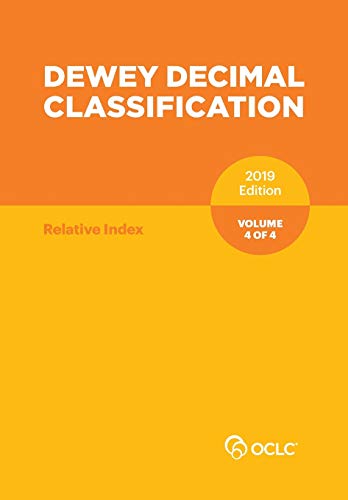
Dewey Decimal Classification, January 2019, Volume 4 of 4
Da: Mispah books, Redhill, SURRE, Regno Unito
Valutazione del venditore 4 su 5 stelle
EUR 494,37
Spedizione EUR 28,91
Spedito da Regno Unito a U.S.A.Quantità: 1 disponibili
Aggiungi al carrellopaperback. Condizione: Very Good. Very Good. Dust Jacket may NOT BE INCLUDED.CDs may be missing. SHIPS FROM MULTIPLE LOCATIONS. book.
-
Dewey Decimal Classification, January 2019, Volume 4 of 4
Da: World of Books (was SecondSale), Montgomery, IL, U.S.A.
Valutazione del venditore 5 su 5 stelle
Condizione: Good. Item in good condition. Textbooks may not include supplemental items i.e. CDs, access codes etc.
-
Dewey Decimal Classification, January 2019, Volume 4 of 4
Da: World of Books (was SecondSale), Montgomery, IL, U.S.A.
Valutazione del venditore 5 su 5 stelle
Condizione: Very Good. Item in very good condition! Textbooks may not include supplemental items i.e. CDs, access codes etc.
-
Dewey Decimal Classification, January 2019, Volume 4 of 4
Da: DeckleEdge LLC, Albuquerque, NM, U.S.A.
Valutazione del venditore 5 su 5 stelle
paperback. Condizione: new.
-

EUR 563,25
Spedizione EUR 105,00
Spedito da Germania a U.S.A.Quantità: 1 disponibili
Aggiungi al carrelloCondizione: Sehr gut. Zustand: Sehr gut | Seiten: 4314 | Sprache: Englisch | Produktart: Bücher | Keine Beschreibung verfügbar.
-
Manners and Customs of the Jews and Other Nations Mentioned in the Bible. I
Editore: The Religious Tract Society, London, England, 1830
Hardcover. Condizione: Good. Condizione sovraccoperta: No Dustjacket, as Issued. (4), 176 Pages. 148 x 96 mm. With many steel engravings. Penciled faintly on front free end paper: Hours Toues. Worn 3/4 leather binding with gilt lettering on spine.
-
The Enthronement of Sabaoth : Jewish Elements in Gnostic Creation Myths
Editore: E. J. Brill, Leiden, 1978
ISBN 10: 9004437169 ISBN 13: 9789004437166
Da: ERIC CHAIM KLINE, BOOKSELLER (ABAA ILAB), Santa Monica, CA, U.S.A.
Membro dell'associazione: ABAA ILAB
Valutazione del venditore 3 su 5 stelle

Prima edizione
Hardcover. Condizione: near fine. First edition. Octavo. x, 158pp. Indices and bibliography. Forest green cloth stamped in gilt, publisher's device on front cover. An ex-library copy with minimal rubber stamping on title & at bottom of text block, and a library pocket on rear pastedown. Contents: Preliminary Material /; Francis T. Fallon --; Introduction /; Francis T. Fallon --; The Relationship of the Two Accounts : A Common Tradition /; Francis T. Fallon --; The Sabaoth Account in NatArch /; Francis T. Fallon --; The Sabaoth Account in OnOrgWld /; Francis T. Fallon --; Conclusion /; Francis T. Fallon --; Select Bibliography /; Francis T. Fallon --; Indices /; Francis T. Fallon. Volume 10 of the Brill series, "Nag Hammadi Studies." (N.H.S.).
-

OTVIET BERNSHTEINU (ANTI-KRITIKA): ????? ??????????: (????-???????)
Editore: [Odessa]: Izd. "Burevestnik", 1905
Da: Dan Wyman Books, LLC, Brooklyn, NY, U.S.A.
Valutazione del venditore 5 su 5 stelle
Prima edizione
1st Russian Edition. Original wrappers with green and blue printing, 8vo, 241 pages. 22 cm. In Russian. Title translates as, "A Reply to Bernstein: (Anti-Criticism)." Liebman Hersch's copy, with his ownership stamp, "L. Hersch." on the front cover and title page. Karl Johann Kautsky (1854-1938) was a "Czech-Austrian philosopher, journalist, and Marxist theorist. A leading theorist of the Social Democratic Party of Germany (SPD) and the Second International, Kautsky advocated orthodox Marxism, which emphasized the scientific, materialist, and determinist character of Karl Marx's work. This interpretation dominated European Marxism for two decades, from the death of Friedrich Engels in 1895 to the outbreak of World War I in 1914." Eduard Bernstein (1850-1932) was a "German social democratic Marxist theorist and politician. A member of the Social Democratic Party of Germany (SPD), Bernstein had held close association to Karl Marx and Friedrich Engels, but he began to identify what he believed to be errors in Marxist thinking and began to criticize views held by Marxism when he investigated and challenged the Marxist materialist theory of history. He rejected significant parts of Marxist theory that were based upon Hegelian metaphysics and rejected the Hegelian perspective of an immanent economic necessity to socialism. Bernstein was born in Berlin-Kreuzberg to Jewish parents who were active in the Reform Temple on the Johannistrasse whose services were performed on Sunday" (Wikipedia). Liebman Hersh (1882-1955), aka Pesach Liebmann Hersch, "was a professor of demography and statistics at the University of Geneva, and an intellectual of the Jewish Labor Bund, whose pioneering work on Jewish migration achieved international recognition in the period after the First World War. Liebmann Hersch was born in the small Lithuanian town of Pamu?is.Liebmann's father was a maskil and a journalist who published articles in various Hebrew journals, including Ha-Maggid and Ha-Melitz. Liebmann Hersch studied mathematics at the University of Warsaw. Because of his involvement in anti-Czarist political activity Hersch was eventually forced to flee Warsaw. He moved to Geneva in 1904. In 1905 he joined the Jewish socialist party-the General Union of Jewish Workers in Lithuania, Poland and Russia (Yiddish: Algemeyner Yidisher Arbeter Bund), also known as the Jewish Labor Bund, or simply the Bund-that had been founded in 1897. Influenced by the debates within the Bund about the economic and political future of the Jews in Eastern Europe, Hersch pursued research on the causes and characteristics of Jewish emigration.In connection with his Bundist activities, Hersch published articles on political and social issues in the Yiddish, Polish and Russian press, with a focus on emigration and the problems of Jewish nationalism.he wrote his book Immigration to and Emigration from Palestine, published in Warsaw in Yiddish in 1928, and subsequently translated into French. In 1931 Hersch's article "International Migration of the Jews," which became a classic work on the topic, appeared in the collection International Migrations (volume 2), edited by Walter Willcox and Imre Ferenczi, and published by the National Bureau of Economic Research in New York. In the 1930s Hersch's research mainly comprised statistical and quantitative analyses of the conditions under which Jews lived. In 1937 he published a study in Yiddish comparing Jewish and non-Jewish crime in Poland, which appeared in Vilna in 1937. During World War II, Hersch was active on behalf of Jews in Nazi-occupied countries, and those who had taken refuge in Switzerland, and was a representative on the American Jewish Labor Committee. He was also a member of the executive council of the World ORT. In 1954 Hersch was elected as chair of the World Population Conference of the United Nations (the fourth international conference for demography and statistics), held in Rome. At that time he was also president of.
-
KOSHER: CUISINE JUIVE, GHETTOS MODERNES: ???
Editore: Paris: Albin Michel, 1929
Da: Dan Wyman Books, LLC, Brooklyn, NY, U.S.A.
Valutazione del venditore 5 su 5 stelle
Prima edizione
1st edition. Original color-printed paper wrappers with later lamination, 12mo 241 pages. 19cm. In French. Title translates as: "Kosher: Jewish Cuisine, Modern Ghettos." Book was later re-issued under the less controversial title, "The Jews of Poland; Recollections and Recipes." Rebecca Miller discussed the book at length in the Jewish Forward in 2013: "De Pomiane (1875-1964), a physician, was also one of the most famous chefs and cookery writers of his day. Born Eduard Pozerski, he was born into the Polish aristocracy, brought up poor but refined. Both his parents were Polish patriots who fought against Russian domination of their homeland; his mother fled to France with the young Eduard when his father was deported to Siberia for insurrection against the Russians. Coming of age within the close-knit community of Polish exiles in Paris, he was sympathetic to liberal causes and was a proponent of the Dreyfus cause. His ethnographic book about Polish Jewish culture and cooking, written in 1928, was originally entitled 'Cuisine Juive; Ghetto Modernes' ('Jewish Cooking; Modern Ghettos'). It is, perhaps, the weirdest book I have ever read. A tantalizingly vague recipe for Carpe a la Juive ('Take a large, live carp. Kill it.') follows a horrifying description of a pogrom, relayed to de Pomiane by a museum guide who had survived the massacre by hiding under a heap of hay in which his sister suffocated overnight: 'A corpse, belly ripped open, lay with its guts wrapped around its neck.A child wandered aimlessly, haggard, mute, crazed, its body beaten to a pulp.' In de Pomiane's writing, appreciative paragraphs about the accomplishment of certain refined Jews rub shoulders with unwittingly racist pseudo-science. 'I observed as a biologist.wrote as a scientist,' claims de Pomiane, as he cheerfully divides all male Jews into three types: 'The dark-haired Jew, with a long beard and a delicate, aquiline nose. His lips are often thin, his ears lie flat against his head. His eyes are deep, almost mystical. He is less excitable than the others. It could be said that he belongs to an ethnic aristocracy. He has an Egyptian profile.' 'This type is also dark-haired, and much more common. His beard is black, shorter, his eyes are bulging and bloodshot, his nose is squat, his lips are thick and very red.This is the excitable Jewish type. When he laughs, he sniggers. The face, overall, has a cruel and bestial appearance. Certainly this type of Jew would frighten a child in France, even if that child were himself Jewish.' 'A third, and rarer, type is completely red-headed. The beard is shorter and divided in two. He has the same negroid facial characteristics as the preceding type. The lips look even thicker and frame the teeth with two red borders of equal size. Although they are red, the peyes look brown from being rolled, twisted, and curled between fingers that are constantly being licked.' Having provided us with this helpful diagram of Jewish types, he takes us on a tour of Jewish Poland, beginning with Kazimierz, the Jewish Ghetto in Crakow since the Middle Ages: The whole place seems fairly, and in some places, extremely, poverty-stricken. The more so since the population is dirty and strange. In Kazimierz, everyone dresses in black, everyone rushes about in a hurry, they all bustle about irritably, pushing, shouting, arguing. One would think the whole city was in the grip of some nervous disease. De Pomiane believes that these poor, nervous Jews give us a sense of what the tribes of Israel must have been like, 'these people who when settled among us became the educated and refined individuals with whom we are familiar.' So, De Pomiane argues, the less 'Jew-y' the Jews are, the more European, the more refined they are-and hence, it seems, equal to non-Jews. Unfortunately in only a few years there was no refinement that could save a Jew in Poland, or indeed, France: being Jewish was considered a racial fact, not a cultural subtlety. But de Pom.
-
SIX LECTURES DELIVERED AT THE TEMPLE ADATH JESHURUN . ON RELIGION: I. IN THEORY. II. IN PRACTICE. III. AS AN IDEAL. IV. IN HISTORY. V. IN SOCIETY. VI. IN ISRAEL
Editore: Philadelphia: Adath Jeshurun, 1889
Da: Dan Wyman Books, LLC, Brooklyn, NY, U.S.A.
Valutazione del venditore 5 su 5 stelle
Prima edizione
Hardcover. 1st edition. Original Salmon Printed Paper Wrappers, 8vo, 36 pages. Cover title: "Six Lectures on Religion." Singerman 3797. Henry Iliowizi (1850-1911) was an "American rabbi and author; born in.Russia. His father was affiliated with the Hasidim. Iliowizi was educated at first in the local heder, afterward at the yeshibah of Vietka, where he studied under Rabbi Bear, and later at Frankfort-on-the-Main, Berlin, Breslau, London, and Paris. Iliowizi became a teacher in the schools of the Anglo-Jewish Association and of the Alliance Israélite Universelle. From 1877 to 1880 he taught in the Alliance's school at Tetuan, Morocco. In July, 1880, he emigrated to New York. For a brief time he was minister of a congregation at Harrisonburg, Virginia; from 1880 to 1888, rabbi of the Congregation Sha'aré Tob in Minneapolis; and from 1888 to 1900, of the Congregation Adath Jeshurun in Philadelphia" (Cyrus Adler & A. M. Friedenberg in EJ). OCLC: 79633978. Singerman and OCLC together locate only 3 copies worldwide (UPenn, JTSA, NLI), only 2 in North America. Jewish institutional stamps to margins of front cover and title page, as well as to blank rear of front wrapper; wear to spine, Good+ Condition. Rare. (B) (AMR-59-2).
-
RINGEN: ZAMLBUKH FAR LITERATUR (xt): ??????: ??????? ??? ?????????
Editore: Kaunas [Kovno]: Sh. Yoselevitsh, 1940
Da: Dan Wyman Books, LLC, Brooklyn, NY, U.S.A.
Valutazione del venditore 5 su 5 stelle
Prima edizione
Paperback. First edition. Original paper wrappers. 8vo. 215 pages, 9 cm. In Yiddish. Title translates as: "Links: Collected Works for Literature." One of the last Yiddish books published in Kovno/Kaunas prior to the Nazi invasion of 1941; OCLC-Worldcat lists not a single Yiddish publication from the city from 1941-1959. "During the interwar period Kaunas had a Jewish population of 35,000-40,000, about one quarter of the city's total population. Jews made up much of the city's commercial, artisan, and professional sectors. Kaunas was a centre of Jewish learning, and the yeshiva in Slobodka (Vilijampole) was one of Europe's most prestigious institutes of higher Jewish learning. Kaunas had a rich and varied Jewish culture. There were almost 100 Jewish organizations, 40 synagogues, many Yiddish schools, 4 Hebrew high schools, a Jewish hospital, and scores of Jewish-owned businesses. It was also an important Zionist centre" (Wikipedia). SUBJECTS: Yiddish literature. OCLC: 970830091 & 647496212. OCLC lists only 5 copies worldwide (Harvard, NYPL, YIVO, UCL, NLI), only 3 in North America. Stains and wear to wrappers, number stamped on copyright page, period name pencilled on title page, toning to pages, but solid, about Good Condition (B)(HOLO2-131-15A).
-
DER ARBAYTER FRAYND: ANARKHISTISH-KOMUNISTISHER ORGAN. VOL 28, NOS. 1-52, 1911. THE WORKERS FRIEND [COMPLETE FOR 1911] (XT): ??? ???????? ?????? ??????????-???????????? ?????
Editore: London: Workers Friend Group, 1911
Da: Dan Wyman Books, LLC, Brooklyn, NY, U.S.A.
Valutazione del venditore 5 su 5 stelle
Prima edizione
First edition. Bound in later boards, Folio, various pagination, includes illustrations. 38 cm. In Yiddish. All 52 issues of weekly, London-based, anarchist publication Der Arbayter Fraynd from the year 1911 bound together in cloth. "[Arbayter Fraynd's] founders included social democrats (Marxists), socialists, and anarchists, but by the early 1890s anarchists were the dominant force. They established good working relationships with non-Jewish anarchists both indigenous and emigre, including Charles Mowbray, Peter Kropotkin, Errico Malatesta and Louise Michel. In 1898 the Arbayter Fraynd appointed a German political exile and bookbinder, Rudolf Rocker, to edit the paper. Rocker, brought up in a Catholic orphanage in Mainz, arrived in London in 1895. He soon found out about the sweatshop conditions through his lover, Millie Witkop, a young Ukrainian Jewish immigrant. Rocker learned to read and write Yiddish and dedicated the next period of his life to organising among the immigrant Jews. In 1906, Rocker's Arbayter Fraynd group established the Jubilee Street Club which, in addition to nightly gatherings, held adult education classes inspired by the pedagogy of the Spanish libertarian educationalist, Francisco Ferrer, and ran an anarchist Sunday School for children. The newspaper was printed next door. Between 1898 and 1914 it appeared every week. In 1914 Rocker was interned pending deportation as an 'enemy alien', and in 1916 the government shut down the Arbayter Fraynd among several radical newspapers it suppressed in wartime." (David Rosenberg, London's Revolutionary Yiddishland, 2016) SUBJECT(S): Anarchism -- Periodicals. Jews -- Periodicals. Anarchism. Jews. OCLC locates no actual paper copies anywhere worldwide. They locate a microfilm (OCLC: 970923640 & 145400609) at only 5 institutions worldwide (NYPL, YIVO, Yale, UToronto, & Stanford), none outside North America including the UK. Ex-library with some markings. Paper browning and somewhat fragile as expected with some edgewear to margins. Binding is slightly worn. Good Condition thus. (YID-48-105-+).






![Immagine del venditore per DER ARBAYTER FRAYND: ANARKHISTISH-KOMUNISTISHER ORGAN. VOL 28, NOS. 1-52, 1911. THE WORKERS FRIEND [COMPLETE FOR 1911] (XT): ??? ???????? ?????? ??????????-???????????? ????? venduto da Dan Wyman Books, LLC](https://pictures.abebooks.com/inventory/md/md32408733771.jpg)