

Importo totale (1 articolo articoli):
Destinazione ordine:

albert einstein werner heisenberg max (8 risultati)
Vai alla pagina principale dei risultati di ricerca
Filtri di ricerca
Tipo di articolo
- Tutti i tipi di prodotto
- Libri (8)
- Riviste e Giornali (Nessun altro risultato corrispondente a questo perfezionamento)
- Fumetti (Nessun altro risultato corrispondente a questo perfezionamento)
- Spartiti (Nessun altro risultato corrispondente a questo perfezionamento)
- Arte, Stampe e Poster (Nessun altro risultato corrispondente a questo perfezionamento)
- Fotografie (Nessun altro risultato corrispondente a questo perfezionamento)
- Mappe (Nessun altro risultato corrispondente a questo perfezionamento)
- Manoscritti e Collezionismo cartaceo (Nessun altro risultato corrispondente a questo perfezionamento)
Condizioni Maggiori informazioni
- Nuovo (3)
- Come nuovo, Ottimo o Quasi ottimo (2)
- Molto buono o Buono (1)
- Discreto o Mediocre (Nessun altro risultato corrispondente a questo perfezionamento)
- Come descritto (2)
Legatura
Ulteriori caratteristiche
- Prima ed. (1)
- Copia autograf. (Nessun altro risultato corrispondente a questo perfezionamento)
- Sovracoperta (1)
- Con foto (7)
- Non Print on Demand (8)
Lingua (3)
Spedizione gratuita
Paese del venditore
Valutazione venditore
-
Hardcover. Condizione: Very Good. Condizione sovraccoperta: Very Good. New York: Continuum, 1996. 8vo (5.5" x 8.5"). Hardcover. Condition is Very Good+ in a Very Good+ dust jacket. Clean and crisp with unmarked pages and tight binding. 314 pp.
-
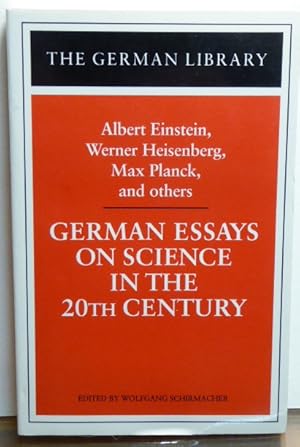
German Essays on Science in the 20th Century
Editore: Continuum, NY, 1996
ISBN 10: 0826407471 ISBN 13: 9780826407474
Da: RON RAMSWICK BOOKS, IOBA, CARLSBAD, CA, U.S.A.
Membro dell'associazione: IOBA
Valutazione del venditore 5 su 5 stelle

Soft Cover. Condizione: Fine. Size: 8vo - over 7¾" - 9¾" tall.
-

Albert Einstein - Max Born. Briefwechsel 1916-1955 [Kommentiert von Max Born / Geleitwort Bertrand Russell / Vorwort Werner Heisenberg]
Editore: Hamburg, rowohlt, 1969
Da: Pallas Books Antiquarian Booksellers, Leiden, Paesi Bassi
Valutazione del venditore 4 su 5 stelle

EUR 10,00
Spedizione EUR 27,00
Spedito da Paesi Bassi a U.S.A.Quantità: 1 disponibili
Aggiungi al carrellopaperbound, 12mo 250 pp. Korrespondenz der beiden grßen Freunde und Kontrahenten; Quantenmachanik, Relativitätstheorie; good condition.
-

Physik und Transzendenz: Die großen Physiker unserer Zeit über ihre Begegnung mit dem Wunderbaren
Lingua: Tedesco
Editore: Driediger Verlag; 3. Edition (3. September 2010), 2010
ISBN 10: 3932130243 ISBN 13: 9783932130243
Da: Rarewaves.com USA, London, LONDO, Regno Unito
Valutazione del venditore 5 su 5 stelle
EUR 34,64
Spedizione gratuita
Spedito da Regno Unito a U.S.A.Quantità: 11 disponibili
Aggiungi al carrelloHardback. Condizione: New.
-

EUR 10,74
Spedizione EUR 31,74
Spedito da Germania a U.S.A.Quantità: 1 disponibili
Aggiungi al carrelloturtleback. Condizione: Wie neu. Neuaufl. 320 S. Alle Bücher & Medienartikel von Book Broker sind stets in gutem & sehr gutem gebrauchsfähigen Zustand. Die Ausgabe des gelieferten Exemplars kann um bis zu 10 Jahre vom angegebenen Veröffentlichungsjahr abweichen und es kann sich um eine abweichende Auflage handeln. Unser Produktfoto entspricht dem hier angebotenen Artikel, dieser weist folgende Merkmale auf: Helle/saubere Seiten in fester Bindung. Sprache: Deutsch Gewicht in Gramm: 458.
-

EUR 19,90
Spedizione EUR 48,99
Spedito da Germania a U.S.A.Quantità: Più di 20 disponibili
Aggiungi al carrelloCondizione: New. Die Erkenntnisse der Quantenphysiker im 20. Jahrhundert haben unsere Weltsicht revolutioniert. Ploetzlich schien das Unmoegliche machbar. Erst nach und nach wird uns bewusst, wie stark diese Erkenntnisse das Weltbild veraendern, nach dem wir unser Leben ausric.
-

Physik und Transzendenz: Die großen Physiker unserer Zeit über ihre Begegnung mit dem Wunderbaren
Lingua: Tedesco
Editore: Driediger Verlag; 3. Edition (3. September 2010), 2010
ISBN 10: 3932130243 ISBN 13: 9783932130243
Da: Rarewaves.com UK, London, Regno Unito
Valutazione del venditore 5 su 5 stelle
EUR 30,98
Spedizione EUR 74,75
Spedito da Regno Unito a U.S.A.Quantità: 11 disponibili
Aggiungi al carrelloHardback. Condizione: New.
-
Électrons et Photons. Rapports et Discussions du Cinquieme Conseil de Physique tenu a Bruxelles du 24 au 29 Octobre 1927 sous les Auspices de L'Institut International de Physique de Solvay. Publiés par la Commission administrative de l'Institut
Editore: Gauthier Villars, Paris, 1928
Da: SOPHIA RARE BOOKS, Koebenhavn V, Danimarca
Membro dell'associazione: ABF ILAB
Valutazione del venditore 5 su 5 stelle
Prima edizione
EUR 3.124,44
Spedizione gratuita
Spedito da Danimarca a U.S.A.Quantità: 1 disponibili
Aggiungi al carrelloFirst edition. The BohrEinstein Debate Begins. First edition, rare in the original printed wrappers, of the proceedings of the fifth Solvay Congress, where the debate between Bohr and Einstein on the consistency and completeness of quantum mechanics began. It was at this, the most famous of the Solvay conferences, that Einstein, disenchanted with Heisenberg's uncertainly principle, made his famous remark that "God does not play dice," to which Niels Bohr replied, "Einstein, stop telling God what to do!" Seventeen of the twenty-nine attendees, which included nearly all the principal architects of the old and the new quantum theory, were or became Nobel Prize winners. "The three and a half years since the fourth Solvay Conference were marked by enormous progress in quantum physics. Partly based on discoveries and ideas that had been available already before 1924 ? such as the Compton effect and matter waves ? the new atomic theory had arisen, which did more than throw new light on the difficulties discussed at the 1924 conference: quantum or wave mechanics went right to the heart of the problems posed by atomic phenomena. The two subjects put programmatically into the title of the fifth Solvay Conference ? electrons and photons ? designated the crucial points of interest, because 'electrons' also stood for the smallest, massive constituents of matter, and they now became associated with waves, and 'photons' (a name given only recently, in October 1926 by the physical chemist Gilbert N. Lewis, to Einstein's light-quanta) characterized the quantum-theoretical aspect of electromagnetic radiation. It was the declared intention of the Scientific Committee of the Institut International dePhysique Solvay to contribute by scientific reports and discussions about them to the clarification of the scientific concepts in the physics of the day. In retrospect, one may indeed attribute an important success to the 1927 Solvay Conference in marking the completion of the ideas that had first been discussed in the international physics community sixteen years previously at the first Solvay Conference of 1911" (Mehra & Rechenberg, pp. 233-4). Following a 'Notice nécrologique' by Lorentz, the present volume contains the following reports, and discussions about them by the participants (all articles in French): 'The Intensity of the Reflection of X-rays,' by Bragg; 'Disagreement between Experience and the Electromagnetic Theory of Radiation,' by Compton; 'The New Dynamics of Quanta,' by de Broglie; 'The Mechanics of Quanta,' by Born and Heisenberg; 'The Mechanics of Waves,' by Schrödinger; 'The Quantum Postulate and the New Development of Atomic Theory,' by Bohr. No copies located in auction records. In 1911 the Belgian industrialist Ernest Solvay invited a group of the world's most prominent physicists, including Einstein, Planck, Lorentz, Sommerfeld, Rutherford and Marie Curie, to participate in a scientific conference on the difficulties of reconciling classical physics with quantum theory. The conference "set the style for a new type of scientific meetings, in which a select group of the most well informed experts in a given field would meet to discuss the problems at its frontiers, and would seek to define the steps for their solution" (Mehra, Solvay Conferences, p. xv). The first Solvay Conferencewidely considered a turning point in the history of modern physicswas so successful that in the following year Solvay established a foundation, now known as the International Solvay Institutes for Physics and Chemistry, "to encourage the researches which would extend and deepen the knowledge of natural phenomena" (ibid.) and to sponsor further conferences. The next two Solvay Conferences met in 1913 and 1921; subsequent conferences have been held every three years except during wartime. "From amongst the members of the Scientific Committee [of the 1927 Congress], two had already played a leading role in 1911: the Chairman Hendrik Lorentz and Albert Einstein; the latter had presented then the most revolutionary report [on the light quantum]. In spring 1926, in the early stage of preparing for the new conference, Lorentz again requested Einstein to write a report. The latter answered promptly: 'If you wish that I take over the report on quantum statistics, I shall do so with pleasure; because, without being in great difficulty, I shall never say "no" to you' (Einstein to Lorentz, 1 May 1926) On 17 June 1927, Einstein wrote to Lorentz: 'I recall having committed myself to you to give a report on quantum statistics at the Solvay [Conference]. After much reflection back and forth, I came to the conclusion that I am not competent for giving such a report in a way which really corresponds to the state of the thing. The reason is that I have not been able to participate as intensively in the modern development of quantum theory as would be necessary for that purpose. This is in part because I have on the whole too little receptive talent for fully following the stormy developments, in part also because I do not approve of the purely statistical way of thinking on which the new theory is founded ' As a substitute speaker for the topic assigned to him, he proposed either Enrico Fermi from Italy or Paul Langevin from France. Ultimately, however, neither of them gave the report on Einstein's subject. Instead, Niels Bohr agreed to contribute a report on a different topic: namely, on his latest considerations on the problem of the interpretation of quantum mechanics. "The rapporteurs at the fifth Solvay Conference fell into three groups: the experimentalists Bragg and Compton; the theoreticians advocating the Gottingen-Cambridge-Copenhagen versions of quantum mechanics ? Bohr, Born, and Heisenberg; and those of the wave-mechanical camp ? de Broglie and Schrodinger. "The selection of Arthur Holly Compton seemed to be most appropriate, because the Compton effect ? discovered in late 1922 ? had been one of the crucial results triggerin.


