
Importo totale (1 articolo articoli):
Destinazione ordine:

carleton osgood (27 risultati)
Vai alla pagina principale dei risultati di ricerca
Filtri di ricerca
Tipo di articolo
- Tutti i tipi di prodotto
- Libri (23)
- Riviste e Giornali (Nessun altro risultato corrispondente a questo perfezionamento)
- Fumetti (Nessun altro risultato corrispondente a questo perfezionamento)
- Spartiti (Nessun altro risultato corrispondente a questo perfezionamento)
- Arte, Stampe e Poster (Nessun altro risultato corrispondente a questo perfezionamento)
- Fotografie (Nessun altro risultato corrispondente a questo perfezionamento)
- Mappe (4)
- Manoscritti e Collezionismo cartaceo (Nessun altro risultato corrispondente a questo perfezionamento)
Condizioni Maggiori informazioni
- Nuovo (15)
- Come nuovo, Ottimo o Quasi ottimo (Nessun altro risultato corrispondente a questo perfezionamento)
- Molto buono o Buono (Nessun altro risultato corrispondente a questo perfezionamento)
- Discreto o Mediocre (Nessun altro risultato corrispondente a questo perfezionamento)
- Come descritto (12)
Legatura
Ulteriori caratteristiche
- Prima ed. (4)
- Copia autograf. (1)
- Sovracoperta (Nessun altro risultato corrispondente a questo perfezionamento)
- Con foto (14)
- Non Print on Demand (22)
Lingua (2)
Spedizione gratuita
Paese del venditore
Valutazione venditore
-

Carleton's Compendium of Practical Arithmetic (Classic Reprint)
Da: PBShop.store US, Wood Dale, IL, U.S.A.
Valutazione del venditore 5 su 5 stelle

PAP. Condizione: New. New Book. Shipped from UK. Established seller since 2000.
-

Carleton's Compendium of Practical Arithmetic
Da: PBShop.store US, Wood Dale, IL, U.S.A.
Valutazione del venditore 5 su 5 stelle
PAP. Condizione: New. New Book. Shipped from UK. Established seller since 2000.
-
Carleton's Compendium of Practical Arithmetic (Classic Reprint)
Da: PBShop.store UK, Fairford, GLOS, Regno Unito
Valutazione del venditore 5 su 5 stelle
EUR 18,99
EUR 4,75 per la spedizione da Regno Unito a U.S.A.Quantità: 15 disponibili
Aggiungi al carrelloPAP. Condizione: New. New Book. Shipped from UK. Established seller since 2000.
-
Carleton's Compendium of Practical Arithmetic
Da: PBShop.store UK, Fairford, GLOS, Regno Unito
Valutazione del venditore 5 su 5 stelle
EUR 19,04
EUR 4,75 per la spedizione da Regno Unito a U.S.A.Quantità: 15 disponibili
Aggiungi al carrelloPAP. Condizione: New. New Book. Shipped from UK. Established seller since 2000.
-

Carleton''s Compendium of Practical Arithmetic (Classic Reprint)
Da: PBShop.store US, Wood Dale, IL, U.S.A.
Valutazione del venditore 5 su 5 stelle
HRD. Condizione: New. New Book. Shipped from UK. Established seller since 2000.
-

Carleton's Compendium of Practical Arithmetic: Applied to the Federal and Other Currencies; Designed for the Use of Schools in the United States (Classic Reprint)
Da: PBShop.store US, Wood Dale, IL, U.S.A.
Valutazione del venditore 5 su 5 stelle
HRD. Condizione: New. New Book. Shipped from UK. Established seller since 2000.
-
Carleton''s Compendium of Practical Arithmetic (Classic Reprint)
Da: PBShop.store UK, Fairford, GLOS, Regno Unito
Valutazione del venditore 5 su 5 stelle
EUR 23,61
EUR 5,73 per la spedizione da Regno Unito a U.S.A.Quantità: 15 disponibili
Aggiungi al carrelloHRD. Condizione: New. New Book. Shipped from UK. Established seller since 2000.
-
Carleton's Compendium of Practical Arithmetic: Applied to the Federal and Other Currencies; Designed for the Use of Schools in the United States (Classic Reprint)
Da: PBShop.store UK, Fairford, GLOS, Regno Unito
Valutazione del venditore 5 su 5 stelle
EUR 23,65
EUR 5,73 per la spedizione da Regno Unito a U.S.A.Quantità: 15 disponibili
Aggiungi al carrelloHRD. Condizione: New. New Book. Shipped from UK. Established seller since 2000.
-
Carleton's Compendium of Practical Arithmetic (Classic Reprint)
Da: Forgotten Books, London, Regno Unito
Valutazione del venditore 5 su 5 stelle
EUR 18,54
Gratis per la spedizione da Regno Unito a U.S.A.Quantità: Più di 20 disponibili
Aggiungi al carrelloPaperback. Condizione: New. Print on Demand. This book offers a clear and comprehensive introduction to practical arithmetic, designed to provide readers with a solid foundation in numerical operations. It begins by explaining the basics of notation, number systems, and the fundamental principles of arithmetic. The author then guides readers through various types of calculations, including addition, subtraction, multiplication, and division, both in their simple and compound forms. The book also covers topics such as fractions, decimals, and the use of federal money, with a focus on practical applications. Along with providing step-by-step instructions and examples, the author emphasizes the importance of understanding the underlying concepts and principles of arithmetic to develop problem-solving skills. This book serves as a valuable resource for students, educators, or individuals seeking to enhance their understanding of foundational arithmetic. This book is a reproduction of an important historical work, digitally reconstructed using state-of-the-art technology to preserve the original format. In rare cases, an imperfection in the original, such as a blemish or missing page, may be replicated in the book. print-on-demand item.
-
Carleton's Compendium of Practical Arithmetic (Classic Reprint)
Da: Forgotten Books, London, Regno Unito
Valutazione del venditore 5 su 5 stelle
EUR 18,60
Gratis per la spedizione da Regno Unito a U.S.A.Quantità: Più di 20 disponibili
Aggiungi al carrelloPaperback. Condizione: New. Print on Demand. This book is an early 19th-century arithmetic textbook intended for use by American children being educated in the newly founded United States. It describes fundamental arithmetic principles such as addition, subtraction, and multiplication, working through basic and intermediate questions with additional advanced concepts for older students. Additionally, the book includes supplemental tables with information such as currency exchange rates and Federal weights and measures. The author's style involves clear instructions and examples, providing a solid foundation for further education in more advanced mathematical concepts. This book is a reproduction of an important historical work, digitally reconstructed using state-of-the-art technology to preserve the original format. In rare cases, an imperfection in the original, such as a blemish or missing page, may be replicated in the book. print-on-demand item.
-

EUR 39,48
EUR 48,99 per la spedizione da Germania a U.S.A.Quantità: Più di 20 disponibili
Aggiungi al carrelloGebunden. Condizione: New.
-

EUR 50,60
EUR 62,72 per la spedizione da Germania a U.S.A.Quantità: 2 disponibili
Aggiungi al carrelloBuch. Condizione: Neu. Neuware - This work has been selected by scholars as being culturally important, and is part of the knowledge base of civilization as we know it. This work was reproduced from the original artifact, and remains as true to the original work as possible. Therefore, you will see the original copyright references, library stamps (as most of these works have been housed in our most important libraries around the world), and other notations in the work.This work is in the public domain in the United States of America, and possibly other nations. Within the United States, you may freely copy and distribute this work, as no entity (individual or corporate) has a copyright on the body of the work.As a reproduction of a historical artifact, this work may contain missing or blurred pages, poor pictures, errant marks, etc. Scholars believe, and we concur, that this work is important enough to be preserved, reproduced, and made generally available to the public. We appreciate your support of the preservation process, and thank you for being an important part of keeping this knowledge alive and relevant.
-
![Immagine del venditore per Carleton's compendium of practical arithmetic : applied to the federal and other currencies : compiled at the request of the associated instructors of youth in Boston / by Osgood Carleton 1810 [LeatherBound] venduto da S N Books World](https://pictures.abebooks.com/inventory/md/md30637283724.jpg)
Leatherbound. Condizione: NEW. BOOKS ARE EXEMPT FROM IMPORT DUTIES AND TARIFFS; NO EXTRA CHARGES APPLY. Leatherbound edition. Condition: New. Leather Binding on Spine and Corners with Golden leaf printing on spine. Bound in genuine leather with Satin ribbon page markers and Spine with raised gilt bands. Pages: 264. A perfect gift for your loved ones. Reprinted from 1810 edition. NO changes have been made to the original text. This is NOT a retyped or an ocr'd reprint. Illustrations, Index, if any, are included in black and white. Each page is checked manually before printing. As this print on demand book is reprinted from a very old book, there could be some missing or flawed pages, but we always try to make the book as complete as possible. Fold-outs, if any, are not part of the book. If the original book was published in multiple volumes then this reprint is of only one volume, not the whole set. IF YOU WISH TO ORDER PARTICULAR VOLUME OR ALL THE VOLUMES YOU CAN CONTACT US. Resized as per current standards. Sewing binding for longer life, where the book block is actually sewn (smythe sewn/section sewn) with thread before binding which results in a more durable type of binding. Language: English Pages: 264.
-

Astronomical Diary: or, an Almanack, for the Year
Data di pubblicazione: 1792
Da: G.S. MacManus Co., ABAA, Bryn Mawr, PA, U.S.A.
Membro dell'associazione: ABAA ILAB
Valutazione del venditore 5 su 5 stelle
CARLETON, Osgood. An Astronomical Diary: or, an Almanack, for the Year of Our Lord 1792. Boston: Samuel Hall; Salem: Thomas C. Cushing, [1791]. 11 leaves. Sewn. Later unprinted wrappers. Lacks leaf A2, closed tear to leaf C3, else very good. Drake 3467 locates one copy with this imprint. Evans 23248. ESTC W22522. Includes an excerpt from the memoirs of Capt. John Smith.
-

Carleton's Compendium of Practical Arithmetic. Applied to the Federal and other Currencies. Designed for the Use of Schools in the United States.
Editore: Boston: Thomas Wells, 1810. First edition., 1810
Da: William Matthews/The Haunted Bookshop, Sidney, BC, Canada
Membro dell'associazione: ABAC ILAB
Valutazione del venditore 5 su 5 stelle
EUR 158,89
EUR 15,52 per la spedizione da Canada a U.S.A.Quantità: 1 disponibili
Aggiungi al carrello12mo. 251pp. (erratta on page [252]). Original pale green boards, cloth spine, unlettered. Cloth torn at lower front hinge, some wear to tips, moderate browning of paper, a very good copy. Presentation inscription on verso of front flyleaf from Daniel Manston to Harvey Soule, dated Duxbury 1834. Later bookplate and ownership inscription from the 1950s on front leaves. Some mathematical notes on front end paper. The scarce final work by this notable Boston cartographer and mathematician.
-
CARLETON'S ALMANACK, (Enlarged and Improved) for the Year of Our Lord 1794 .
Editore: Printed and Sold by Samuel Hall, Boston, 1793
Da: Tavistock Books, ABAA, Reno, NV, U.S.A.
Membro dell'associazione: ABAA ESA ILAB IOBA
Valutazione del venditore 5 su 5 stelle
Drake 3510; Evans 25261. Unpaginated, though 36 pp. 2 cuts illustrating eclipses for 1794. 12mo: A - C6. 7-1/4" x 4-3/8" Besides the 2 pp monthly entries, additional matter includes 'Courts' in New Hampshire, Rhode-Island, Vermont & Connecticut; 'Table of the Value of Foreign Gold'; Memoirs of Capt John Smith [begun in the 1793 issue]; a 'Cure for Cancers' & 'Roads to the Principal Towns'. A Good copy (edge chipping/paper browning/period po annotations to lower margin of 'November' pp). Self wrappers, sewn [by po, with straight pin reinforcement along spine]. Now housed in a clear archival mylar sleeve.
-
Map of Massachusetts proper compiled from Actual Surveys made by Order of the General Court, and under the inspection of agents of their appointment
Editore: B. & J. Loring, [Boston, 1801
Da: Donald A. Heald Rare Books (ABAA), New York, NY, U.S.A.
Membro dell'associazione: ABAA ILAB
Valutazione del venditore 2 su 5 stelle

Mappa Prima edizione Copia autografata
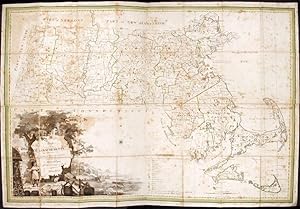
Copper-engraved map, with original outline colour, folded and mounted on linen. Publisher's paper label to verso, in good condition apart from some slight browning. Modern cloth chemise, within a morocco-backed cloth slipcase. A very rare and highly important early map of Massachusetts. The revised and much improved first "official" edition of the most important early map of Massachusetts. In three key ways, this edition is a great improvement over Osgood Carleton's 1798 original which was rejected for official sanction by the government of the Commonwealth. Firstly, the coastline and coastal islands have been more correctly rendered, largely due to the incorporation of information from the charts of Joseph Des Barres. Secondly, roads and streams that had been left incomplete in the earlier map were extended. Thirdly, some of the clutter of the 1798 map, engraved by Carleton's partner, John Norman, was removed, and the map is more attractive and informative, with a cleaner and crisper appearance. The history of the creation and publication of Carleton's map is interesting. There was a movement to create a state-sponsored map of Massachusetts as early as 1791. In 1795, after a failed attempt by the Massachusetts Historical Society, Osgood Carleton and John Norman signed a contract with the Commonwealth to create a state map based on surveys submitted by every town, with the entire map to be endorsed as to its quality by the state government. The map was produced in 1798, but it failed to win approval by the General Court which criticized Norman's engraving. The government asked Norman to redraw the map, although he had already printed 400 copies and went about marketing it without the official seal of approval from the Massachusetts government. Carleton, however, began to recompile the map and the firm of Callendar and Hill was contracted to engrave it. The present version of the map was approved by the General Court in 1801, and 500 copies were ordered to be printed. The map was published by B. & J. Loring in Boston, and offered (along with a companion map of Maine, which was then a constituent part of Massachusetts) at four dollars for a set, seven dollars if mounted on cloth with rollers, and eight dollars folded into cases. This copy of the map retains the publisher's original paper label, which forcefully asserts that this 1801 version of the Carleton map of Massachusetts, approved by the General Court, is "the only accurate one ever published of this state." The map is drawn on a scale of four miles to the inch, and gives a clear delineation of the boundaries and coastline of Massachusetts, and of the borders of each town in the state. The distance of each town from Boston and from their respective county seat is given, and major roads and streams are shown. Public and private institutions, including academies, meetinghouses, courthouses, etc., are located, as are topographical features such as mountains, ponds, rivers and streams. The cartouche, smaller in size and more attractive than that in the 1798 version, is still quite large, taking up much of the lower left corner of the map. It shows an Indian standing beside trees on a shoreline, with boats in the distant waters, and casks, anchors, nets, and a globe in the foreground. Danforth, 'The First Official Maps of Maine and Massachusetts,' in Imago Mundi 35 (1983), pp. 37-57; Krieger & Cobb, Mapping Boston, p. 52; Phillips, A List of Maps of America, p. 400; Ristow, American Maps and Mapmakers, pp. 89-92.
-

Carleton's Compendium of Practical Arithmetic
Da: Majestic Books, Hounslow, Regno Unito
Valutazione del venditore 4 su 5 stelle

EUR 33,64
EUR 7,42 per la spedizione da Regno Unito a U.S.A.Quantità: 4 disponibili
Aggiungi al carrelloCondizione: New. Print on Demand pp. 262.
-
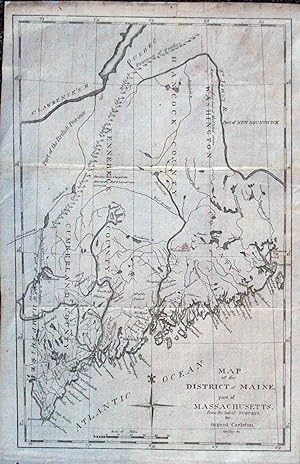
Map of the District of Maine, part of Massachusetts, from the Latest Surveys
Editore: Boston, Boston, 1802
Da: High Ridge Books, Inc. - ABAA, South Deerfield, MA, U.S.A.
Membro dell'associazione: ABAA ESA ILAB SNEAB
Valutazione del venditore 5 su 5 stelle
Osgood Carleton's last map of Maine, issued in Jedediah Morse's American Universal Geography, 4th edition. Uncolored. Fine condition, with light wear along previous folds. Six counties are shown. There is a boundary line between Cumberland and York Counties, but York County is not named. Thompson (Printed Maps of Maine) 9.
-

The District of Main, from the Latest Surveys
Editore: Boston, Boston, 1793
Da: High Ridge Books, Inc. - ABAA, South Deerfield, MA, U.S.A.
Membro dell'associazione: ABAA ESA ILAB SNEAB
Valutazione del venditore 5 su 5 stelle
The first printed map of Maine, published in Jedidiah Morse's American Universal Geography. Uncolored, fine condition. This map was issued at a time when the spelling of the name of this area was shifting from "District of Main" as shown in the map's title and in the text of the book, to "District of Maine" as used on the map surface. Five counties are named. Thompson (Printed Map of Maine) 1, Smith [2] 33, Wheat & Brun 168.
-

General Chart of the West Indies from the latest Marine Journals and Surveys.
Data di pubblicazione: 1789
Da: Geographicus Rare Antique Maps, Brooklyn, NY, U.S.A.
Membro dell'associazione: ABAA ESA ILAB
Valutazione del venditore 5 su 5 stelle
Mappa Prima edizione
Very good. Right and left margins extended. Minor wormhole infill in northern Florida. Laid on archival tissue to stabilize a few old edge tears and seam splits. Size 28.5 x 39.75 Inches. An important c. 1789 - 1794 nautical map of the West Indies, Florida, the Bahamas, and the Gulf of Mexico littoral by Osgood Carleton and John Norman. This is the second edition of John Norman's first published nautical chart, representing one of the first instances of post-Revolutionary American commercial chart making, predating the publication of the Clark Pilot by several months. A Closer Look Coverage extends from the Gulf of Mexico littoral to the Gulf of Panama, embracing Florida, all of the West Indies, including the Greater and Lesser Antilles, the Bahamas, the Yucatan, Central America, and the northern parts of South America. There are extensive and novel soundings north of the Yucatan and around Florida, particularly along the western coast of the peninsula. Although drawn, engraved, and sold by John and William Norman, the chart features a printed certification by Osgood Carleton, a well-known Boston-based expert on navigation. Historical Context The map is derived from a similar chart of the same name published in the 1780s in London by Sayer and Bennet. Although European sea charts were the norm throughout the Revolutionary period, the United States was rapidly emerging as an economic, industrial, and seagoing power. As more engravers, papermakers, and printers established themselves in the former British Colonies, demand rose for economical domestically produced charts of the same caliber as European charts. Although Clark has been attributed as the publisher of the first American nautical atlas, it was John Norman, and later his son William Norman, who actually produced the charts and took up the challenge of supplying the American maritime trade. Their work paved the way for other American hydrographers, including Edmund Blunt, to establish their own firms. A Complicated Publication History This map was most likely engraved in 1789 by John Norman at the request of Bartholomew Burges (c. 1740 - 1807). Burges was a maritime lecturer and mathematician who on August 3, 1789, published a subscription proposal for a set of 12 nautical charts in the Boston Gazette . That proposal suggested the set would include a map of the West Indies engraved by John Norman. In his promotion, Burges boldly claimed the charts would be approved by the Boston Marine Society. Affronted, the Marine Society interviewed Burges, but refused to lend its name to the project, determining that 'Burges has produced no recommendation of his character and scientific abilities'. In his response, Burges begged the society to examine the one chart already complete - one engraved by John Norman sometime before August 1789. It remains unclear which chart that was. Burges was again rejected by the Marine Society. Burges turned to Matthew Clark (1748 - 1798). Clark was not a publisher or hydrographer, but as an auctioneer and shipbuilder, had deep connections in the Marine Society. Where Burges's was rejected, Clark received approval. He made his first appeal to the Marine Society in October 1789 and, together with the respected local chartmaker and mathematician Osgood Carleton, presented their case in January 1790. They brought with them several charts, suggesting that Norman must have been hard at work between August, when only one chart was complete, and October, by which time 'several' were ready for presentation. Also around this time, Clark had forced Burges (and possibly Norman) from the project. Clark proceeded to publish the Pilot and separate charts in the winter of 1790. The full complement included 18 charts, offered both separately and as a bound set. Most were engraved by Norman, with added charts by Joseph Seymour. In most, but not all, Burges' name was effaced. Burges himself relocated to New York in the Spring of 1790, where he published a notice to '.
-

Map of Massachusetts Proper Compiled from Actual Surveys Made by Order of the General Court, and Under the Inspection of Agents of Their Appolintment
Editore: Boston, Boston, 1801
Da: High Ridge Books, Inc. - ABAA, South Deerfield, MA, U.S.A.
Membro dell'associazione: ABAA ESA ILAB SNEAB
Valutazione del venditore 5 su 5 stelle
4 part map, restored. Modern linen backing. Extensive facsimile work at edges, particularly in the large cartouche at the lower left. An early crease runs vertically through Hampshire County and there is a 2 inch circular stain in the lower right border, just below Nantucket. While extensively restored, this is now a very presentable copy of and early, important map of Massachusetts by Carleton, one of the most prominent early American cartographers. The map was engraved by Joseph Callender and Samuel Hall. The vignette was drawn by G. Graham.
-
Chart from New York to Timber Island including Nantucket Shoals from the latest Surveys
Editore: printed and sold by John Norman, Boston, 1794
Da: Donald A. Heald Rare Books (ABAA), New York, NY, U.S.A.
Membro dell'associazione: ABAA ILAB
Valutazione del venditore 2 su 5 stelle
Mappa Prima edizione
Copper engraved sea chart, on seven sheets, unjoined. Greatest dimensions (if joined): approximately 50 x 76 inches. Rare complete copy of the first edition of Norman's chart of the New England coast line on seven sheets. The American Revolution brought an end to Britain's leading role in the mapping of America. The task now fell to the American publishing industry still in its infancy, but with first-hand access to the new surveys that were documenting the rapid growth of the nation. In particular, there was a need for nautical charts for use by the expanding New England commercial fleets. The first American marine atlas, Mathew Clark's A Complete Set of Charts of the Coast of America, was published in Boston in 1790. Two of Clark's charts had been engraved by John Norman, who was inspired to launch his own enterprise. In January 1790, Norman published a notice in the Boston Gazette stating he was currently engraving charts of all the coast of America on a large scale. These were assembled and published as The American Pilot in Boston in 1791. Norman's Pilot, the second American marine atlas, indeed the second American atlas of any kind, marked an advance over the earlier work of Mathew Clark. The present map is among the most impressive from the atlas. Printed on seven sheets, the map joins to an irregular shape (sometimes described as an inverted T or inverted L shape). As the title suggests, the map depicts the entire coastline, from Manhattan Island in the south west, to Timber Island, Maine. Besides an accurate depiction of the coastline based on Holland's surveys, the map includes shoals and soundings, and with both coastal and inland towns and waterways. As the cartouche states, the map, and indeed the entire atlas, includes an attestation by Osgood Carleton (described as a "Teacher of Navigation and other Branches of the Mathematics"), certifying its accuracy. New editions of Norman's Pilot appeared in 1792 and 1794, and after his death, his son William Norman, brought out editions in 1794, 1798, 1801, and 1803. The present map is Wheat & Brun's second state, i.e. from the 1794 edition preceding John Norman's death, with the inclusion of the right extension sheet showing George's Bank, the inclusion of the northernmost sheet extending the map to Timber Island and with roads added connecting towns north of Boston. Later editions included a number of changes, most notably excluding the George's Bank and northernmost sheets. Despite the seemingly large number of editions, The American Pilot is one of the rarest of all American atlases. Wheat and Brun locate just ten complete copies for the first five editions: 1791 (Huntington, Harvard); 1792 (Library of Congress, Clements); 1794(1) (Library of Congress, John Carter Brown Library, Boston Public Library); 1794(2) (Yale); 1798 (Library of Congress, Boston Public Library). Only one other example of this map has appeared at auction in the last quarter century, being a later 19th century issue without the additional two sheets (Swann Galleries, 5 December 2013, selling for $37,500). Wheat & Brun 157 (state 2); McCorke 791.4; Suarez, Shedding the Veil 60 (1801 edition); Bosse, "The Boston Map Trade of the Eighteenth Century" in Mapping Boston, pp. 49-52.
-
Carleton's compendium of practical arithmetic. Applied to the federal and other currencies . Compiled at the request of the associated instructors of youth in Boston 1810 [Leather Bound]
Data di pubblicazione: 2025
Da: Gyan Books Pvt. Ltd., Delhi, India
Valutazione del venditore 5 su 5 stelle
EUR 30,66
Gratis per la spedizione da India a U.S.A.Quantità: Più di 20 disponibili
Aggiungi al carrelloLeather Bound. Condizione: New. Language: English. Presenting an Exquisite Leather-Bound Edition, expertly crafted with Original Natural Leather that gracefully adorns the spine and corners. The allure continues with Golden Leaf Printing that adds a touch of elegance, while Hand Embossing on the rounded spine lends an artistic flair. This masterpiece has been meticulously reprinted in 2025, utilizing the invaluable guidance of the original edition published many years ago in 1810. The contents of this book are presented in classic black and white. Its durability is ensured through a meticulous sewing binding technique, enhancing its longevity. Imprinted on top-tier quality paper. A team of professionals has expertly processed each page, delicately preserving its content without alteration. Due to the vintage nature of these books, every page has been manually restored for legibility. However, in certain instances, occasional blurriness, missing segments, or faint black spots might persist. We sincerely hope for your understanding of the challenges we faced with these books. Recognizing their significance for readers seeking insight into our historical treasure, we've diligently restored and reissued them. Our intention is to offer this valuable resource once again. We eagerly await your feedback, hoping that you'll find it appealing and will generously share your thoughts and recommendations. Lang: - English, Pages:- 266, Print on Demand. If it is a multi-volume set, then it is only a single volume. We are specialised in Customisation of books, if you wish to opt different color leather binding, you may contact us. This service is chargeable. Product Disclaimer: Kindly be informed that, owing to the inherent nature of leather as a natural material, minor discolorations or textural variations may be perceptible. Explore the FOLIO EDITION (12x19 Inches): Available Upon Request. 266.
-
Massachusetts, New-Hampshire, Rhode-Island
Data di pubblicazione: 1794
Da: G.S. MacManus Co., ABAA, Bryn Mawr, PA, U.S.A.
Membro dell'associazione: ABAA ILAB
Valutazione del venditore 5 su 5 stelle
[CARLETON, Osgood]. The Massachusetts, New-Hampshire, Rhode-Island, Connecticut, and Vermont Almanack for the Year of Our Lord, 1794. . By Abraham Weatherwise. Boston: [Nathaniel Coverly] Printed and Sold by the Booksellers, [1793]. 12 leaves. Sewn. Complete. Some soiling to exterior leaves, else very good. Drake 3514. Evans 26441. ESTC W32424. Includes 3-page "Concise Calendar for young Farmers and Gardeners." Apparently calculated by Osgood Carleton. The calculations on the calendar pages are identical with those in the corresponding columns of Carleton's almanack for 1794 (Boston). The eclipse predictions also contain identical calculations, and, though brief, seem clearly by the same hand; and there are significantly frequent similarities in the notes on the calendar pages. An advertisement by Carleton appears on p. [18]. Identical in typography and contents, except for the title page, with the Massachusetts, New-Hampshire, Rhode-Island, Connecticut, and Vermont almanack for 1794, by Isaac Bickerstaff (Boston : For the booksellers).
-

Map of Massachusetts Proper Compiled form Actual Surveys made by Order of the General Court, and under the inspection of Agents of their appointment, by Osgood Carleton.
Data di pubblicazione: 1801
Da: Geographicus Rare Antique Maps, Brooklyn, NY, U.S.A.
Membro dell'associazione: ABAA ESA ILAB
Valutazione del venditore 5 su 5 stelle
Mappa Prima edizione
Very good. Full professional restoration Dissected as issued and mounted on fresh linen. Size 32 x 47.5 Inches. Known as 'The Agent's Map', this is a fine example of the first official map of Massachusetts, published in 1801 by Osgood Carleton. The map emerged out of a long and complex struggle to produce a large-scale, accurate, and comprehensive state map - something increasingly important in the heady early days of independence following the American Revolutionary War (1775 - 1783). This expansive map covers all of Massachusetts in considerable detail, giving no attention whatsoever to the neighboring states. While generally ignoring topography, the map offers superb practical detail throughout, noting roads, county borders, schools, meeting houses, courts, milage from Boston, and more. The sole mountain illustrated is the Hoosack Range, near modern-day North Adams. A Long and Complicated History The Massachusetts legislature put out a call for a large-scale state map in 1792. In the subsequent months, the state received several proposals. Nearly 18 months later, in June of 1794, they accepted a proposal put forth by veteran cartographers Osgood Carleton and John Norman. Both Carleton and Norman were known to the Legislature. They traveled in educated circles and had already published an important nautical atlas of great benefit to Massachusetts seamen. They further liked Carleton's proposal that a regional map be produced by each town - at the town's expense - sparing the state the need for immediate cash outlay. Collecting the Surveys While the process of mandating that each town produce its own local survey, at its own expense, became the norm for state mapmaking, in 1794 it was revolutionary. Some towns had already produced detailed surveys, so had no problem submitting them, but most lacked the means and expertise to issue anything comprehensive. Provincetown, for example, submitted a 'plan' consisting of nothing more than an outline of the town with no interior detail. More than 90 other towns simply ignored the legislative mandate and submitted nothing at all. The legislature began assessing tax penalties on non-compliant towns, and all but 17 eventually produced surveys, although many were inaccurate and useless. Presenting the Finished Map Despite these many issues, Carleton and Normal completed the map roughly on schedule, presenting it to a committee established by the Massachusetts Legislature on June 29, 1798. The committee was unimpressed. The engraving, done by Norman, was hastily completed and sloppy, leading to numerous errors. Moreover, attempts to illustrate topography with mountain profiles resulted in a sloppy, cluttered map. The legislature demanded these issues be fixed, It is expected in the Mean time they correct all the Error in said maps, and take out the many accidental strokes in the Plate; and also that they make Margins of the Rivers, Ponds, and Sea Coasts neater, and that the whole Plate be better Polished ( Boston Gazette , Aug. 20, 1798, quoted in Ristow, W., American Maps and Mapmakers , p. 91.). The legislature further appointed the known geographical experts Jedidiah Morse, John Davis, and Samuel Webber as 'Agents of the Commonwealth' (Davis later withdrew) to verify the soon-to-be-revised map. The First Official Map of Massachusetts It took Carleton more than two years to revise the map to his satisfaction. In this time, new surveys arrived from the delinquent towns, and others were ordered or updated. Carleton split with Norman and hired two new engravers, Samuel Hill and Joseph Callender, both well known in Boston for quality work. He also reached out to the artist and line-and-stipple engraver George Graham to produce a striking new vignette cartouche. The final product incorporated the wealth of new information, but also removed all topography (except lakes and rivers), yielding a clean, easy-to-read map rich in detail. The new cartouche was also impressive, featuring rich pastures.
-
Map of Massachusetts Proper Compiled from Actual Surveys
Data di pubblicazione: 1801
Da: Arader Galleries - AraderNYC, New York, NY, U.S.A.
Valutazione del venditore 5 su 5 stelle
No Binding. Condizione: Please Contact Seller. With the end of the war arrived a new sense of American pride and confidence, and detailed mapping of the states and their cities came into great demand partly for administrative purposes. Osgood Carleton was at the forefront of this trend and with the assistance of the Massachusetts Historical Society, lobbied the Massachusetts State Legislature to pass a resolution in 1794 directing each town to prepare an accurate town map. This is the second map of Massachusetts by Carleton. His first was made in 1798, but when the Massachusetts Historical Society examined the engraved plates, they deemed his work to be unsatisfactory. Working from Carleton's design and the information he gathered, the map was re-engraved by Samuel Hill and Joseph Callender and published by the Commonwealth of Massachusetts in 1801. This map is now known as the first official map of Massachusetts. Engraving Engraved by Joseph Callender and Samuel HillVignette Drawn by G. GrahamThomas & Andrews: Boston, 1801 1801 Size: Unframed: 47 x 31.5". Book.




![Immagine del venditore per Carleton's compendium of practical arithmetic. Applied to the federal and other currencies . Compiled at the request of the associated instructors of youth in Boston 1810 [Leather Bound] venduto da Gyan Books Pvt. Ltd.](https://pictures.abebooks.com/inventory/md/md31424795000.jpg)