
Importo totale (1 articolo articoli):
Destinazione ordine:

coffey warren (6 risultati)
Vai alla pagina principale dei risultati di ricerca
Filtri di ricerca
Tipo di articolo
- Tutti i tipi di prodotto
- Libri (6)
- Riviste e Giornali (Nessun altro risultato corrispondente a questo perfezionamento)
- Fumetti (Nessun altro risultato corrispondente a questo perfezionamento)
- Spartiti (Nessun altro risultato corrispondente a questo perfezionamento)
- Arte, Stampe e Poster (Nessun altro risultato corrispondente a questo perfezionamento)
- Fotografie (Nessun altro risultato corrispondente a questo perfezionamento)
- Mappe (Nessun altro risultato corrispondente a questo perfezionamento)
- Manoscritti e Collezionismo cartaceo (Nessun altro risultato corrispondente a questo perfezionamento)
Condizioni Maggiori informazioni
- Nuovo (Nessun altro risultato corrispondente a questo perfezionamento)
- Come nuovo, Ottimo o Quasi ottimo (1)
- Molto buono o Buono (2)
- Discreto o Mediocre (Nessun altro risultato corrispondente a questo perfezionamento)
- Come descritto (3)
Legatura
Ulteriori caratteristiche
- Prima ed. (1)
- Copia autograf. (Nessun altro risultato corrispondente a questo perfezionamento)
- Sovracoperta (Nessun altro risultato corrispondente a questo perfezionamento)
- Con foto (3)
- Non Print on Demand (6)
Lingua (1)
Spedizione gratuita
Paese del venditore
Valutazione venditore
-

Windstar
Editore: Thomson Shore
Da: Books End Bookshop, Syracuse, NY, U.S.A.
Valutazione del venditore 4 su 5 stelle

Trade Paperback. Condizione: Very Good. Condizione sovraccoperta: None.
-
Windstar
Editore: Private, 1990
Da: Lobster Lane Books, Pembroke, MA, U.S.A.
Valutazione del venditore 5 su 5 stelle

Hardcover. Condizione: Fine. A very smart copy in all respects.
-
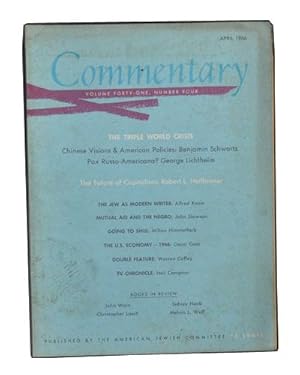
Commentary: Vol. 41, No. 4 (April 1966)
Editore: The American Jewish Committee, New York, 1966
Da: Cat's Cradle Books, Archdale, NC, U.S.A.
Valutazione del venditore 5 su 5 stelle
Softcover. Condizione: Good with no dust jacket. Binding is sound. Pages age-darkened, clean. Wraps faded, soiled, moderately shelf worn. Wear to corner tips. ; Contents: The Triple World Crisis: Schwartz, "Chinese Visions & American Policies"; Lichtheim, "Pax Russo-Americana?"; Heilbroner, "The Future of Capitalism"; Kazin, "The Jew as Modern Writer"; Slawson, "Mutual Aid and the Negro"; Himmelfarb, "Going to Shul"; Gass, "The U.S. Economy - 1966"; Coffey, "Double Feature"; Compton, "TV Chronicle." Reviews. 11.0" tall; 112 pages.
-
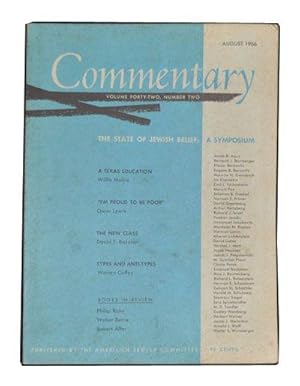
Commentary: Vol. 42, No. 2 (August 1966)
Editore: The American Jewish Committee, New York, 1966
Da: Cat's Cradle Books, Archdale, NC, U.S.A.
Valutazione del venditore 5 su 5 stelle
Softcover. Condizione: Good with no dust jacket. Binding is sound. Pages age-darkened, clean. Wraps faded, soiled, moderately shelf worn with closed tear at bottom front. ; Contents: "The State of Jewish Belief: A Symposium"; Morris, "A Texas Education"; Lewis, "I'm Proud to Be Poor"; Bazelon, "The New Class"; Coffey, "Types and Anti-types"; reviews. 11.0" tall; 160 pages.
-
Human Dimensions of School Improvement
Editore: Research for Better Schools, Inc., Philadelphia, 1975
Da: Books to Die For, The Woodlands, TX, U.S.A.
Valutazione del venditore 5 su 5 stelle
Soft cover. Condizione: Very Good. VG- in glossy illustrated wrappers, as published. Trade paperback. 201 pp. Covers rubbed, sunned, smudged, curled, creased. Front bottom and rear top corners heavily creased. Page edges sunned, smudged. Page fore edges have prior owner's name. Spine square, tight, creased. Half-title page has prior owner's name in ink, blind embossed personal library stamp, old price stamp. Interior clean, bright. No marks. Hard-to-find text on school improvement methods.
-
Letters on the State of Ireland - Addresses by J.K.L. to a friend in England [With a section: "Administration of Justice and Spirit of the Penal Laws"].
Editore: Dublin, Printed by Richard Coyne [Printer and Bookseller to the Royal College of St.Patrick, Maynooth, and Publisher to the Roman Catholic Bishops of Ireland]., 1825
Da: Inanna Rare Books Ltd., Skibbereen, CORK, Irlanda
Valutazione del venditore 5 su 5 stelle
Prima edizione
EUR 280,00
Spedizione EUR 28,00
Spedito da Irlanda a U.S.A.Quantità: 1 disponibili
Aggiungi al carrelloFirst Edition. Octavo (15 cm x 21 cm). VIII, 364 pages. Hardcover / Recently restored and rebacked original binding. Excellent condition after the restoration. From the library of Judge James Charles Coffey, with his name signed on the titlepage and dated May, 1860. Some mild foxing to first 10 pages, otherwise very good. Extremely rare publication ! Letters include topics like: "The Character of the Irish Government, and the effect of its measures upon the Country; including remarks on the Peace-preservation Act, or Constabulary Bill, the Burial Service Bill and the Tithe Composition Act / The State and Composition of Parties (Sketch of the Irish Gentry) / The State of Religion and the Character of its Ministers in Ireland / The Administration of Justice and Spirit of the Penal Laws / The Increase of Population - its causes and effects, prevailing errors on this subject / Public Education and to whom it should be intrusted / The Bible Societies - Their Opposition to the interests of Religion and Peace in Ireland / On Catholic Emancipation - On the Papal Power and the Nature of Allegiance and on the Oath and Declaration taken or made by Protestants of the Established Church / On the Disenfranchisement of the Forty-Shilling-Freeholders - How unjust and injurious such a measure would be / On a legal Provision for the Poor - Its practicability and advantages to all classes in Ireland, but especially to the Government // James Warren Doyle, O.E.S.A. (17861834) was a Roman Catholic Bishop of Kildare and Leighlin in Ireland, who used the signature "JKL", an acronym from "James Kildare and Leighlin." Doyle was active in the Anti-Tithe movement. A campaigner for Catholic Emancipation up to 1829, he was also an educator, church organiser and the builder of Carlow cathedral. Doyle was born close to New Ross, County Wexford in 1786, the posthumous son of a respectable farmer; his mother (Anne Warren, of Quaker extraction) was living in poverty at the time of his birth. At the age of eleven he witnessed all the horrors of the Battle of New Ross between the United Irishmen and British Crown forces supplemented by the militia and yeomanry. He received his early education at Clonleigh, at Rathconrogue at the school of a Mr. Grace, and later at the Augustinian College, New Ross under the care of an Augustinian monk, Rev. John Crane. Doyle joined the Augustinian friars in 1805 at Grantstown, County Wexford and then studied for his doctorate at Coimbra in Portugal (180608). His studies were disturbed by the Peninsular War, during which he served as a sentry in Coimbra. Later, he accompanied the British Army with Wellington's forces to Lisbon as an interpreter. Following Doyle's return to Ireland, he was ordained to the priesthood on 1 October 1809, at Enniscorthy. He taught logic at the Augustinian College, New Ross. In 1813, Doyle was appointed to a professorship at Carlow College, holding the Chair of Rhetoric and in 1814, the Professorship of Theology. Michael Corcoran, Bishop of Kildare and Leighlin, died on 22 February 1819. Doyle was a popular choice of the clergy and bishops of the Archdiocese of Dublin and was chosen by the Holy See as Corcoran's successor. He was formally named in August 1819 and was duly consecrated in Carlow Parish Church on 14 November. During his fifteen-year tenure as Bishop of Kildare and Leighlin, Doyle earned respect nationwide for his polemics in furtherance of the Catholic position in both Irish and British society, and in supporting the work of the Catholic Association. His books on pastoral, political, educational and inter-denominational matters provide a rich source of material for social and religious historians (see below). He was a close ally of Daniel O'Connell in the political campaign for Catholic Emancipation which was finally passed in 1829 by the Wellington government. Tithe - War: In 1830, the new tithe-proctor of Graigue (a parish of 4,779 Catholics and 63 Protestants) decided to break with the tradition of his predecessor and to enforce seizure orders for the collection of arrears of Tithes. Tithes provided financial support of the established Anglican Church of Ireland. Some of the recalcitrant Catholics had habitually transferred ownership of their livestock to Doyle in order to avoid seizure at the town fair. The new proctor requested their priest's cooperation in handing over the assets. Doyle refused, and the proctor, aided by the Irish Constabulary, seized some of the livestock. A mass riot broke out at the fair and there were several casualties. A civil disobedience campaign followed, peppered with sporadic violence mostly at country fairs over the seizure of livestock. A period of instability that would become known as the Tithe War followed. Doyle was a leader of nonviolent resistance to the Tithe, devoting himself both to strengthening the nonviolent resistance and to discouraging like paramilitary secret societies who had taken to using violence to drive out tithe-collectors and to intimidate collaborators. He said: "I maintain the right which [Irish Catholics] have of withholding, in a manner consistent with the law and their duty as subjects, the payment of tithe in kind or in money until it is extorted from them by the operation of the law." Given Doyle's prior experience in education, his major contribution was arguably in helping the establishment of National Schools across Ireland from 1831, the initiative of Edward Stanley, Chief Secretary of Ireland, which were initially started with a U.K. government grant of £30,000. The proposed system was ahead of state provision for education in England or Scotland at that time. This Model School prototype was, in some respects, experimental. His involvement is a sign of his practicality and foresight. He told his priests: "all the teachers henceforth to be employed be provided from some Model School, with a certificate of their competency, that will aid us in a work of great difficulty, to wit.


![Immagine del venditore per Letters on the State of Ireland - Addresses by J.K.L. to a friend in England [With a section: "Administration of Justice and Spirit of the Penal Laws"]. venduto da Inanna Rare Books Ltd.](https://pictures.abebooks.com/inventory/md/md30877815795.jpg)