

Importo totale (1 articolo articoli):
Destinazione ordine:

david kueker carl smith (19 risultati)
Vai alla pagina principale dei risultati di ricerca
Filtri di ricerca
Tipo di articolo
- Tutti i tipi di prodotto
- Libri (19)
- Riviste e Giornali (Nessun altro risultato corrispondente a questo perfezionamento)
- Fumetti (Nessun altro risultato corrispondente a questo perfezionamento)
- Spartiti (Nessun altro risultato corrispondente a questo perfezionamento)
- Arte, Stampe e Poster (Nessun altro risultato corrispondente a questo perfezionamento)
- Fotografie (Nessun altro risultato corrispondente a questo perfezionamento)
- Mappe (Nessun altro risultato corrispondente a questo perfezionamento)
- Manoscritti e Collezionismo cartaceo (Nessun altro risultato corrispondente a questo perfezionamento)
Condizioni Maggiori informazioni
- Nuovo (15)
- Come nuovo, Ottimo o Quasi ottimo (4)
- Molto buono o Buono (Nessun altro risultato corrispondente a questo perfezionamento)
- Discreto o Mediocre (Nessun altro risultato corrispondente a questo perfezionamento)
- Come descritto (Nessun altro risultato corrispondente a questo perfezionamento)
Legatura
Ulteriori caratteristiche
- Prima ed. (Nessun altro risultato corrispondente a questo perfezionamento)
- Copia autograf. (Nessun altro risultato corrispondente a questo perfezionamento)
- Sovracoperta (Nessun altro risultato corrispondente a questo perfezionamento)
- Con foto (8)
- Non Print on Demand (16)
Lingua (1)
Spedizione gratuita
Paese del venditore
Valutazione venditore
-

Learning and Geometry: Computational Approaches
Da: La bataille des livres, Pradinas, Francia
Valutazione del venditore 5 su 5 stelle

EUR 15,00
Spedizione EUR 54,00
Spedito da Francia a U.S.A.Quantità: 1 disponibili
Aggiungi al carrelloCondizione: Très bon. Learning and Geometry: Computational Approaches | Kueker, Smith | Birhaüser, 1996. In-8° cartonné, 210 pages. Couverture propre. Dos solide. Intérieur frais sans soulignage ou annotation. Exemplaire de bibliothèque : petit code barre en pied de 1re de couv., cotation au dos, rares et discrets petits tampons à l'intérieur de l'ouvrage. Très bon état général pour cet ouvrage. [Ba 46+] Pour les expéditions internationales, nous consulter au préalable pour l ajustement des frais de port qui seront peut-être revus à la baisse/ For international shipments, please contact us in advance to adjust shipping costs. |.
-
Learning and Geometry
Da: Books Puddle, New York, NY, U.S.A.
Valutazione del venditore 4 su 5 stelle

Condizione: New. pp. 210 1st Edition.
-
Learning and Geometry
Da: Majestic Books, Hounslow, Regno Unito
Valutazione del venditore 4 su 5 stelle
EUR 78,05
Spedizione EUR 7,51
Spedito da Regno Unito a U.S.A.Quantità: 1 disponibili
Aggiungi al carrelloCondizione: New. pp. 210.
-
Learning and Geometry - Computational Approaches
Da: Basi6 International, Irving, TX, U.S.A.
Valutazione del venditore 5 su 5 stelle
Condizione: Brand New. New. US edition. Expediting shipping for all USA and Europe orders excluding PO Box. Excellent Customer Service.
-
Learning and Geometry - Computational Approaches
Da: Romtrade Corp., STERLING HEIGHTS, MI, U.S.A.
Valutazione del venditore 5 su 5 stelle
Condizione: New. This is a Brand-new US Edition. This Item may be shipped from US or any other country as we have multiple locations worldwide.
-
Learning and Geometry
Da: Biblios, Frankfurt am main, HESSE, Germania
Valutazione del venditore 4 su 5 stelle
EUR 79,40
Spedizione EUR 9,95
Spedito da Germania a U.S.A.Quantità: 1 disponibili
Aggiungi al carrelloCondizione: New. pp. 210.
-

Learning and Geometry: Computational Approaches: Computational Approaches (Progress in Computer Science and Applied Logic (PCS))
Da: Ria Christie Collections, Uxbridge, Regno Unito
Valutazione del venditore 5 su 5 stelle
EUR 112,62
Spedizione EUR 13,85
Spedito da Regno Unito a U.S.A.Quantità: Più di 20 disponibili
Aggiungi al carrelloCondizione: New. In.
-

EUR 92,27
Spedizione EUR 48,99
Spedito da Germania a U.S.A.Quantità: Più di 20 disponibili
Aggiungi al carrelloCondizione: New.
-
Learning and Geometry: Computational Approaches
Da: Revaluation Books, Exeter, Regno Unito
Valutazione del venditore 5 su 5 stelle
EUR 152,88
Spedizione EUR 11,56
Spedito da Regno Unito a U.S.A.Quantità: 2 disponibili
Aggiungi al carrelloPaperback. Condizione: Brand New. reprint edition. 210 pages. 9.80x7.10x0.60 inches. In Stock.
-
EUR 112,77
Spedizione EUR 62,23
Spedito da Germania a U.S.A.Quantità: 1 disponibili
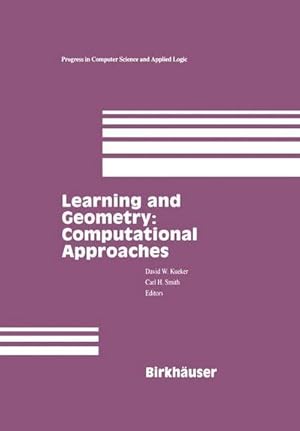
Aggiungi al carrelloTaschenbuch. Condizione: Neu. Druck auf Anfrage Neuware - Printed after ordering - The field of computational learning theory arose out of the desire to for mally understand the process of learning. As potential applications to artificial intelligence became apparent, the new field grew rapidly. The learning of geo metric objects became a natural area of study. The possibility of using learning techniques to compensate for unsolvability provided an attraction for individ uals with an immediate need to solve such difficult problems. Researchers at the Center for Night Vision were interested in solving the problem of interpreting data produced by a variety of sensors. Current vision techniques, which have a strong geometric component, can be used to extract features. However, these techniques fall short of useful recognition of the sensed objects. One potential solution is to incorporate learning techniques into the geometric manipulation of sensor data. As a first step toward realizing such a solution, the Systems Research Center at the University of Maryland, in conjunction with the Center for Night Vision, hosted a Workshop on Learning and Geometry in January of 1991. Scholars in both fields came together to learn about each others' field and to look for common ground, with the ultimate goal of providing a new model of learning from geometrical examples that would be useful in computer vision. The papers in the volume are a partial record of that meeting.
-
Learning and Geometry: Computational Approaches
Da: Mispah books, Redhill, SURRE, Regno Unito
Valutazione del venditore 4 su 5 stelle
EUR 160,72
Spedizione EUR 28,90
Spedito da Regno Unito a U.S.A.Quantità: 1 disponibili
Aggiungi al carrelloHardcover. Condizione: Like New. Like New. book.
-

Mathematical Logic and Theoretical Computer Science
Libro 130 di 142: Lecture Notes in Pure and Applied MathematicsDa: GreatBookPrices, Columbia, MD, U.S.A.
Valutazione del venditore 5 su 5 stelle
Condizione: As New. Unread book in perfect condition.
-

Mathematical Logic and Theoretical Computer Science
Libro 130 di 142: Lecture Notes in Pure and Applied MathematicsDa: GreatBookPricesUK, Woodford Green, Regno Unito
Valutazione del venditore 5 su 5 stelle
EUR 331,56
Spedizione EUR 17,34
Spedito da Regno Unito a U.S.A.Quantità: 10 disponibili
Aggiungi al carrelloCondizione: New.
-

Mathematical Logic and Theoretical Computer Science
Libro 130 di 142: Lecture Notes in Pure and Applied MathematicsDa: GreatBookPrices, Columbia, MD, U.S.A.
Valutazione del venditore 5 su 5 stelle
Condizione: New.
-

Mathematical Logic and Theoretical Computer Science
Libro 130 di 142: Lecture Notes in Pure and Applied MathematicsDa: GreatBookPricesUK, Woodford Green, Regno Unito
Valutazione del venditore 5 su 5 stelle
EUR 342,19
Spedizione EUR 17,34
Spedito da Regno Unito a U.S.A.Quantità: 10 disponibili
Aggiungi al carrelloCondizione: As New. Unread book in perfect condition.
-

Mathematical Logic and Theoretical Computer Science
Libro 130 di 142: Lecture Notes in Pure and Applied MathematicsDa: Revaluation Books, Exeter, Regno Unito
Valutazione del venditore 5 su 5 stelle
EUR 540,16
Spedizione EUR 14,45
Spedito da Regno Unito a U.S.A.Quantità: 2 disponibili
Aggiungi al carrelloPaperback. Condizione: Brand New. 407 pages. 10.25x7.25x0.75 inches. In Stock.
-
Learning and Geometry: Computational Approaches (eng)
Da: Brook Bookstore On Demand, Napoli, NA, Italia
Valutazione del venditore 4 su 5 stelle
EUR 86,24
Spedizione EUR 5,50
Spedito da Italia a U.S.A.Quantità: Più di 20 disponibili
Aggiungi al carrelloCondizione: new. Questo è un articolo print on demand.
-

Learning and Geometry: Computational Approaches
Lingua: Inglese
Editore: Birkhäuser Boston Sep 2011, 2011
ISBN 10: 1461286468 ISBN 13: 9781461286462
Da: BuchWeltWeit Ludwig Meier e.K., Bergisch Gladbach, Germania
Valutazione del venditore 5 su 5 stelle
EUR 139,09
Spedizione EUR 23,00
Spedito da Germania a U.S.A.Quantità: 2 disponibili
Aggiungi al carrelloTaschenbuch. Condizione: Neu. This item is printed on demand - it takes 3-4 days longer - Neuware -The field of computational learning theory arose out of the desire to for mally understand the process of learning. As potential applications to artificial intelligence became apparent, the new field grew rapidly. The learning of geo metric objects became a natural area of study. The possibility of using learning techniques to compensate for unsolvability provided an attraction for individ uals with an immediate need to solve such difficult problems. Researchers at the Center for Night Vision were interested in solving the problem of interpreting data produced by a variety of sensors. Current vision techniques, which have a strong geometric component, can be used to extract features. However, these techniques fall short of useful recognition of the sensed objects. One potential solution is to incorporate learning techniques into the geometric manipulation of sensor data. As a first step toward realizing such a solution, the Systems Research Center at the University of Maryland, in conjunction with the Center for Night Vision, hosted a Workshop on Learning and Geometry in January of 1991. Scholars in both fields came together to learn about each others' field and to look for common ground, with the ultimate goal of providing a new model of learning from geometrical examples that would be useful in computer vision. The papers in the volume are a partial record of that meeting. 232 pp. Englisch.
-

Learning and Geometry: Computational Approaches
Lingua: Inglese
Editore: Birkhäuser Boston, Birkhäuser Boston Sep 2011, 2011
ISBN 10: 1461286468 ISBN 13: 9781461286462
Da: buchversandmimpf2000, Emtmannsberg, BAYE, Germania
Valutazione del venditore 5 su 5 stelle
EUR 106,99
Spedizione EUR 60,00
Spedito da Germania a U.S.A.Quantità: 1 disponibili
Aggiungi al carrelloTaschenbuch. Condizione: Neu. This item is printed on demand - Print on Demand Titel. Neuware -The field of computational learning theory arose out of the desire to for mally understand the process of learning. As potential applications to artificial intelligence became apparent, the new field grew rapidly. The learning of geo metric objects became a natural area of study. The possibility of using learning techniques to compensate for unsolvability provided an attraction for individ uals with an immediate need to solve such difficult problems. Researchers at the Center for Night Vision were interested in solving the problem of interpreting data produced by a variety of sensors. Current vision techniques, which have a strong geometric component, can be used to extract features. However, these techniques fall short of useful recognition of the sensed objects. One potential solution is to incorporate learning techniques into the geometric manipulation of sensor data. As a first step toward realizing such a solution, the Systems Research Center at the University of Maryland, in conjunction with the Center for Night Vision, hosted a Workshop on Learning and Geometry in January of 1991. Scholars in both fields came together to learn about each others' field and to look for common ground, with the ultimate goal of providing a new model of learning from geometrical examples that would be useful in computer vision. The papers in the volume are a partial record of that meeting.Springer Basel AG in Springer Science + Business Media, Heidelberger Platz 3, 14197 Berlin 232 pp. Englisch.

