
Importo totale (1 articolo articoli):
Destinazione ordine:

david walbridge (4 risultati)
Vai alla pagina principale dei risultati di ricerca
Filtri di ricerca
Tipo di articolo
- Tutti i tipi di prodotto
- Libri (4)
- Riviste e Giornali (Nessun altro risultato corrispondente a questo perfezionamento)
- Fumetti (Nessun altro risultato corrispondente a questo perfezionamento)
- Spartiti (Nessun altro risultato corrispondente a questo perfezionamento)
- Arte, Stampe e Poster (Nessun altro risultato corrispondente a questo perfezionamento)
- Fotografie (Nessun altro risultato corrispondente a questo perfezionamento)
- Mappe (Nessun altro risultato corrispondente a questo perfezionamento)
- Manoscritti e Collezionismo cartaceo (Nessun altro risultato corrispondente a questo perfezionamento)
Condizioni Maggiori informazioni
- Nuovo (2)
- Come nuovo, Ottimo o Quasi ottimo (Nessun altro risultato corrispondente a questo perfezionamento)
- Molto buono o Buono (2)
- Discreto o Mediocre (Nessun altro risultato corrispondente a questo perfezionamento)
- Come descritto (Nessun altro risultato corrispondente a questo perfezionamento)
Legatura
Ulteriori caratteristiche
- Prima ed. (1)
- Copia autograf. (1)
- Sovracoperta (Nessun altro risultato corrispondente a questo perfezionamento)
- Con foto (2)
- Non Print on Demand (3)
Lingua (2)
Spedizione gratuita
Paese del venditore
Valutazione venditore
-
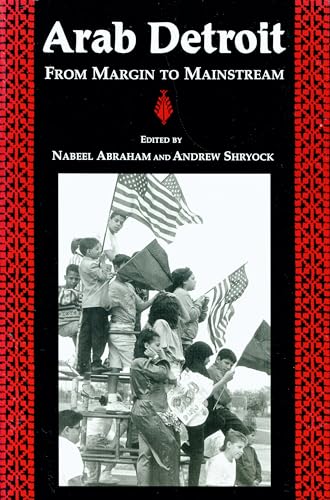
Arab Detroit: From Margin to Mainstream (Great Lakes Books)
Libro 6 di 73: Great Lakes Books SeriesLingua: Inglese
Editore: Wayne State University Press, 2000
ISBN 10: 0814328121 ISBN 13: 9780814328125
Da: A Squared Books (Don Dewhirst), South Lyon, MI, U.S.A.
Valutazione del venditore 5 su 5 stelle

Copia autografata
paperback. Condizione: Very Good. 2000. Glossy paper covers; mild wear; rear cover creased along spine and top corner; 8vo, 7 3/4" to 9 3/4" tall; inscribed and signed by the author on half title page; interior is clean and unmarked; 629 book. Signed by Author.
-
Arab Detroit: From Margin to Mainstream (Great Lakes Books)
Libro 6 di 73: Great Lakes Books SeriesLingua: Inglese
Editore: Wayne State University Press, 2000
ISBN 10: 0814328121 ISBN 13: 9780814328125
Da: BennettBooksLtd, San Diego, NV, U.S.A.
Valutazione del venditore 5 su 5 stelle
paperback. Condizione: New. In shrink wrap. Looks like an interesting title!
-
![Immagine del venditore per Speech of Hon. D. S. Walbridge, of Michigan, in the House of representatives, March 30, 1858, on the action of the Select committee ordered to inquire into the facts connected with the formation of the Lecompton constitution of Kansas 1858 [LeatherBound] venduto da S N Books World](https://pictures.abebooks.com/inventory/md/md30639461457.jpg)
Speech of Hon. D. S. Walbridge, of Michigan, in the House of representatives, March 30, 1858, on the action of the Select committee ordered to inquire into the facts connected with the formation of the Lecompton constitution of Kansas 1858 [LeatherBound]
Lingua: Inglese
Data di pubblicazione: 2025
EUR 21,29
Spedizione gratuita
Spedito da India a U.S.A.Quantità: 18 disponibili
Aggiungi al carrelloLeatherbound. Condizione: NEW. BOOKS ARE EXEMPT FROM IMPORT DUTIES AND TARIFFS; NO EXTRA CHARGES APPLY. Leather Binding on Spine and Corners with Golden leaf printing on spine. Bound in genuine leather with Satin ribbon page markers and Spine with raised gilt bands. A perfect gift for your loved ones. Reprinted from 1858 edition. NO changes have been made to the original text. This is NOT a retyped or an ocr'd reprint. Illustrations, Index, if any, are included in black and white. Each page is checked manually before printing. As this print on demand book is reprinted from a very old book, there could be some missing or flawed pages, but we always try to make the book as complete as possible. Fold-outs, if any, are not part of the book. If the original book was published in multiple volumes then this reprint is of only one volume, not the whole set and contains approximately 8 pages. IF YOU WISH TO ORDER PARTICULAR VOLUME OR ALL THE VOLUMES YOU CAN CONTACT US. Resized as per current standards. Sewing binding for longer life, where the book block is actually sewn (smythe sewn/section sewn) with thread before binding which results in a more durable type of binding. Language: English.
-
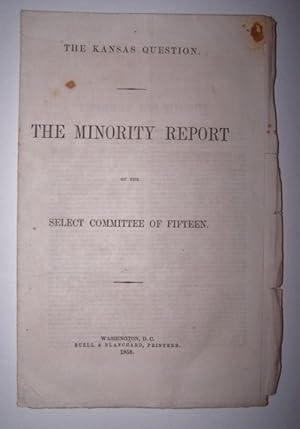
THE KANSAS QUESTION -- THE MINORITY REPORT of the Select Committee of Fifteen
Editore: Buell & Blanchard, Printers, Washington, 1858
Da: Antiquarian Bookshop, Washington, DC, U.S.A.
Valutazione del venditore 5 su 5 stelle
Prima edizione
Pamphlet. Condizione: Very Good. First Edition. 16 pages; Very good condition in original self wrappers; pages unopened, small stain at upper right corner of front wrapper. OCLC 43906948 This Minority Report of the Select Committee of Fifteen on the Kansas Question, particularly their opinion on the Lecompton Constitution which would admit Kansas as a slave-holding state and President Buchanan's aggressive support of it. The report presents the historical context of the Kansas Question along with the evidence undermining the validity of the Lecompton Constitution, based on the voter fraud afflicting its initial ratification in late 1857 and its clear defeat by more than 10,000 votes in the second referendum held in January 1858. "That the President has been misinformed and badly afvided 'in relation to the condition of parties in Kansas.' Thou he says 'a great delusion seems to pervade the public mind,' it is quite apparent that the public might with greater justice say,' thou theyself beholdest not the beam that is thine own eye.'" KANSAS QUESTION - Kansas Territory was officially established in 1854 with the passage of the Kansas-Nebraska Act. The act provided that each territory would decide the issue through the constitution under which it would enter the union. Kansas Territory, because of its proximity to Missouri, a slave state, became a political and literal battleground for pro- and anti-slavery forces. Contested elections, armed conflict, and recruitment of and support for settlers from both the North and the South contributed to the label of "Bleeding Kansas." The battle for Kansas was waged also in the halls of Congress, the national press, and anywhere people gathered to discuss or debate the issues of the day. All of this increased the tensions between the North and the South, which eventually led to the outbreak of the Civil War. The Kansas conflict further polarized the nation and weakened the American two-party political system, which was already unravelling under the pressures of sectionalism and westward expansion. The Democratic Party of Andrew Jackson, with its pro-Southern, state rights bent, was well entrenched, but the Whig Party of Henry Clay and Daniel Webster lost its sway during the late 1840s and early 1850s. Dissidents from both parties ultimately organized as the Free Soil Party in 1848, and the new party united around the Wilmot Proviso (a ban on slavery in the territory acquired as a result of the Mexican War). Although their candidate, former Democratic president Martin Van Buren, ran a distant third, the introduction of a significant third party was a harbinger of political things to come. In less than six years, despite the efforts of Clay, Webster, and others who fashioned the Compromise of 1850, the two party system reached its breaking point with the passage of the Kansas-Nebraska Act. During the months surrounding the 1856 election, several incidents in Kansas Territory and in Washington, D.C. drastically altered the national discourse. Civil war broke out in Kansas with the sacking of Lawrence and the subsequent Pottawatomie Massacre of May 1856; while in Congress, Massachusetts Senator Charles Sumner denounced the slave power and its "rape of Kansas" in his famous "Crime Against Kansas" speech. Throughout 1856 much congressional time and attention was given to the Kansas Question, especially as it pertained to the proposed free-state Topeka Constitution. Although the violence in Kansas subsided, sectional strife had risen to a new level. Immediately after the inauguration of President James Buchanan, the U.S. Supreme Court entered the fray. Chief Justice Roger B. Taney rendered the decision of the high court in Dred Scott v Sanford, which in effect held that slaves were not citizens of the U.S., residency in a "free" state did not alter their status, and that Congress had no authority to ban slavery in the territories. The decision made the Missouri Comprise unconstitutional. Drawing on the dissenting opinions of two Northern jurists, opposition to the decision was vehement. In 1857 the Lecompton Constitutional Convention eventually resulted in the ratification of a proslave constitution for Kansas, which badly split the national Democratic Party. Subsequently, anti-slavery Kansans were in the majority by January 1858 when they defeated the Lecompton Constitution in a second referendum. Despite this fact, President Buchanan submitted the Lecompton document to Congress and recommended that Kansas be admitted as a slave state. Many Northern Democrats, including the influential Senator Douglas, who recognized the violation of the principal of popular sovereignty in the Lecompton action, split with their party's president on this issue. Subsequently, the Senate voted for admission and the House for resubmission; a compromisethe English bill, providing for an up or down vote by territorial residents on the constitution passed both houses on April 30, and Kansas voters overwhelmingly rejected the Lecompton Constitution on August 2, 1858. Technically, because of Dred Scott, slavery remained legal in the territory of Kansas until admission; in reality, however, the free-state victory in the fall 1857 legislative elections and the defeat of the pro-slave constitution in 1858 settled the issue for Kansas. As Senator Douglas had indicated during one of his debates with Abraham Lincoln, slavery could not survive, no matter what the courts might say, in a territory where the majority was hostile to its continued existence. (Excerpted from "Territorial Kansas Online").
