
Importo totale (1 articolo articoli):
Destinazione ordine:

edited forsyth hardy (9 risultati)
Vai alla pagina principale dei risultati di ricerca
Filtri di ricerca
Tipo di articolo
- Tutti i tipi di prodotto
- Libri (9)
- Riviste e Giornali (Nessun altro risultato corrispondente a questo perfezionamento)
- Fumetti (Nessun altro risultato corrispondente a questo perfezionamento)
- Spartiti (Nessun altro risultato corrispondente a questo perfezionamento)
- Arte, Stampe e Poster (Nessun altro risultato corrispondente a questo perfezionamento)
- Fotografie (Nessun altro risultato corrispondente a questo perfezionamento)
- Mappe (Nessun altro risultato corrispondente a questo perfezionamento)
- Manoscritti e Collezionismo cartaceo (Nessun altro risultato corrispondente a questo perfezionamento)
Condizioni Maggiori informazioni
- Nuovo (Nessun altro risultato corrispondente a questo perfezionamento)
- Come nuovo, Ottimo o Quasi ottimo (2)
- Molto buono o Buono (7)
- Discreto o Mediocre (Nessun altro risultato corrispondente a questo perfezionamento)
- Come descritto (Nessun altro risultato corrispondente a questo perfezionamento)
Legatura
- Tutte
- Rilegato (9)
- Brossura (Nessun altro risultato corrispondente a questo perfezionamento)
Ulteriori caratteristiche
- Prima ed. (6)
- Copia autograf. (Nessun altro risultato corrispondente a questo perfezionamento)
- Sovracoperta (5)
- Con foto (5)
- Non Print on Demand (9)
Lingua (1)
Spedizione gratuita
- Spedizione gratuita in U.S.A. (Nessun altro risultato corrispondente a questo perfezionamento)
Paese del venditore
Valutazione venditore
-

Grierson on Documentary
Editore: University of California, Berkeley CA, 1965
Da: Chequamegon Books, Washburn, WI, U.S.A.
Valutazione del venditore 4 su 5 stelle

hardcover. Condizione: very good. Condizione sovraccoperta: very good. revised edition. 5 3/4 x 8 3/4 " 411 pages. ex library revised edition stamped on top edge of pages & title page. pocket on last page, stamped withdrawn old tape spots on inside front and rear covers and first and last pages. dj now in mylar protector.
-
Grierson on Documentary
Editore: New York: Harcourt, Brace & Co., 1947
Da: Betterbks/ COSMOPOLITAN BOOK SHOP, Burbank, CA, U.S.A.
Valutazione del venditore 5 su 5 stelle

Prima edizione
Hardcover. Condizione: Near Fine. Condizione sovraccoperta: Fair. 1st Edition. 1st American edition. Condition: DJ heavily chipped & worn; else near fine in fair DJ. 324 pages.
-

Grierson on Documentary
Editore: Harcourt, Brace and Company, New York, 1947
Da: Between the Covers-Rare Books, Inc. ABAA, Gloucester City, NJ, U.S.A.
Membro dell'associazione: ABAA ESA ILAB IOBA
Valutazione del venditore 5 su 5 stelle
Prima edizione
Hardcover. Condizione: Very Good. First American edition. American notes by Richard Griffith and Mary Losey. 324pp. Endpapers lightly foxed, text block edges slightly soiled, binding a bit cocked, very good, lacking the dust jacket. Writings of the Scottish documentary film pioneer John Grierson.
-
Grierson on Documentary
Editore: Collins, London, 1946
Da: KULTURAs books, Los Angeles, CA, U.S.A.
Valutazione del venditore 4 su 5 stelle
Prima edizione
Hardcover. Condizione: Very Good. Condizione sovraccoperta: Very Good. First Edition. Hardcover in dust jacket. 8vo. First printing. Book is crisp and clean, in slightly faded aqua cloth boards; small tear at spine. Top edge is a bit dusty. Former owner's name on front free endpage. Unclipped dust jacket has small chips along top and bottom edges and some minor loss at bottom of spine. Two newspaper obituaries are tucked onto the rear free endpage and pastedown page, for documentary filmmakers Lindsay Anderson and Basil Wright (one is glued in, the other is laid in) . Ninety two black and white illustrations (photos) . A nice copy of this historically significant work. 256 pp. Including index. In protective Mylar.
-
Grierson on Documentary
Editore: Collins, London, United Kingdom, 1946
Da: Olmstead Books, Port Dover, ON, Canada
Valutazione del venditore 5 su 5 stelle
Prima edizione
EUR 24,29
Spedizione EUR 6,74
Spedito da Canada a U.S.A.Quantità: 1 disponibili
Aggiungi al carrelloHardcover. Condizione: Very Good. Condizione sovraccoperta: Very Good Minus. 1st. Green cloth boards with black lettering. FIRST EDITION. The spine has faded. Previous owner's signature on the front free page. Illustrated with 92 illustrations. Introduction by Forsyth Hardy. The DJ has four tears to 2 cm. and a 2 cm. chip. The DJ is not price-clipped and is in a protective book jacket cover. 256 pages. Weight over 1 lb.
-
Grierson on Documentary
Editore: Collins, London, 1946
Da: Il Salvalibro, Foligno, PG, Italia
Valutazione del venditore 5 su 5 stelle
EUR 12,00
Spedizione EUR 33,00
Spedito da Italia a U.S.A.Quantità: 1 disponibili
Aggiungi al carrellohardcover. Condizione: Very Good. Edizione originale inglese / Original English edition - Volume in copertina rigida mancante di sovraccoperta, 256 pagine con 92 illustrazioni in nero su tavole fuori testo. A cura e con introduzione di Forsyth Hardy. Copia in ottimo stato. Book.
-
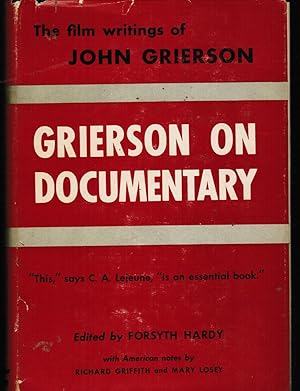
Grierson on Documentary
Editore: Harcourt, Brace, New York, 1947
Da: Autumn Leaves, Allentown, PA, U.S.A.
Valutazione del venditore 5 su 5 stelle
Prima edizione
Hardcover. Condizione: Near Fine. Condizione sovraccoperta: Very Good. First American Edition. A clean, crisp copy, with slight toning of the pages, but no signs of use or wear. The price-clipped jacket is lightly edgeworn, but still bright. A mylar Brodart cover now protects it. Fast shipping, with tracking number provided. ; 324 pages.
-

JOHN GRIERSON'S SCOTLAND
Editore: EDINBURGH: THE RAMSAY HEAD PRESS, 1979
Da: Haddington Rare Books, North Berwick, Regno Unito
Membro dell'associazione: ABA ILAB
Valutazione del venditore 5 su 5 stelle
EUR 17,79
Spedizione EUR 33,92
Spedito da Regno Unito a U.S.A.Quantità: 1 disponibili
Aggiungi al carrelloHardcover. Condizione: Very Good. 8vo, pp,217, gilt titled brown cloth, pictorial unclipped dust-jacket which has two small tears.
-
Cinema Quarterly: Vol. I (Nos. 1, 2, 3 & 4) & Vol. II (Nos. 1, 2, 3, & 4), 2. Vols. set (Complete) [FROM THE PERSONAL LIBRARY OF PAUL BURNFORD*]
Editore: G. D. Robinson, Edinburgh, 1933
Da: ERIC CHAIM KLINE, BOOKSELLER (ABAA ILAB), Santa Monica, CA, U.S.A.
Membro dell'associazione: ABAA ILAB
Valutazione del venditore 4 su 5 stelle
Prima edizione
Hardcover. Condizione: g+. First edition. Large octavo. 245, [3], [2], 262pp. Contemporary olive cloth, with gold lettering on spines. Paul Burnford's Ex Libris on inside of each front cover. Complete collection of the first eight issues (two years) of "Cinema Quarterly" a film magazine published in Edinburgh, Scotland between 1932 and 1935. Featuring regular contributions from John Grierson, Basil Wright, Stuart Legg and Alberto Cavalcanti, the magazine became a critical centre for the emerging British Documentary movement. Some of Grierson's defining pieces on Documentary cinema first appeared within these pages, championing and defining 'Documentary, or the creative treatment of actuality' as a 'new art.' Forsyth Hardy would serve as review editor and Paul Rotha as London correspondent. In later years, the magazine would increasingly include contributions from noted literary figures, including Graham Greene, Aldous Huxley, T.S. Eliot and Somerset Maugham. The magazine was renamed "World Film News and Television Progress" in 1936. After changing its name for three issues to "SEE: World Film News", the magazine ceased publication at the end of 1938. Each issue contains from 8 to 10 pages of b/w photographic reproductions depicting mostly movie scenes. Some of the documentaries and movies featured in this work are the following: Robert J. Flaherty's "Man of Aran;" Stuart Legg's "The New Generation;" Fritz Lang's "M;" Sergei M. Eisenstein's "Que Viva Mexico!;" Eric Waschneck's "Zwei Menschen;" Arthur Elton's "Voice of the World" (a documentary dealing with the manufacture of radio sets and the influence of wireless); E. Dzigan's "Woman" (a Soviet film dealing with the 'fuller' life experienced by women in the USSR); Andrew Buchanan's "Dance Flaws;" René Clair's "Le Quatorze Juillet;" G. W. Pabst's "Don Quixote;" Alexander Korda's "The Private Life of Henry VIII;" Rouben Mamoulian's "The Song of Songs;" George Roland's "The Wandering Jew;" Jean Vigo's "Zéro de Conduite;" Alfred Hitchcock's "Waltzes from Vienna;" Basil Wright's "Windmill in Barbados;" Pudovkin's "Deserter;" etc. Head and tail of spine rubbed and partly chipped. Moderate and sporadic age-toning along paper margin. Bindings in overall good-, interior in good+ to very good condition. *Paul Burnford (1914-1999) produced or directed over 100 academic films, on subjects ranging from zoology, to history, to art. Documentarians John Grierson and Paul Rotha offered Paul his first professional job as a film maker, and became his mentors. His first film was "Rooftops of London", followed by "Statues of London." Paul also made a film about the hardships of the miners in Wales, and later worked for MGM in London. Having made a name for himself as a documentary film maker, he was officered a job as head photographer at the London Zoo by Sir Julian Huxley, the famed biologist and scientist, and soon Burnford became known for his filming of animals. Many years later, when the San Diego zoo opened, Sir Julian was there to be honored for his work in modernizing zoos, and asked Paul to join him. Burnford later used the San Diego Zoo and Wild Animal Park in Escondido as locations for many of his films. In the mid-1930s, he edited Sergei Eisenstein's classic film "Qué Viva México." In 1939, when he was 25 years old, Burnford's book "Filming for Amateurs" was published, and was soon in use as a text book in the film school at the university of Southern California. In the World War II era, Burnford arrived in the U.S. as a drafted civilian, working for the British Ministry of Agriculture in conjunction with the U.S. Department of Agriculture. Based in Washington D.C., he was soon making films about crop conservation, flying over the Midwest and shooting various farmlands. He was never allowed to edit his film or even see a finished project, but instead was instructed to take his footage to an office in Rockefeller Center. Sometimes he, with film in hand, would board a camouflaged military transport, and be flown back to London, to deposit the film there. He was under strict orders not to contact any friends or family while in England. As later revealed in William Stevenson's "A Man Called Intrepid," microdots were placed on such films made by various filmmakers as a means of carrying intelligence between the United States and Great Britain. Through friend Sidney Solow, Burnford was introduced to Samuel Mayer, and soon began a short tenure as a director of short films at MGM, and worked on George Cukor's "It Should Happen to You." He also served a short stint at Columbia Pictures. Burnford soon realized that he wanted to run his own film company and be more in charge of the end product. Along with teacher Irwin (Irv) Braun, he founded Film Associates, a company specializing in educational films. Every film he made won an award. Paul was now recognized as one of the top educational film producers. Eventually, Film Associated was bought by CBS and merged with Bailey Films to become Bailey Film Associates (BFA). From that point onward, he worked as an independent producer.


![Immagine del venditore per Cinema Quarterly: Vol. I (Nos. 1, 2, 3 & 4) & Vol. II (Nos. 1, 2, 3, & 4), 2. Vols. set (Complete) [FROM THE PERSONAL LIBRARY OF PAUL BURNFORD*] venduto da ERIC CHAIM KLINE, BOOKSELLER (ABAA ILAB)](https://pictures.abebooks.com/inventory/md/md13710568234.jpg)