
Frederick warren freer (1 risultati)
Da: CorgiPack, Fulton, NY, U.S.A.CorgiPack
Contatta il venditoreVenditore con 4 stelleCondizione: Usato - Molto buono
EUR 139,13
Spedizione gratuitaSpedito in U.S.A.Quantità: 1 disponibili
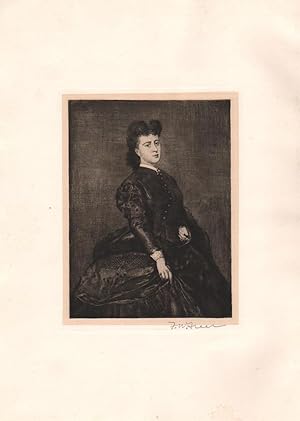
Original Etching. Condizione: VG. Overall size: 13.75" x 11.75"; Plate impression size: 8.25" x 6.5" Original etching after the painting by Mariano Fortuny. Printed upon fine hand made, laid paper and with full margins. Hand-signed in pencil by the etcher in the margin. About the artist/etcher: Son of a distinguished Chicago phy…sician who served as president of Rush Medical College, Frederick Warren Freer was encouraged to take up art after a childhood illness left him partially deaf. In 1867, his parents took Frederick and his sister Cora to Munich to study at the Royal Academy, then a popular art school for Americans. He began sending work to exhibits at the Chicago Academy of Design (predecessor of the Art Institute of Chicago) even before the family returned home, only weeks before the Great Fire of 1871. Two years later, Freer exhibited in the first Interstate Industrial Exposition art exhibition, and in 1876 he was elected to the Academy, a mark of his rising local reputation. On a second sojourn in Europe, between 1877 and 1880, Freer associated with some of America?s leading expatriate artists, notably Frank Duveneck, an influential exponent of the Munich style, and William Merritt Chase, a pioneer of American impressionist painting. On his return to the United States, Freer settled in New York City, became active in numerous artists? organizations, and exhibited widely. He worked in every genre of subject matter and explored a variety of media, including etching, pastel drawing, and watercolor painting; in the late 1880s, he was even in demand as a book illustrator. Following a third trip abroad, Freer taught at New York?s Art Students League. With his marriage, he began to specialize in images of women, for which his wife and their six children frequently served as models. The successful exhibition of one such work brought Freer election as an associate member of the National Academy of Design, and in 1889 he was represented in the Exposition Universelle in Paris. Possibly to take advantage of Chicago's plentiful art opportunities, Freer returned home in 1890. Thereafter, he used the brighter colors and distinct brush strokes of impressionism in some of his figural works and painted landscapes outdoors and on site, according to impressionist practice. Freer was a beloved instructor at the Art Institute where he began teaching in 1892. Busy with local portrait commissions, he continued to exhibit nationally and to serve on juries, including the national art jury for the 1893 World?s Columbian Exposition in Chicago. At the world?s fair, he won a medal, one of several honors from exhibitions at the National Academy, the Art Institute, and other venues. Freer was among a handful of artists of his generation who maintained a national presence while living in Chicago: ?One Of Chicago?s Own Boys?He Was Born Here and His Pictures Are Known the World Over,?? trumpeted the Chicago Evening Post in 1891.[i] The artist?s successful career was capped by a retrospective show presented at the Art Institute in early 1906, two years before his death at age fifty-eight. --Schwartz Collection.
