
Fremont john subject (2 risultati)
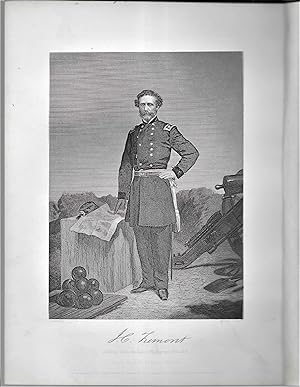
Lingua: Inglese
Editore: Johnson, Fry & Company, NY 1862
- Stampa artistica
Da: Legacy Books II, Louisville, KY, U.S.A.Legacy Books II
Contatta il venditoreVenditore con 4 stelleCondizione: Usato - Molto buono
EUR 22,02
EUR 5,06 spedizioneSpedito in U.S.A.Quantità: 1 disponibili
No Binding. Condizione: VG. Sized 8.25 x 11.25 inches, unsigned engraver, after the painting by Chappel, generally sharp, clean, and bright. Alonzo Chappel (illustratore).

TICKET. Steamer Fremont. For Salt River, via "Bleeding Kansas" This Ticket Entitles the Holder to a Free Passage up Salt River, on and after Novmber 5th, 1856.
[Political Satire]. "Beecher, Rev. Rifle, Agent." Frémont, John Charles [1813 - 1890] - Subject
Editore: (n. p.) 1856
- Rilegato
- Prima edizione
Da: Tavistock Books, ABAA, Reno, NV, U.S.A.Tavistock Books, ABAA
Contatta il venditoreVenditore con 5 stelleCondizione: Usato
EUR 734,32
EUR 6,48 spedizioneSpedito in U.S.A.Quantità: 1 disponibili
1st printing (presumed). 8 lines of type. Verso blank. Small cut of a river packet in center. Oblong format: 1-7/8" x 2-3/4" Presidential elections were held in the United States on November 4, 1856. Democratic nominee James Buchanan defeated Republican nominee John C. Frémont, nicknamed the "Woolly Horse", and Know Nothing/Whig… nominee Millard Fillmore. The main issue was the expansion of slavery as facilitated by the KansasNebraska Act of 1854. With slavery as the main issue, and with it came the question of the survival of the United States as it then existed. The Democrats were seen as the pro-slavery party. While the new Republican party was hostile to slavery, they limited their efforts to the politically more manageable question of the extension of slavery into federal territories (and its removal from the District of Columbia). The nativist Know Nothings (known formally as the American Party) competed with the Republicans to replace the moribund Whig Party as the primary opposition to the Democrats. They emphasized opposition to Catholic immigrants. The 1856 Republican National Convention nominated a ticket led by Frémont, an explorer and military officer who had served in the MexicanAmerican War. The Know Nothings, who ignored slavery and instead emphasized anti-immigration and anti-Catholic policies, nominated a ticket led by former Whig President Millard Fillmore. Domestic political turmoil was a major factor in the nominations of both Buchanan and Fillmore, who appealed in part because of their recent time abroad, when they did not have to take a position on the divisive questions related to slavery. Frémont won a majority of electoral votes from free states and finished second in the nationwide popular vote, while Fillmore took 21.5% of the popular vote but only carried Maryland. The Know Nothings soon collapsed as a national party, as most of its anti-slavery members joined the Republican Party after the 1857 Dred Scott v. Sandford Supreme Court ruling. This election marked the end of the Second Party System and also proved to be the last Democratic presidential victory until 1884, as Republicans emerged as the dominant party during and after the Civil War. The phrase 'to go up Salt River' or 'to be rowed up Salt River' is a colloquial political slogan or catchphrase originating from the Antebellum South era of the United States, with its earliest references from 1827 onwards. It was often used in political cartoons and speeches as a metaphor to symbolise political defeat, or even specifically synonymous with 'losing an election.' The satire of this ticket futher enhanced by the supposed agent's name, "Rifle Beecher", as this was a play on "the name given to the breech-loading Sharps rifle that were supplied to and used by the anti-slavery settlers and combatants in Kansas, during the Bleeding Kansas period (18541860)." This 'ticket' obviously used by Fremont's opposition, advising his potential supporters that voting for him would be fruitless, i.e., a loss in the election. An extremely rare survivor from this "Bleeding Kansas" period of 19th C America, e.g., we find no copy held by LCP in a search of their on-line Salt River Ephemera Collection database. Soiling & wear, with the top line of type a bit obscured. A Good copy. Now housed in an archival mylar sleeve.

