

Importo totale (1 articolo articoli):
Destinazione ordine:

gernot salzer (12 risultati)
Vai alla pagina principale dei risultati di ricerca
Filtri di ricerca
Tipo di articolo
- Tutti i tipi di prodotto
- Libri (12)
- Riviste e Giornali (Nessun altro risultato corrispondente a questo perfezionamento)
- Fumetti (Nessun altro risultato corrispondente a questo perfezionamento)
- Spartiti (Nessun altro risultato corrispondente a questo perfezionamento)
- Arte, Stampe e Poster (Nessun altro risultato corrispondente a questo perfezionamento)
- Fotografie (Nessun altro risultato corrispondente a questo perfezionamento)
- Mappe (Nessun altro risultato corrispondente a questo perfezionamento)
- Manoscritti e Collezionismo cartaceo (Nessun altro risultato corrispondente a questo perfezionamento)
Condizioni Maggiori informazioni
- Nuovo (9)
- Come nuovo, Ottimo o Quasi ottimo (Nessun altro risultato corrispondente a questo perfezionamento)
- Molto buono o Buono (3)
- Discreto o Mediocre (Nessun altro risultato corrispondente a questo perfezionamento)
- Come descritto (Nessun altro risultato corrispondente a questo perfezionamento)
Legatura
- Tutte
- Rilegato (Nessun altro risultato corrispondente a questo perfezionamento)
- Brossura (12)
Ulteriori caratteristiche
- Prima ed. (1)
- Copia autograf. (Nessun altro risultato corrispondente a questo perfezionamento)
- Sovracoperta (Nessun altro risultato corrispondente a questo perfezionamento)
- Con foto (6)
- Non Print on Demand (11)
Lingua (1)
Prezzo
- Qualsiasi prezzo
- Inferiore a EUR 20 (Nessun altro risultato corrispondente a questo perfezionamento)
- EUR 20 a EUR 45
- Superiore a EUR 45
Spedizione gratuita
Paese del venditore
Valutazione venditore
-
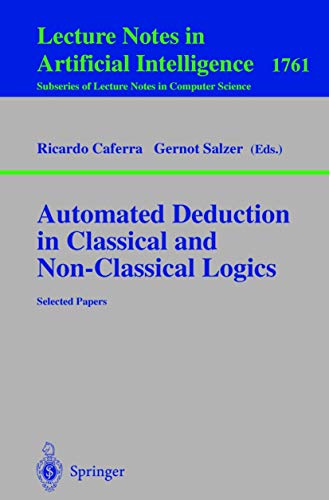
Automated Deduction in Classical and Non-Classical Logics : Selected Papers
Lingua: Inglese
Editore: Springer Berlin / Heidelberg, 2000
ISBN 10: 3540671900 ISBN 13: 9783540671909
Da: Better World Books, Mishawaka, IN, U.S.A.
Valutazione del venditore 5 su 5 stelle

Condizione: Good. Former library copy. Pages intact with minimal writing/highlighting. The binding may be loose and creased. Dust jackets/supplements are not included. Includes library markings. Stock photo provided. Product includes identifying sticker. Better World Books: Buy Books. Do Good.
-
Automated Deduction in Classical and Non-Classical Logics: Selected Papers (Lecture Notes in Computer Science / Lecture Notes in Artificial Intelligence)
Da: Redux Books, Grand Rapids, MI, U.S.A.
Valutazione del venditore 5 su 5 stelle
Paperback. Condizione: New. An Unused, unmarked and unblemished copy. Still in plastic packaging!; 100% Satisfaction Guaranteed! Ships same or next business day!
-
Automated deduction in classical and non-classical logic
Da: avelibro OHG, Dinkelscherben, Germania
Membro dell'associazione: BOEV
Valutazione del venditore 5 su 5 stelle
Prima edizione
EUR 37,00
Spedizione EUR 10,00
Spedito da Germania a U.S.A.Quantità: 1 disponibili
Aggiungi al carrello23,5 x 15,5 cm. Condizione: Gut. 1. Auflage. VIII, 297 Seiten Selected Papers. - Innen sauberer, guter Zustand. Softcover, Broschur mit den üblichen Bibliotheks-Markierungen, Stempeln und Einträgen, innen wie außen, siehe Bilder. Untere Ecke leicht geknickt. - Lecture Notes in Artificial Intelligence 1761. Subseries of Lectur Notes in Computer Science. DE-10-53 Sprache: Englisch Gewicht in Gramm: 420.
-
Automated Deduction in Classical and Non-Classical Logics: Selected Papers (Lecture Notes in Computer Science)
Da: GuthrieBooks, Spring Branch, TX, U.S.A.
Valutazione del venditore 5 su 5 stelle
Paperback. Condizione: Very Good. Ex-library paperback in nice condition with the usual markings and attachments. Text block clean and unmarked. Tight binding.
-
Automated Deduction in Classical and Non-Classical Logics: Selected Papers (Lecture Notes in Computer Science, 1761)
Da: Ria Christie Collections, Uxbridge, Regno Unito
Valutazione del venditore 5 su 5 stelle
EUR 58,85
Spedizione EUR 13,88
Spedito da Regno Unito a U.S.A.Quantità: Più di 20 disponibili
Aggiungi al carrelloCondizione: New. In.
-
Automated Deduction in Classical and Non-Classical Logics : Selected Papers
Da: Chiron Media, Wallingford, Regno Unito
Valutazione del venditore 5 su 5 stelle
EUR 57,01
Spedizione EUR 17,95
Spedito da Regno Unito a U.S.A.Quantità: 10 disponibili
Aggiungi al carrelloPF. Condizione: New.
-
Automated Deduction in Classical and Non-Classical Logics: Selected Papers
Da: Revaluation Books, Exeter, Regno Unito
Valutazione del venditore 5 su 5 stelle
EUR 79,20
Spedizione EUR 11,59
Spedito da Regno Unito a U.S.A.Quantità: 2 disponibili
Aggiungi al carrelloPaperback. Condizione: Brand New. 1st edition. 297 pages. 9.25x6.00x0.75 inches. In Stock.
-

Automated Deduction in Classical and Non-Classical Logics
Lingua: Inglese
Editore: Springer Berlin Heidelberg, 2000
ISBN 10: 3540671900 ISBN 13: 9783540671909
EUR 48,37
Spedizione EUR 48,99
Spedito da Germania a U.S.A.Quantità: Più di 20 disponibili
Aggiungi al carrelloCondizione: New.
-
EUR 53,49
Spedizione EUR 62,38
Spedito da Germania a U.S.A.Quantità: 1 disponibili
Aggiungi al carrelloTaschenbuch. Condizione: Neu. Druck auf Anfrage Neuware - Printed after ordering - Thisvolumeisacollectionofpapers onautomateddeduction inclassical,modal, and many-valued logics, with an emphasis on rst-order theories. Some authors bridgethe gaptohigher-order logicbydealingwithsimpletype theory ina r- order setting, or by resolving shortcomings of r st-order logic with the help of higher-order notions. Most papers rely on resolution or tableaux methods, with a few exceptions choosing the equational paradigm. In its entirety the volume is a mirror of contemporary research in r st-order theorem proving. One trend to be observed is the interest in e ective decision procedures. The main aim of rs t-order theorem proving was and still is to demonstrate the validity or unsatisa bility of formulas, by more and more - phisticatedmethods. Withinthelastyears,however,theothersideofthemedal{ falsi abilityand satisab ility { has r eceived growing attention. Though in g- eral non-terminating, theorem provers sometimes act as decision procedures on subclasses ofrs t-order logic. Inparticularcases theiroutputcanevenbeused to extract n ite representations of models or counter-examples. Another devel- mentistheextension ofdeductiontechniquesfromclassicallogictomany-valued and modal logics. By suitably generalizing classical concepts many results carry over to non-classical logics. This line of research is stimulated by artici al int- ligence with its need for more expressive logics capable of modeling real-world reasoning. From a formal point of view this volume comprises two types of papers, invited and contributed ones. Gilles Dowek, Melvin Fitting, Deepak Kapur, Alexander Leitsch, and David Plaisted accepted our invitation to present recent developments in and their view of the e ld. Contributed papers on the other hand underwent a two-staged selection process.
-

Automated Deduction in Classical and Non-Classical Logics
Lingua: Inglese
Editore: Springer Berlin Heidelberg, Springer Berlin Heidelberg Feb 2000, 2000
ISBN 10: 3540671900 ISBN 13: 9783540671909
Da: buchversandmimpf2000, Emtmannsberg, BAYE, Germania
Valutazione del venditore 5 su 5 stelle
EUR 53,49
Spedizione EUR 60,00
Spedito da Germania a U.S.A.Quantità: 2 disponibili
Aggiungi al carrelloTaschenbuch. Condizione: Neu. Neuware -Thisvolumeisacollectionofpapers onautomateddeduction inclassical,modal, and many-valued logics, with an emphasis on rst-order theories. Some authors bridgethe gaptohigher-order logicbydealingwithsimpletype theory ina r- order setting, or by resolving shortcomings of r st-order logic with the help of higher-order notions. Most papers rely on resolution or tableaux methods, with a few exceptions choosing the equational paradigm. In its entirety the volume is a mirror of contemporary research in r st-order theorem proving. One trend to be observed is the interest in e ective decision procedures. The main aim of rs t-order theorem proving was and still is to demonstrate the validity or unsatisa bility of formulas, by more and more - phisticatedmethods. Withinthelastyears,however,theothersideofthemedal{ falsi abilityand satisab ility { has r eceived growing attention. Though in g- eral non-terminating, theorem provers sometimes act as decision procedures on subclasses ofrs t-order logic. Inparticularcases theiroutputcanevenbeused to extract n ite representations of models or counter-examples. Another devel- mentistheextension ofdeductiontechniquesfromclassicallogictomany-valued and modal logics. By suitably generalizing classical concepts many results carry over to non-classical logics. This line of research is stimulated by artici al int- ligence with its need for more expressive logics capable of modeling real-world reasoning. From a formal point of view this volume comprises two types of papers, invited and contributed ones. Gilles Dowek, Melvin Fitting, Deepak Kapur, Alexander Leitsch, and David Plaisted accepted our invitation to present recent developments in and their view of the e ld. Contributed papers on the other hand underwent a two-staged selection process. 312 pp. Englisch.
-
EUR 50,25
Spedizione EUR 70,00
Spedito da Germania a U.S.A.Quantità: 5 disponibili
Aggiungi al carrelloTaschenbuch. Condizione: Neu. Automated Deduction in Classical and Non-Classical Logics | Selected Papers | Ricardo Caferra (u. a.) | Taschenbuch | Einband - flex.(Paperback) | Englisch | 2000 | Springer | EAN 9783540671909 | Verantwortliche Person für die EU: Springer-Verlag KG, Sachsenplatz 4-6, 1201 WIEN, ÖSTERREICH, productsafety[at]springernature[dot]com | Anbieter: preigu.
-
Automated Deduction in Classical and Non-Classical Logics
Lingua: Inglese
Editore: Springer Berlin Heidelberg Feb 2000, 2000
ISBN 10: 3540671900 ISBN 13: 9783540671909
Da: BuchWeltWeit Ludwig Meier e.K., Bergisch Gladbach, Germania
Valutazione del venditore 5 su 5 stelle
EUR 53,49
Spedizione EUR 23,00
Spedito da Germania a U.S.A.Quantità: 2 disponibili
Aggiungi al carrelloTaschenbuch. Condizione: Neu. This item is printed on demand - it takes 3-4 days longer - Neuware -Thisvolumeisacollectionofpapers onautomateddeduction inclassical,modal, and many-valued logics, with an emphasis on rst-order theories. Some authors bridgethe gaptohigher-order logicbydealingwithsimpletype theory ina r- order setting, or by resolving shortcomings of r st-order logic with the help of higher-order notions. Most papers rely on resolution or tableaux methods, with a few exceptions choosing the equational paradigm. In its entirety the volume is a mirror of contemporary research in r st-order theorem proving. One trend to be observed is the interest in e ective decision procedures. The main aim of rs t-order theorem proving was and still is to demonstrate the validity or unsatisa bility of formulas, by more and more - phisticatedmethods. Withinthelastyears,however,theothersideofthemedal{ falsi abilityand satisab ility { has r eceived growing attention. Though in g- eral non-terminating, theorem provers sometimes act as decision procedures on subclasses ofrs t-order logic. Inparticularcases theiroutputcanevenbeused to extract n ite representations of models or counter-examples. Another devel- mentistheextension ofdeductiontechniquesfromclassicallogictomany-valued and modal logics. By suitably generalizing classical concepts many results carry over to non-classical logics. This line of research is stimulated by artici al int- ligence with its need for more expressive logics capable of modeling real-world reasoning. From a formal point of view this volume comprises two types of papers, invited and contributed ones. Gilles Dowek, Melvin Fitting, Deepak Kapur, Alexander Leitsch, and David Plaisted accepted our invitation to present recent developments in and their view of the e ld. Contributed papers on the other hand underwent a two-staged selection process. 312 pp. Englisch.


