
Giles jessop (4 risultati)

- Rilegato
Da: BoundlessBookstore, Wallingford, , Regno UnitoBoundlessBookstore
Contatta il venditoreVenditore con 5 stelleCondizione: Usato - Buono
EUR 3,56
EUR 8,05 spedizioneSpedito da Regno Unito a U.S.A.Quantità: 1 disponibili
Condizione: Good. Good condition. Light wear to boards. Content is clean and bright. Good DJ with some edge wear and sun fading.

- Rilegato
Da: C & J Read - Books, Great Yarmouth, , Regno UnitoC & J Read - Books
Contatta il venditoreVenditore con 5 stelleCondizione: Usato - Molto buono
EUR 11,88
EUR 19,32 spedizioneSpedito da Regno Unito a U.S.A.Quantità: 1 disponibili
Hardcover. Condizione: Very Good. No Jacket. 4th Edition. pp.viii 192, illustrated with tables and graphs with loosely inserted correction charts for pages 58 and 92. Green boards, gilt with slight fading to spine.
 Altre immagini
Editore: Richard Bentley, London 1862
- Rilegato
- Prima edizione
Da: Michael Treloar Booksellers ANZAAB/ILAB, Adelaide, SA, AustraliaMichael Treloar Booksellers ANZAAB/ILAB
Contatta il venditoreVenditore con 5 stelleCondizione: Usato - Molto buono
EUR 629,14
EUR 20,91 spedizioneSpedito da Australia a U.S.A.Quantità: 1 disponibili
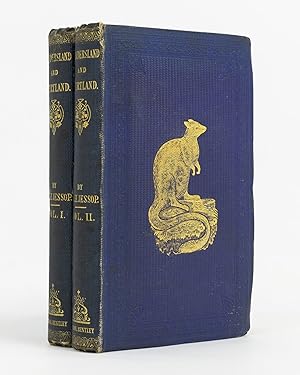
Hardcover. Condizione: Very Good. First Edition. London, Richard Bentley, 1862 (first edition, first issue). Octavo, two volumes, viii, 289 and x, 322 pages. Original navy blue textured cloth blocked in gilt and blind (with the large kangaroo illustration on the front covers particularly striking); all edges uncut; covers a litt…le bumped and marked, with slight wear at the extremities and the spines a little tanned; trifling signs of age and use; overall, an excellent set with the armorial bookplate of Edward Bennett on both front pastedowns, and a very small inkstamp ('Knox Collection') on the verso of both title pages. An adventurous tourist's travels in Australia in the late 1850s and early 1860s ('A detailed description of the South Eastern part of Australia, including station properties, social conditions, travel, aborigines, etc.' according to Ferguson), but there's much more . In the second volume (pages 233-50) Jessop records meeting two men at Wilpena 'on their way back to Adelaide, with the results of a private exploration. The leader, or scout, was named Giles, who was engaged by Mole, a man of more energy than money, to assist him in opening up some new part . [They] finally left the known country at Angipena, and entered upon the unknown in the direction of north-west . They were absent about a month from Angipena, and altogether, going and coming, passed over 1,200 miles'. The meeting is recorded in some detail, not least regarding contact with the Aborigines ('Giles said he was the first person in the Colony that vaccinated a black, and that it happened on this occasion'). Wantrup notes that this expedition 'does not appear to be elsewhere recorded and dates at least ten years before Giles's career became a matter of public record. Jessop supplies no precise date, but from the context it is clear that the expedition took place in the first half of 1859. Constituting the first appearance in print of the last of the great Australian explorers, it is well worth adding to an exploration library'. Wantrup 2023, pages 346-7; not in McLaren; see Ferguson 10938-41. [2 items].

Editore: London: Richard Bentley, 1862. 1862
- Rilegato
- Prima edizione
Da: Arader Galleries - AraderNYC, New York, NY, U.S.A.Arader Galleries - AraderNYC
Contatta il venditoreVenditore con 5 stelleCondizione: Usato
EUR 762,94
Spedizione gratuitaSpedito in U.S.A.Quantità: 1 disponibili
Hardcover. 1st Edition. GILES, Ernest (1835-1897) - JESSOP, William Rowlestone Henry (died 1862). Flindersland and Sturtland; or, the Inside and Outside of Australia. London: Richard Bentley, 1862. 2 volumes. 8vo., (8 x 4 7/8 inches). Half-titles. Original purple cloth, each front cover decorated with a fine and large gilt stamp… of a Quokka, by Edmonds & Remnants, with their ticket on the rear paste-down of the first volume (spine a little dulled, corners bumped). Provenance: with the 19th-century library label of J. Pythian on the front free endpaper of each volume; with the small ink library stamp of Hugh Selbourne, his sale, Bonhams, 8th March 2016, lot 261 First edition and a bright and attractive copy, principally because "In the twenty-fourth chapter of the second volume Jessop records in interesting and accurate detail an early expedition of one Ernest Giles whom the author met at Wilpena where Giles had stopped on his homeward trip from the north. This expedition, in the company of a Mr Mole, was from Adelaide to the northward in search of new pastoral land. It does not appear to be elsewhere recorded." (Wantrup). Although Giles made no major discoveries, "he is among the more interesting Australian explorers by virtue of his journals which, although overwritten, display a fine descriptive ability and constitute a record of inner experience as well as outward observation." (Louis Green, 'Giles, Ernest (18351897)', Australian Dictionary of Biography, National Centre of Biography, Australian National University). Jessop's style may also be described as 'overwritten'."I have a mortal hatred of any old place being called new. I do not like to see a greybearded old fellow using hair-dye; hence I have a great objection to these islands being christened New. It is a fond thing, vainly invented, and grounded upon no warrant, at least a very slender one, of antiquity, and is rather repugnant to science. Consequently, I hold the Dutch in abhorrence for having nicknamed the principal part of Australasia, the largest of all islands, New Holland. A noble comparison, forsooth!a brave christening this! A land, as dry as a bone, sandy, stony, burning hot; a wilderness, an earthly furnace; cloudless, windless, fruitless. This, according to the wise men of Dutchland, bears a strong resemblance to their own muddy, marshy, flat, damp, squashy, slushy Holland! What perversity of bodily sense could have operated in them to make so huge a blunder? They are ever slow-goes, they are more than a century behind other people, obstinate, strange, and covetous; without natural attachment for their country, which they once thought of quitting; with an inordinate hankering for what does not belong to them. Could they have been so foolish, coidd they have been so vain-glorious, so mighty fine, so perking, so blind to their own littleness, so contemptuous of others' greatness, as to suppose, to take for granted, that calling this country New Holland would make it theirs? Had they no knowledge of other people? Did they not feel that they were living of sufferance, and not of their own vigour? They should have been more respectful; a little modesty would have become them; it would have saved them from being treated with indifference" (page 20). Ferguson, 10940; Wantrup, pp. 265-7.


