
Hartom (13 risultati)
 Altre immagini
Lingua: Ebraico
Editore: Yavneh Publishing House Ltd., 82 Allenby Street, Tel Aviv, Israel 1962
- Rilegato
Da: Meir Turner, New York, NY, U.S.A.Meir Turner
Contatta il venditoreVenditore con 5 stelleCondizione: Usato - Discreto
EUR 7,25
EUR 8,80 spedizioneSpedito in U.S.A.Quantità: 1 disponibili
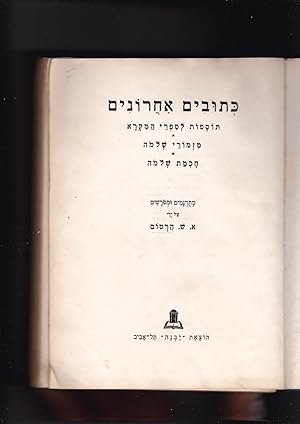
Hardcover. Condizione: Fair. No Jacket. In vowelized Hebrew. This is one volume of many. 219 pages. 235 x 170 mm. ENdpapers soilder with sh, from a fire. The boards, and to a lesser degree the leaves, have buckled from the water damage. Took block and all its pages are really in good condition. Jewish apocrypha includes texts wr…itten in the Jewish religious tradition either in the Intertestamental period or in the early Christian era, but outside the Christian tradition. It does not include books in the canonical Hebrew Bible, nor those accepted into the canon of some or all Christian faiths. Although Judaism historically insisted on the exclusive canonization of the 24 books in the Tanakh, it also claimed to have an oral law handed down from Moses. Certain circles in Judaism, such as the Essenes in Judea and the Therapeutae in Egypt, were said to have a "secret" literature. The Pharisees were also familiar with these texts. A large part of this "secret" literature was the apocalypses. Based on unfulfilled prophecies, these books were not considered scripture, but rather part of a literary form that flourished from 200 BCE to 100 CE. These works usually bore the names of ancient Hebrew worthies to establish their validity among the true writers' contemporaries. To reconcile the late appearance of the texts with their claims to great antiquity, alleged authors are represented as "shutting up and sealing" (Dan. xii. 4, 9) the works until the time of their fulfillment had arrived; as the texts were not meant for their own generations but for far-distant ages (also cited in Assumption of Moses i. 16-17). This literature was treasured by many Jewish enthusiasts, in some cases more so than the canonical scriptures. The book of 4 Ezra reinforces this theory: when Ezra was inspired to dictate the sacred scriptures that were destroyed in the overthrow of Jerusalem, "in forty days they wrote ninety-four books: and it came to pass when the forty days were fulfilled that the Highest spake, saying: the first that thou hast written publish openly that the worthy and unworthy may read it; but keep the seventy last that thou mayst deliver them only to such as be wise among the people; for in them is the spring of understanding, the fountain of wisdom and the stream of knowledge." (4 Ezra xiv. 44 sqq.) Such esoteric books are apocryphal, in the original conception of the term. In due course, the Jewish authorities drew up a canon. They marked other books off from those that claimed to be such without justification. Scholars Theodor Zahn, Emil Schürer, among others, stated that these secret books formed a class by themselves and were called "Genuzim". But the Hebrew verb does not mean "to hide" but "to store away", and is only used of things that are in themselves precious. Moreover, the phrase is unknown in Talmudic literature. The derivation of this idea from Judaism has therefore not yet been established. Writings that were wholly apart from scriptural texts, such as the books of heretics or Samaritans, were designated as "khitsonim" (literally: external) by The Mishnah Sanh. x. and reading them was forbidden. After the 3rd century CE, Sirach and other apocryphal books were included in this category; until then, Sirach was largely quoted by rabbis in Palestine, indicating some change in this classification throughout the centuries. In the following centuries, these apocrypha fell out of use in Judaism. Although they are Jewish literature, the apocrypha were actively preserved through the Middle Ages exclusively by Christians.

Editore: Defus ha-Ir ha-Atikah, Jerusalem 1966
- Rilegato
Da: Henry Hollander, Bookseller, Los Angeles, CA, U.S.A.Henry Hollander, Bookseller
Contatta il venditoreVenditore con 4 stelleCondizione: Usato - Molto buono
EUR 13,60
EUR 6,16 spedizioneSpedito in U.S.A.Quantità: 1 disponibili
Hardbound. Condizione: Very Good. Octavo in dust jacket, 167 pp., bibliography Text is in Hebrew.
Lingua: Inglese
Editore: Michigan Art Education Association, Michigan
- Brossura
Da: Take Five Books, Ashland, OR, U.S.A.Take Five Books
Contatta il venditoreVenditore con 5 stelleCondizione: Usato - Molto buono
EUR 26,29
EUR 4,39 spedizioneSpedito in U.S.A.Quantità: 1 disponibili
Soft cover. Condizione: Very Good-. Circa 1990. Oblong. Reader's crease. Expedited or International shipping may cost more.

Editore: Yavneh Publishing House 1954
- Rilegato
Da: Bookshop Baltimore, Baltimore, MD, U.S.A.Bookshop Baltimore
Contatta il venditoreVenditore con 5 stelleCondizione: Usato - Buono
EUR 16,32
EUR 5,28 spedizioneSpedito in U.S.A.Quantità: 1 disponibili
Hardcover. No Dust Jacket. Hebrew text, Clean book, good binding. Sifre ha-Mikrah - contains Sefer Yehoshua and Sefer Shoftim; Sifrey Ha-Mikra.
Editore: Yavneh Publishing House Ltd., Tel Aviv 1962
- Rilegato
Da: Dunaway Books, St. Louis, MO, U.S.A.Dunaway Books
Contatta il venditoreVenditore con 4 stelleCondizione: Usato - Buono
EUR 19,04
EUR 3,52 spedizioneSpedito in U.S.A.Quantità: 1 disponibili
Hardcover. Condizione: Good. Condizione sovraccoperta: Good. Text in Hebrew. 8vo in dark blue covers. Hebrew text is vowelized, making for an easier read. In addition to works attributed to Solomon, includes the book of Baruch, additions to the books of Esther, Daniel and Ezra, and Psalm 151, among others. Dust jacket has minor…tears at edges, has a piece of tape on bottom left corner cover.
Editore: Yavneh Publoshing House
Da: Wonder Book, Frederick, MD, U.S.A.Wonder Book
Contatta il venditoreVenditore con 5 stelleCondizione: Usato - Molto buono
EUR 25,79
Spedizione gratuitaSpedito in U.S.A.Quantità: 1 disponibili
Condizione: Very Good. Very Good condition. Acceptable dust jacket. Hebrew edition. (books in hebrew, torah, isaiah, judaism) A copy that may have a few cosmetic defects. May also contain light spine creasing or a few markings such as an owner's name, short gifter's inscription or light stamp.

- Rilegato
Da: Grimbergen Booksellers, Lisse, Paesi BassiGrimbergen Booksellers
Contatta il venditoreVenditore con 3 stelleCondizione: Usato
EUR 12,00
EUR 23,00 spedizioneSpedito da Paesi Bassi a U.S.A.Quantità: 1 disponibili
Hardcover. 219 pp. [Hebrew title page on photo].
 Altre immagini
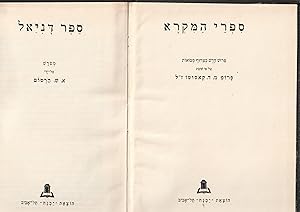
sefer DANIEL; sefer EZRA; sefer NHEHEMIA [in the series:] Sifrey HaMikra : perush khadash betseruf mevo'ot al pi shitat Professor M.D. Cassuto, zikhrono liverakha
Hartom, E.S., interpreted by, (Elia Samuele Artom (15 June1887 Turin, Italy - 25 February 1965, Rome, Italy)
Lingua: Ebraico
Editore: Yavneh Publishing House, 82, Allenby Street, Tel Aviv, Israel 1956
- Rilegato
Da: Meir Turner, New York, NY, U.S.A.Meir Turner
Contatta il venditoreVenditore con 5 stelleCondizione: Usato - Molto buono
EUR 35,36
EUR 8,80 spedizioneSpedito in U.S.A.Quantità: 1 disponibili
Hardcover. Condizione: Very Good. In Hebrew, vowelized (with nikud, with the vowels). DANIEL: 80 pages. EZRA and NEHEMIA 80 pages. 241 x 177 mm. Dust jacket has broken up into several pieces. (Elia Samuele Artom (15 June1887 Turin, Italy - 25 February 1965, Rome, Italy) was an Italian rabbi and author. He graduated from the Rabb…inical College in Florence and served as rabbi in various communities, including Tripoli, Libya, 1920-1923 and Florence 1926-1935, where he also taught at the university and at the Rabbinical College. He settled in Mandatory Palestine in 1939, but from 1953 to 1965 he spent part of the year in Italy, teaching at the Rabbinical Schools of Turin and Rome. Among his many pupils was his son Emanuele. Artom's son Reuven was killed in the battle of Motza during the Israel War of Independence in 1948. A close friendship bound Artom to the distinguished scholar Umberto Cassuto, who was his brother-in-law. Artom's work includes numerous biblical studies, and he also wrote on literature, grammar, history, halakhah, and Jewish thought. Artom's major work is a Hebrew commentary, with introduction, to the Bible and a Hebrew translation, commentary, and introduction to the Apocrypha (1958-1967).
 Altre immagini
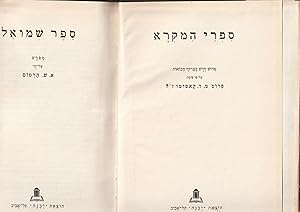
sefer Shmuel {Book of Samuel] [in the series:] Sifrey HaMikra : perush khadash betseruf mevo'ot al pi shitat Professor M.D. Cassuto, zikhrono liverakha
Hartom, E.S., interpreted by, (Elia Samuele Artom (15 June1887 Turin, Italy - 25 February 1965, Rome, Italy)
Lingua: Ebraico
Editore: Yavneh Publishing House, 82, Allenby Street, Tel Aviv, Israel 1955
- Rilegato
Da: Meir Turner, New York, NY, U.S.A.Meir Turner
Contatta il venditoreVenditore con 5 stelleCondizione: Usato - Molto buono
EUR 35,36
EUR 8,80 spedizioneSpedito in U.S.A.Quantità: 1 disponibili
Hardcover. Condizione: Very Good. Condizione sovraccoperta: Good. In Hebrew, vowelized (with nikud, with the vowels). 179 pages. 241 x 177 mm. (Elia Samuele Artom (15 June1887 Turin, Italy - 25 February 1965, Rome, Italy) was an Italian rabbi and author. He graduated from the Rabbinical College in Florence and served as rabbi in… various communities, including Tripoli, Libya, 1920-1923 and Florence 1926-1935, where he also taught at the university and at the Rabbinical College. He settled in Mandatory Palestine in 1939, but from 1953 to 1965 he spent part of the year in Italy, teaching at the Rabbinical Schools of Turin and Rome. Among his many pupils was his son Emanuele. Artom's son Reuven was killed in the battle of Motza during the Israel War of Independence in 1948. A close friendship bound Artom to the distinguished scholar Umberto Cassuto, who was his brother-in-law. Artom's work includes numerous biblical studies, and he also wrote on literature, grammar, history, halakhah, and Jewish thought. Artom's major work is a Hebrew commentary, with introduction, to the Bible and a Hebrew translation, commentary, and introduction to the Apocrypha (1958-1967).
 Altre immagini
sefer baMidbar [in the series:] Sifrey HaMikra : perush khadash betseruf mevo'ot al pi shitat Professor M.D. Cassuto, zikhrono liverakha
Hartom, E.S., interpreted by, (Elia Samuele Artom (15 June1887 Turin, Italy - 25 February 1965, Rome, Italy)
Lingua: Ebraico
Editore: Yavneh Publishing House, 82, Allenby Street, Tel Aviv, Israel 1956
- Rilegato
Da: Meir Turner, New York, NY, U.S.A.Meir Turner
Contatta il venditoreVenditore con 5 stelleCondizione: Usato - Molto buono
EUR 35,36
EUR 8,80 spedizioneSpedito in U.S.A.Quantità: 1 disponibili
Hardcover. Condizione: Very Good. Condizione sovraccoperta: Good. In Hebrew, vowelized (with nikud, with the vowels). 124 pages. 241 x 177 mm. (Elia Samuele Artom (15 June1887 Turin, Italy - 25 February 1965, Rome, Italy) was an Italian rabbi and author. He graduated from the Rabbinical College in Florence and served as rabbi in… various communities, including Tripoli, Libya, 1920-1923 and Florence 1926-1935, where he also taught at the university and at the Rabbinical College. He settled in Mandatory Palestine in 1939, but from 1953 to 1965 he spent part of the year in Italy, teaching at the Rabbinical Schools of Turin and Rome. Among his many pupils was his son Emanuele. Artom's son Reuven was killed in the battle of Motza during the Israel War of Independence in 1948. A close friendship bound Artom to the distinguished scholar Umberto Cassuto, who was his brother-in-law. Artom's work includes numerous biblical studies, and he also wrote on literature, grammar, history, halakhah, and Jewish thought. Artom's major work is a Hebrew commentary, with introduction, to the Bible and a Hebrew translation, commentary, and introduction to the Apocrypha (1958-1967).
Torah, Nevi'im, Ketuvim meforashim perush hadash betseruf mevo'ot, 16 Volumes
ed. by Umberto Cassuto and commentary by Elia Samuel Artom (Hartom)
Lingua: Ebraico
Editore: Yavneh Publishing House Ltd., Tel Aviv 1958
- Rilegato
Da: Library of Religious Thought, Omaha, NE, U.S.A.Library of Religious Thought
Contatta il venditoreVenditore con 5 stelleCondizione: Usato - Buono
EUR 199,45
EUR 2,64 spedizioneSpedito in U.S.A.Quantità: 1 disponibili
Hardcover. Condizione: Good. Condizione sovraccoperta: Fair. Published 1958-64. Dustjackets have shelfwear. Numbers volume has water damage, one or two others may have minor moisture retention, some toning.
Torah, Nevi'im, Ketuvim meforashim perush hadash betseruf mevo'ot, 16 Volumes
ed. by Umberto Cassuto and commentary by Elia Samuel Artom (Hartom)
Lingua: Ebraico
Editore: Yavneh Publishing House Ltd., Tel Aviv 1964
- Rilegato
Da: Library of Religious Thought, Omaha, NE, U.S.A.Library of Religious Thought
Contatta il venditoreVenditore con 5 stelleCondizione: Usato - Buono
EUR 290,10
EUR 2,64 spedizioneSpedito in U.S.A.Quantità: 1 disponibili
Hardcover. Condizione: Good. Condizione sovraccoperta: Good. Published 1964-1970. Some shelfwear to dustjackets, Chronicles volume is crimped a little at top corner.
 Altre immagini
TANAKH. Torah, Nevi'im, Ketuvim meforashim perush hadash betseruf mevo'ot. Complete set 20 parts in 15 volumes. 1. Be-reshit 2. Shemot 3. Va-yikra 4. Be-midbar 5. Devarim 6. Yehoshua 7. Shoftim 8. Shemu'el 9. Melakhim 10. Yeshayah 11. Yirmeyah 12. Yehezkel 13. Tere Asar 14. Tehilim 15. Mishle 16. Iyov 17. Hamesh Megilot 18. Daniyel 19. Ezra u-Nehemyah 20. Divre ha-Yamim
Cassuto, Umberto (Moses David) (editor) ; Hartom (Artom), Elia Samuel (Commentary)
Da: Antiquariaat Spinoza, Amsterdam, Paesi BassiAntiquariaat Spinoza
Contatta il venditoreVenditore con 5 stelleCondizione: Usato
EUR 260,00
EUR 16,00 spedizioneSpedito da Paesi Bassi a U.S.A.Quantità: 1 disponibili
Tel Aviv, Yavneh - Orenstein, 1972-1976. 24,5x 17,5. Paper of some volumes slightly age-yellowed. Small handwritten name and date on fep's. Owner's stamps on copyright-pages. Else clean and very good. Hardcovers, dustj. lacking. Corners slightly bumped with occasionally minor wear. HEBREW. Complete vowelized Tenach. Heavy item.…For shipment outside Europe, extra shipping-charges are required. Complete Hebrew bible in 15 volumes.


