
Hay jean editor (8 risultati)

INTERNATIONAL JOURNAL OF AFRICAN HISTORICAL STUDIES: VOLUME 33, NUMBER 3 (2000.)
Hay, Jean, editor. (Jama Mohammed, Heidi Gengenbach and others, contributors.)
Lingua: Inglese
Editore: African Studies Center, Boston, 2000
- Brossura
- Prima edizione
Da: Bookfever, IOBA (Volk & Iiams), Ione, CA, U.S.A.Bookfever, IOBA (Volk & Iiams)
Contatta il venditoreVenditore con 5 stelleCondizione: Usato - Ottimo
EUR 16,70
EUR 4,34 spedizioneSpedito in U.S.A.Quantità: 1 disponibili
Condizione: FINE. First appearance in print of these works. A journal devoted to the study of Africa's past from prehistoric archeology to modern problems, and to the interaction between Africa and the Afro-American people of the new world. This issue includes articles on Winnie Mandela and the 1976 Soweto uprising, on women's n…aming practices in Mozambique, the 1937 Somaliland camel corps mutiny and more. Book reviews. Index for Volume 33. pp 513-758. Near fine in glossy red wrappers (slight curling to edges.).
Lingua: Inglese
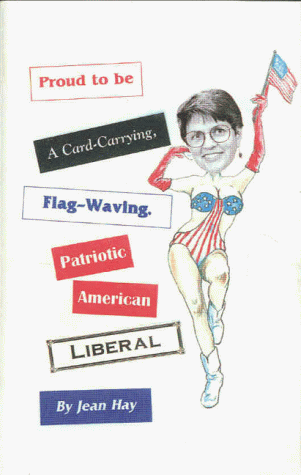
Editore: Jean Hay for Congress/ U. S. Senate (BrightBerry Press), 1996
- Brossura
Da: Sperry Books, Rollinsford, NH, U.S.A.Sperry Books
Contatta il venditoreVenditore con 5 stelleCondizione: Usato - Come nuovo
EUR 21,17
Spedizione gratuitaSpedito in U.S.A.Quantità: 1 disponibili
Paperback. Condizione: As New. Jean Hay for Congress/ Jean Hay for U. S. Senate 1996 paperback, fine cover, smooth spine, tight binding, clean text Prompt, reliable service, shipped next business day. Int'l mailed via first class or priority.
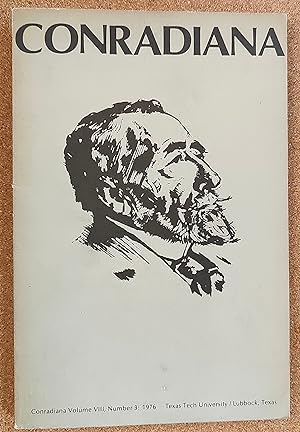
Conradiana A Journal of Joseph Conrad 1976 Volume VIII, Number 3 / Eloise Knapp Hay "Conrad's Self-Portraiture" / John S Lewis "'Artless Photos': Two Previously Unknown Photographs of Joseph Conrad" / Mario Curreli "Four Unpublished Conrad Letters" / Jean-Pierre Cap "A Conrad Letter to Henri Gheon" / Wray C Herbert "Conrad's Psychic Landscape: The Mythic Element in 'Karain'" / C Ponnuthurai Sarvan "Under African Eyes" / Dwight H Purdy "Creature and Creator in 'Under Western Eyes" / Allen F Stein "Conrad's Debt to Cooper: The Sea Lions and 'The Secret Sharer'" / Daniel E Lees "Conrad's Unpublished Pen and Ink Sketches for The Secret Agent: A Drama" / Hans van Marle "Conrad's English Lodgings, 1880-1896" / James Walt "At Home with Jessie Conr
David Leon Higdon (Editor) / Eloise Knapp Hay "Conrad's Self-Portraiture" / John S Lewis "'Artless Photos': Two Previously Unknown Photographs of Joseph Conrad" / Mario Curreli "Four Unpublished Conrad Letters" / Jean-Pierre Cap "A Conrad Letter to Henri Gheon" / Wray C Herbert "Conrad's Psychic Landscape: The Mythic Element in 'Karain'" / C Ponnuthurai Sarvan "Under African Eyes" / Dwight H Purdy "Creature and Creator in 'Under Western Eyes" / Allen F Stein "Conrad's Debt to Cooper: The Sea Lions and 'The Secret Sharer'" / Daniel E Lees "Conrad's Unpublished Pen and Ink Sketches for The Secret Agent: A Drama" / Hans van Marle "Conrad's English Lodgings, 1880-1896" / James Walt "At Home with Jessie Conrad" / Roger Little "A Letter about Con
Editore: Texas Tech University Press, 1976
- Brossura
- Periodico
Da: Shore Books, London, Regno UnitoShore Books
Contatta il venditoreVenditore con 5 stelleCondizione: Usato - Molto buono
EUR 18,14
EUR 12,91 spedizioneSpedito da Regno Unito a U.S.A.Quantità: 1 disponibili
Soft cover. Condizione: Very Good. 105 pages. Eloise Knapp Hay "Conrad's Self-Portraiture" / John S Lewis "'Artless Photos': Two Previously Unknown Photographs of Joseph Conrad" / Mario Curreli "Four Unpublished Conrad Letters" / Jean-Pierre Cap "A Conrad Letter to Henri Gheon" / Wray C Herbert "Conrad's Psychic Landscape: The M…ythic Element in 'Karain'" / C Ponnuthurai Sarvan "Under African Eyes" / Dwight H Purdy "Creature and Creator in 'Under Western Eyes" / Allen F Stein "Conrad's Debt to Cooper: The Sea Lions and 'The Secret Sharer'" / Daniel E Lees "Conrad's Unpublished Pen and Ink Sketches for The Secret Agent: A Drama" / Hans van Marle "Conrad's English Lodgings, 1880-1896" / James Walt "At Home with Jessie Conrad" / Roger Little "A Letter about Conrad by Saint-John Perse" / Lyman Owen "Conrad and A Safroni-Middleton". (SL#82).
Editore: National Science Foundation and the University of California., 1984
- Rilegato
Da: Eryops Books, Stephenville, TX, U.S.A.Eryops Books
Contatta il venditoreVenditore con 5 stelleCondizione: Usato - Buono
EUR 28,83
EUR 5,26 spedizioneSpedito in U.S.A.Quantità: 1 disponibili
Hardcover. Condizione: Good. Hardcover; ex-library; minor edgewear w/ corners bumped; o/w contents in very good condition. This is a heavy volume; extra shipping may be required for priority mail or international orders. Book.
Editore: National Science Foundation and the University of California., 1984
- Rilegato
Da: Eryops Books, Stephenville, TX, U.S.A.Eryops Books
Contatta il venditoreVenditore con 5 stelleCondizione: Usato - Buono
EUR 28,83
EUR 5,26 spedizioneSpedito in U.S.A.Quantità: 1 disponibili
Hardcover. Condizione: Good. Hardcover; owner's stamp; light foxing spots on endpages and edges; o/w in good condition. This is a heavy volume; extra shipping may be required for priority mail or international orders. Book.
Initial Reports of the Deep Sea Drilling Project. Volume LXXV, Part 1. Covering Leg 75. Walvis Bay, South Africa to Recife, Brazil, July - September, 1980.
Amidei, Rosemary ( Editor ), William W. Hay, Jean - Claude Sibuet, Eric J. Barron and Others and Deep Sea Drilling Project ( DSDP, D.S.D.P.).
Editore: National Science foundation and University of California, 1984, 544 Pp., 1984
- Rilegato
Da: Eryops Books, Stephenville, TX, U.S.A.Eryops Books
Contatta il venditoreVenditore con 5 stelleCondizione: Usato - Molto buono
EUR 31,54
EUR 5,26 spedizioneSpedito in U.S.A.Quantità: 1 disponibili
Hard Cover. Condizione: Very Good. No Jacket. Hardcover; ex-library; minor shelfwear w/ corners bumped; o/w in very good condition. This is a heavy book; extra postage may be required for priority mail or international orders.
Initial Reports of the Deep Sea Drilling Project, Volume LXXV, Part 2, Covering Leg 75. Walvis Bay, South Africa to Recife, Brazil.
Amidei, Rosemary ( Editor ), Robert E. Boyce, William W. Hay, Jean - Claude Sibuet and Others and Deep Sea Drilling Project ( D. S. D. P. ; DSDP).
Editore: National Science Foundation and University of California, 1984, Pp. 547 - 1303., 1984
- Rilegato
Da: Eryops Books, Stephenville, TX, U.S.A.Eryops Books
Contatta il venditoreVenditore con 5 stelleCondizione: Usato - Molto buono
EUR 31,54
EUR 5,26 spedizioneSpedito in U.S.A.Quantità: 1 disponibili
Hard Cover. Condizione: Very Good. No Jacket. Hardcover; part 2 only; ex-library; minor shelfwear w/ lightly bumped corners; o/w in very good condition.
 Altre immagini
Editore: Chez Basan Graveur, Paris, 1714
- Rilegato
Da: Donald A. Heald Rare Books (ABAA), New York, NY, U.S.A.Donald A. Heald Rare Books (ABAA)
Contatta il venditoreVenditore con 5 stelleCondizione: Usato
EUR 72.180,96
EUR 21,90 spedizioneSpedito in U.S.A.Quantità: 1 disponibili
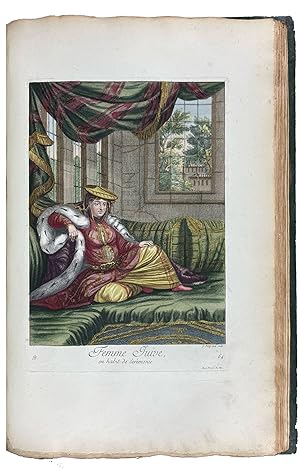
Folio. (21 x 13 1/2 inches). Cars's edition. [2] [I]-[XVI] [1-210] 228 pp. 114 ff. 102 hand-colored engraved plates extensively heightened with gold and mica chips, numbered 1-100, 2 unnumbered, and 3 are double-page. The engravings are by Bernard Baron (1696-1762), Charles-Nicolas Cochin (1688-1754), Jacques de Franssieres (fl.…1670-1730), Claude Du Bosc (1682-1745), Jean-Baptise Haussard (c.1680-1749), Pierre de Rochefort (1673-1728), Gerard Scotin the Older (1643-1715) and Younger (c.1698-1755), and Philippe Simmoneau (c.1685-1753), after Jean-Baptiste Van Mour. Title, Preface, Anecdotes de l'Ambassade, Explication des Figures, Music Sheet, 102 hand-colored engravings. Quarter green morocco with tips, straight-grain paper boards with gilt roll-tooled borders, spine in seven gilt-ruled compartments with title in second compartment and gilt device of a lyre in the rest, edges uncut A beautiful example of the expanded edition, uncut with all the plates finely colored and many luxuriously heightened with gold and mica chips, of Le Hay, de Ferriol, and Van Mour's landmark Turqurie work depicting the costume of the Ottoman Empire. The greatest color-plate book of the Ottoman Empire, the Recueil has 99 typological portraits and 3 scenes of Ottoman life at the dawn of the Tulip Era after paintings by Jean-Baptiste Van Mour. Van Mour was a Flemish-French painter who studied with Jacques-Albert Gérin (d.1702) and lived in Constantinople from the early-1700s until his death in 1737. One hundred of Van Mour's highly successful paintings were commissioned by the Marquis Charles de Ferriol between 1699 and 1709, while de Ferriol was the French ambassador to the Porte. De Ferriol represented Louis XIV in the Ottoman Empire at Hungary and Constantinople from 1692-1711 during the rule of Sultan Ahmed III. De Ferriol then worked with the artist and publisher Jacques Le Hay to have a roster of well-regarded printmakers execute engravings after Van Mour's paintings, and to publish the resulting collection. The project was so well-received that Van Mour was granted the unique post of "Peintre Ordinaire du Roi en Levant" in 1725. The plates after Van Mour depict Ottomans in the costumes of the Turkish court, nobility, and military, as well as of the distinctive regional, religious, and ethnic identities found in the diverse Empire. These include portraits of the Chief Eunuch; a Turkish man cutting his arm to prove his love for his mistress; Turkish women playing a form of backgammon; Dervishes whirling; an Albanian soldier; and a merchant in a bazaar feeding six cats. Van Mour's paintings, and the plates which were derived from them, show Constantinople as a cosmopolitan cultural center where Muslims and non-Muslims unite in shared Ottoman pleasures. Armenians, Franks, Greeks, and Persians drink coffee, make music, and dance together. The diverse peoples depicted here include Greeks (10); Armenians (5); Barbary Coast (4); Jews (3); Wallachians (3); Albanians (2); Hungarians (2); Bulgarians (2); Persians (2); Indians (2); Crimean Tartars (1); Arabs (1); and Moors (1). The Recueil enjoyed widespread popularity and dissemination and became the "basic prototype for Levantine costume plates." [Atabey] It was in part responsible for the vogue for Turquerie, or European images of Turkish Ottoman life, a form of exoticism popular in the Rococo period, which prefigured the Orientalist craze which would come to dominate much of European painting in the 1800s. The Recueil's use as a sourcebook by artists and publishers of other European texts was rampant. The work was translated into at least five languages, including the German edition printed at Nuremberg in 1719-21, and Italian and Spanish pirated editions. The plates were used by Thomas Jeffreys in his Collection of the Dresses of Different Nations in 1757 and by Viero in his Raccolta, published in Venice in 1783. Most copies were issued uncolored, and these are still the majority of copies seen today. A few w.


