Importo totale (1 articolo articoli):
Destinazione ordine:

j a jerome henry (6 risultati)
Vai alla pagina principale dei risultati di ricerca
Filtri di ricerca
Tipo di articolo
- Tutti i tipi di prodotto
- Libri (6)
- Riviste e Giornali (Nessun altro risultato corrispondente a questo perfezionamento)
- Fumetti (Nessun altro risultato corrispondente a questo perfezionamento)
- Spartiti (Nessun altro risultato corrispondente a questo perfezionamento)
- Arte, Stampe e Poster (Nessun altro risultato corrispondente a questo perfezionamento)
- Fotografie (Nessun altro risultato corrispondente a questo perfezionamento)
- Mappe (Nessun altro risultato corrispondente a questo perfezionamento)
- Manoscritti e Collezionismo cartaceo (Nessun altro risultato corrispondente a questo perfezionamento)
Condizioni Maggiori informazioni
- Nuovo (1)
- Come nuovo, Ottimo o Quasi ottimo (Nessun altro risultato corrispondente a questo perfezionamento)
- Molto buono o Buono (2)
- Discreto o Mediocre (Nessun altro risultato corrispondente a questo perfezionamento)
- Come descritto (3)
Legatura
- Tutte
- Rilegato (3)
- Brossura (Nessun altro risultato corrispondente a questo perfezionamento)
Ulteriori caratteristiche
Lingua (2)
Spedizione gratuita
Paese del venditore
Valutazione venditore
-

Modern British Bridges
Editore: The Adelphi
Da: ThriftBooks-Dallas, Dallas, TX, U.S.A.
Valutazione del venditore 5 su 5 stelle

Hardcover. Condizione: Good. No Jacket. Former library book; Missing dust jacket; Pages can have notes/highlighting. Spine may show signs of wear. ~ ThriftBooks: Read More, Spend Less.
-
Modern British Bridges
Lingua: Inglese
Editore: Henry, Dorothy & Jerome, J A, 1965
Da: Riveting Books, Southsea, HAMPS, Regno Unito
Valutazione del venditore 5 su 5 stelle
Prima edizione
EUR 19,10
Spedizione EUR 28,97
Spedito da Regno Unito a U.S.A.Quantità: 1 disponibili
Aggiungi al carrelloHardcover. Condizione: Very Good +. Condizione sovraccoperta: Very Good +. 1st. Dust Jacket: Yes. Unclipped. External Condition: Some wear to the corners and edges. There is a closed tear to the front bottom left corner and the centre of the top edge. Some surface wear to the front cover. Grubby. Internal Condition: Excellent. Clean. There is a very faint grubby mark on the front endpaper. Author/Editor: Henry, Dorothy & Jerome, J A. Publisher: Henry, Dorothy & Jerome, J A. Year: 1965. Edition: 1st. Binding: Hardcover. Illustrated: Yes, B&W. Language: English. Page Count: 187. Keywords: Architecture, Art & Architecture. The book for sale is the one in the photo.
-

Insect Sounds and Communication: Physiology, Behaviour, Ecology, and Evolution (Contemporary Topics in Entomology)
Libro 2 di 10: Contemporary Topics in EntomologyDa: Chiron Media, Wallingford, Regno Unito
Valutazione del venditore 5 su 5 stelle
EUR 219,90
Spedizione EUR 17,96
Spedito da Regno Unito a U.S.A.Quantità: 5 disponibili
Aggiungi al carrelloHardcover. Condizione: New.
-
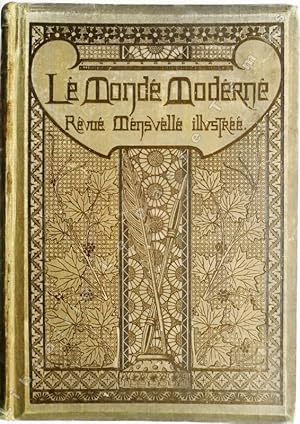
LE MONDE MODERNE - Tome III - Janvier-Juin 1896.
Data di pubblicazione: 1896
Da: Jean-Paul TIVILLIER, MEYS, Francia
Valutazione del venditore 5 su 5 stelle
EUR 40,00
Spedizione EUR 23,00
Spedito da Francia a U.S.A.Quantità: 1 disponibili
Aggiungi al carrelloPARIS, Albert Quantin, Éditeur [5, rue Saint-Benoît /// May & Montteroz, Lib.-Imp. réunies, 7, rue Saint-Benoît] - 1896 - R.25,5x19x4,3 cm - L'ENSEMBLE DES 60 LIVRAISONS DU 1er SEMESTRE DE L'ANNÉE 1896, sous reliure éditeur, pleine percaline verte Art Nouveau (Fernandez & Cie), premier plat et dos illustrés en noir, plats biseautés; tranche de tête dorée; 960 pages en pagination continue (16 pages par livraison); importante iconographie illustrée ou photographique en noir; texte sur 2 colonnes. (Collection Le Monde Moderne - Revue mensuelle illustrée - 2e Année - Tome III - Janvier-Juin 1896 - L'Éditeur-Gérant: A. Quantin). Percaline passée et frottée; mors faibles, coupure sur 3 cm (1er plat) et 5 cm (2e plat); mouillure au dos. Ensemble solide et très correct. LE PREMIER SEMESTRE COMPLET DU TOME III (1896). ASINA. (p. 7 à 31 - G. Bergeret, 5 illustrations de Roux). *****___***** LA MOISSON. (p. 32 à 38 - F. Fabié, 7 illustrations de Gusman). *****___***** LES FEMMES D'ESPAGNE. (p. 39 à 54 - L. Garcia-Ramon, 12 illustrations de L. M. Vauzanges). *****___***** EN ÉRYTHRÉE. (p. 65 à 75 - L. Lanier, 6 illustrations de P. Steck). *****___***** L'ÉCOLE D'APPLICATION DE CAVALERIE DE SAUMUR. (p. 76 à 88 - L. d'Or, 14 illustrations de F. Régamay). *****___***** L'EXPOSITION DE 1900. (p. 97 à 117 - A. Robida, 26 illustrations de l'auteur). *****___***** LA MODE DU MOIS. (p. 150 à 151, 312 à 313, 474 à 475, 632 à 633, 792 à 793, 950 à 951 - B. de Présilly, illustrations). *****___***** ROUSSOT ET BLANCAS. (p. 161 à 176 - J. Rameau, 5 illustrations de F. Courboin). *****___***** POUR L'HISTOIRE DE L'ARMURE. (p. 177 à 187 - F. Maindron, 13 illustrations). *****___***** AUX ABATTOIRS DE LA VILETTE. (p. 188 à 196 - T. Bourrier, 10 illustrations de A. Lemaistre). *****___***** UNE MAISON DU VIEUX COLOGNE. (p. 197 à 205 - J. Adeline, 8 illustrations de l'auteur). *****___***** EXCURSIONS DANS LES ASILES DE NUIT d'hommes et de femmes à Paris. (p. 286 à 297 - P. Gsell, 15 illustrations de Seguin). *****___***** LE VOL. (p. 321 à 331 - G. Beaume, 5 illustrations de Etcheverry). *****___***** VIEILLARDS. (p. 347 à 350 - Edgy, 1 illustration de Mucha). *****___***** LE MÉTROPOLITAIN DE PARIS. (p. 353 à 368 - G. Cadoux, 11 illustrations et photographies). *****___***** LES CHIENS COURANTS. (p. 440 à 450 - P. Mégnin, 7 illustrations de C. Weisser). *****___***** MÈRE DES DOULEURS. (p. 481 à 497 - C. Lemonnier, 5 illustrations de Mucha). *****___***** DANS LE BEFFROI. (p. 526 à 176 - J. Doucet, 3 illustrations de A. Robida). *****___***** LES AFFICHES ILLUSTRÉES ÉTRANGÈRES. (p. 537 à 546 - J. Adeline, 10 reproductions). *****___***** THÉÂTRE DU CHAT NOIR. (p. 563 à 579 - P. Eudel, 18 illustrations dont 3 de Robida). *****___***** LES COURSES DE TAUREAUX. (p. 580 à 497 - P. Vrignault, 15 illustrations de D. Serlach). *****___***** L'ARTILLERIE EN CAMPAGNE. (p. 591 à 602 - E. Manceau, 9 illustrations de A. Lalauze). *****___***** REVUE DU MOIS. (p. 639 - 9 illustrations par Moloch). *****___***** LES PASSANTS. (p. 641 à 651 - A. Hermant, 5 illustrations de R. Lelong). *****___***** LES FÊTES FORAINES DE PARIS. (p. 652 à 660 - P. Vauthier, 8 illustrations de l'auteur). *****___***** HANOÏ ET SES ENVIRONS. (p. 676 à 602 - E. Jung, 7 illustrations de A. Montader). *****___***** LA MONNAIE. (p. 685 à 602 - C. de Néronde, 23 illustrations et photographies). *****___***** PROFIL DE COMÉDIENS DE SALON. (p. 709 à 718 - P. Bilhaud, 6 illustrations de E. Bayard). *****___***** UN COUVENT CATHOLIQUE A LONDRES. (p. 731 à 736 - L. P., 11 illustrations de G. Lambert). *****___***** UNE EXCURSION AU TRANSVAAL. (p. 737 à 753 - L. de Launay, 18 illustrations et photographies). *****___***** LE MOIS COMIQUE. (p. 799 - 9 illustrations par Moloch). *****___***** LES DEUX FILS FARCOT. (p. 801 à 817 - Masson-Forestier, 5 illustrations de C. Vaugneray). *****___***** CHANTEURS COMIQUES. (p. 926 à 932 - P. Frimm, 12 portraits illustrés de P. Frimm). *****___***** LE MOIS COM.
-
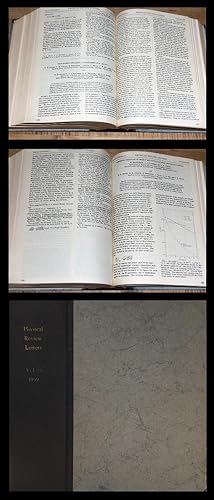
High-Energy Inelastic e-p Scattering at 6(deg) and 10(deg) (Bloom et al., pp. 930-934) WITH Observed Behavior of Highly Inelastic Electron-Proton Scattering (Friedman et al., pp. 935-939) in Physical Review Letters 23, 1969
Editore: The American Physical Society, New York, 1969
Da: Atticus Rare Books, West Branch, IA, U.S.A.
Valutazione del venditore 5 su 5 stelle
Prima edizione
1st Edition. FULL VOLUME 1969 FIRST EDITION OF TWO PAPERS PRESENTING THE FIRST EMPIRICAL EVIDENCE OF THE EXISTENCE OF QUARKS WITHIN THE ATOMIC NUCLEUS. Quarks had been predicted in 1964 by Murray Gell-Mann but until these experiments, no one had produced convincing experimental evidence for the existence of quarks inside the proton or neutron ("Friedman, Kendall and Taylor Win Nobel Prize for First Quark Evidence", Physics Today, Vol. 44, 1, pp. 17). In demonstrating that quarks are real particles, the lead scientists on these two papers, Jerome Friedman, Henry Kendall, and Richard Taylor confirmed Murray Gell-Mann's hypothesis of their existence and for their discovery, the trio were awarded the 1990 Nobel Prize in Physics. Taylor passed away in early 2018 a further note about his import appears below. The first paper, "High-Energy Inelastic e-p Scattering at 6(deg) and 10(deg)" "describes the experiment that identified the point-like centers within protons that were later identified as quarks" (The History of Science: Wenner Collection). The second, "Observed Behavior of Highly Inelastic Electron-Proton Scattering" "explains the significance of the experiment in terms of theory" (ibid). Gell-Mann's seminal 1964 work positing the 'idea' of quarks was based on the assumption that strongly interacting particles he classified (called hadrons) were all "built up from more elementary constituents" that he famously called 'quarks' (Levinovitz, The Nobel Prize, 44). Few people, however, "believed that quarks were real particles. Despite many searches in accelerators and in cosmic rays, no one had found an isolated quark. As Gell-Mann himself said: 'Such particles [quarks] presumably are not real but we may use them in our field theory anyway'" (Alan Lightman, The Discoveries, pp. 457). In the late 1960s while at the new two-mile electron linear accelerator, the Stanford Linear Accelerator Center (SLAC), Friedman, Kendall, and Taylor proved the existence of quarks by using "high-energy electrons from the then new accelerator, and [showed] that they bounced back in an unexpected way from the protons and neutrons in a gas target" (Quinn, The Mystery of the Missing Antimatter, 97). High-energy collisions â?? such as those enabled by SLAC â?? "disrupt the target, and the ensuing scattering is called inelastic. When high-energy electrons are used for this purpose, their wavelengths are small enough to probe within protons and neutrons inside the nucleusâ??that is, deep within the nucleus (the â??deep' within â??deep inelastic scattering'). In 1969, American theoretical physicist James Bjorken (born 1934) used a form of mathematics called current algebra to predict behavior in deep inelastic scattering (now called "Bjorken scaling") and proposed an experiment to test the theory of hadrons being comprised of smaller, point-like particles" (Wenner). Friedman, Kendall, and Taylor then "conducted the Bjorken scaling experiment using liquid hydrogen as the target the Bjorken scaling experiment using liquid hydrogen as the target" (ibid). "Friedman's group was startled. to observe that the scattering pattern suggested not that the positive charge of the proton was uniformly spread out, but rather that charges were confined to point-like centers within the protons. As the Nobel Prize Committee's presentation speech makes clear, Friedman, Kendall, and Taylor had not anticipated anything fundamentally new: "similar experiments, albeit at lower energies, had found that the proton behaved like a soft gelatinous sphere with many excited states, similar to those of atoms and nuclei. Nevertheless, the Laureates decided to go one step further and study the proton under extreme conditions. They looked for the electron undergoing a large deflection, and where the proton, rather than keeping its identity, seized a lot of the collision energy and broke up into a shower of new particles. This so called "deep inelastic scattering" had generally been considered to be too ra.
-
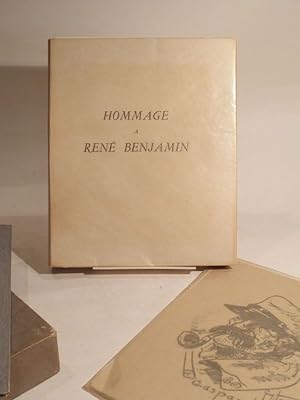
Hommage à René Benjamin. Illustrations de Guy Arnoux et André Jacquemin.
Da: L'Ancienne Librairie, Paris, Francia
Valutazione del venditore 5 su 5 stelle
Copia autografata
EUR 570,00
Spedizione EUR 26,00
Spedito da Francia a U.S.A.Quantità: 1 disponibili
Aggiungi al carrelloParis, Pierre Lanauve de Tartas, 1949. In-8 en feuilles, sou couverture rempliée, chemise et étui (bords de l'étui un peu frottés, sinon bel exemplaire). Tirage limité à 193 exemplaires sur Annam, ici UN DES 10 exemplaires comportant une QUADRUPLE SUITE (Japon, Satin de Lyon, Annanm et Johannot) des 3 gravures (après 3 exemplaires uniques). Exemplaire SIGNÉ par Guitry, Farrère, La Varende, Maurras, les frères Tharaud et H. Bordeaux. * Voir photographie(s) / See picture(s). * Membre du SLAM et de la LILA / ILAB Member. La librairie est ouverte du lundi au vendredi de 14h à 19h. Merci de nous prévenir avant de passer,certains de nos livres étant entreposés dans une réserve.