Importo totale (1 articolo articoli):
Destinazione ordine:

j e pearce a t jackson arthur (1 risultati)
Vai alla pagina principale dei risultati di ricerca
Filtri di ricerca
Tipo di articolo
- Tutti i tipi di prodotto
- Libri (1)
- Riviste e Giornali (Nessun altro risultato corrispondente a questo perfezionamento)
- Fumetti (Nessun altro risultato corrispondente a questo perfezionamento)
- Spartiti (Nessun altro risultato corrispondente a questo perfezionamento)
- Arte, Stampe e Poster (Nessun altro risultato corrispondente a questo perfezionamento)
- Fotografie (Nessun altro risultato corrispondente a questo perfezionamento)
- Mappe (Nessun altro risultato corrispondente a questo perfezionamento)
- Manoscritti e Collezionismo cartaceo (Nessun altro risultato corrispondente a questo perfezionamento)
Condizioni Maggiori informazioni
- Nuovo (Nessun altro risultato corrispondente a questo perfezionamento)
- Come nuovo, Ottimo o Quasi ottimo (Nessun altro risultato corrispondente a questo perfezionamento)
- Molto buono o Buono (Nessun altro risultato corrispondente a questo perfezionamento)
- Discreto o Mediocre (1)
- Come descritto (Nessun altro risultato corrispondente a questo perfezionamento)
Legatura
- Tutte
- Rilegato (Nessun altro risultato corrispondente a questo perfezionamento)
- Brossura (1)
Ulteriori caratteristiche
- Prima ed. (1)
- Copia autograf. (Nessun altro risultato corrispondente a questo perfezionamento)
- Sovracoperta (Nessun altro risultato corrispondente a questo perfezionamento)
- Con foto (1)
- Non Print on Demand (1)
Lingua (1)
Prezzo
- Qualsiasi prezzo
- Inferiore a EUR 20 (Nessun altro risultato corrispondente a questo perfezionamento)
- EUR 20 a EUR 45
- Superiore a EUR 45 (Nessun altro risultato corrispondente a questo perfezionamento)
Spedizione gratuita
- Spedizione gratuita in U.S.A. (Nessun altro risultato corrispondente a questo perfezionamento)
Paese del venditore
Valutazione venditore
-
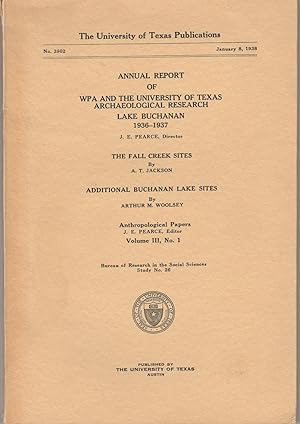
Annual Report of WPA: Archaeological Research, Lake Buchanan
Lingua: Inglese
Editore: University of Texas, Austin, Texas, 1938
Da: Whitledge Books, Austin, TX, U.S.A.
Valutazione del venditore 5 su 5 stelle

Prima edizione
Soft cover. Condizione: Fair. No Jacket. 1st Edition. ANNUAL REPORT OF WPA AND THE UNIVERSITY OF TEXAS: ARCHAEOLOGICAL RESEARCH, LAKE BUCHANAN 1936-1937 by J.E. Pearce, with The Fall Creek Sites by A.T. Jackson and Additional Buchanan Lake Sites by Arthur M. Woolsey; U.T. Bureau of Research in the Social Sciences Study No. 26; University of Texas Publications No. 3802 (January 8, 1938), softcover; illustrated with photographs, drawings, charts. BOOK CONDITION: fair. The text block is in fine condition with no marks, tears, or dog ears. There is no bookplate, but the signature of a previous owner is written inside the front cover and inside the back cover. Not a remainder or library book. The cream-colored wraps are in fair condition (slight curling of corners, smudges and discoloration on covers, and two small tears along the spine). 10 x 8 ¾, 153 pages, 13 ounces [From the foreword] When the federal government developed the Colorado River project for the construction of a series of dams across the River and the Hills above Austin, the undersigned [J.E. Pearce] became deeply concerned at the prospect of seeing many of the richest and most important archaeological sites in Texas inundated and lost to science for all time. He made application early in 1936 to the WPA authorities for approval of a project to explore as many of these sites as possible before they should be fully covered by water. The project was finally set up in January 1937, so that less than 6 months of the then current fiscal year was left in which to do the work which had been planned for the whole year. Some of this work was carried over into the present fiscal year, and that work is represented in the present report. At present Buchanan Lake has nearly filled with water, and all work in that basin has ceased. The map with Jackson's paper indicates that nearly all sites are near the mouths of creeks. This is due to the fact that the red floods of the Colorado render the River water undrinkable often for weeks on end, while the perennial small mountain streams are never muddy for longer than a few hours at a time. At the same time, the mussels, fish, bathing, and canoeing of the River kept the early inhabitants from living long away from them. undoubtedly much camp refuse, deposited near the River in periods of drought and low water was destroyed or carried away in floods, while that deposited on the high terraces or along the small streams accumulated uninterrupted through the centuries. The resulting middens often show archaeological stratification, as indicated in this report.