
Jacob vennekool (5 risultati)
 Altre immagini
Editore: David Mortier, Amsterdam 1719
- Rilegato
- Prima edizione
Da: Antiquariat Hieronymus, München, , GermaniaAntiquariat Hieronymus
Contatta il venditoreVenditore con 5 stelleCondizione: Usato - Molto buono
EUR 2600,00
EUR 38,00 spedizioneSpedito da Germania a U.S.A.Quantità: 1 disponibili
Halbleder des 20. Jahrhunderts. Condizione: Gut. 1. Auflage. Gut. Folio (40-45 cm). 22 S., 109 Tafeln Halbleder des 20. Jahrhunderts 1. Auflage. Einband etwas berieben und bestoßen, Papier etwas gebräunt (Text stärker), ohne Fliegende Blätter, rauer Buchschnitt, insgesamt gut erhalten. Fowler 77, 274; Shirley 423; Ornamentstichs…ammlung 2235. Gesuchte erste und einzige Ausgabe des monumentalen Werks über das Königliche Palais (Koninklijk Paleis) in Amsterdam, entworfen ursprünglich als Rathaus von dem niederländischen Maler und Architekten Jacob van Campen (1596-1657). Mit einer Titelvignette (Porträt von Erasmus von Rotterdam), 2 zusätzlichen (!) ganzseitigen Porträtkupfern von van Campen (durch L.Meyer) sowie dem Bildhauer Artus Quellinus I. (1609-1668) (durch Hubertus Quellinus) und 124 gestochenen Darstellugnen der Architektur (Grund-und Aufrisse), Skulptur und Malerei des Gebäudes auf 109 Tafeln, davon 6 doppelseitig. In den Kupfern so vollständig und um die beiden Porträts bereichert! Niederlande, Amsterdam, Royal Palace, Palais auf dem Damm, Paleis, Stadhius, illustriertes Werk, Architektur, Ausstattung, Kupferstiche, Barock. 8200 Gramm.
 Altre immagini
Editore: David Mortier,, Amsterdam, 1719
- Rilegato
- Prima edizione
Da: Antiquariaat FORUM BV, Houten, , Paesi BassiAntiquariaat FORUM BV
Contatta il venditoreVenditore con 5 stelleCondizione: Usato
EUR 1950,00
EUR 25,00 spedizioneSpedito da Paesi Bassi a U.S.A.Quantità: 1 disponibili
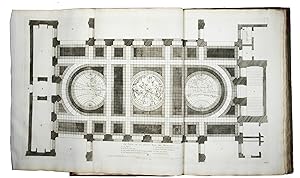
First French edition of Van Campen's famous description of the Amsterdam City Hall (the present day Royal Palace), with more than a hundred plates of the architectural features and sculptures of the building, including ground plans, elevations, and sections of the interior and exterior. Particularly impressive are the giant plat…es of the tympana, which are more than 160 cm wide when fully unfolded. The work also includes the famous plate of the extraordinary cartographic mosaic floor of the Burgerzaal, which shows the zodiac signs that were originally painted on the celestial map in the middle, but are now no longer visible on the floor itself due to fading.The City Hall is the most famous and last major work by Jacob van Campen (1595-1657), the greatest Dutch architect of the 17th century. He began work on the design in 1640, and though the building opened in 1655, it was not actually completed until 1665. It was called "the eighth wonder of the world" at the time, and is still considered the most important Dutch monument from the 17th century. It was designed to show off Amsterdam's wealth and magnificence. This is especially visible in the Burgerzaal, the heart of the building, which depicts Amsterdam as the centre of the world. The impressive mosaic floor, with a celestial map in the centre and the two maps of both hemispheres of the world on either side, symbolises that the world was at Amsterdam's feet. These maps are the largest ever made. They show Abel Tasman's then recent discoveries in Australia and Tasmania. Many discoveries from his second voyage remained otherwise unpublished until the end of the 17th century.The present work is the French edition of Van Campen's Afbeelding van 't stadt huys van Amsterdam (1664). The plates were drawn by Hubert Quiellinus (1619-1687), and Danckert Danckertsz. (1634-1666) and his father after drawings by Jacob Vennekool (17th century), and were first published in Quiellinus' Prima [et secunda] pars praecipuarum . curiae Amstelrodamenis (1655-1663) and Afbeelding van 't stadt huys van Amsterdam in dartigh coopere plaaten . geteeckent door Jacob Vennekool (1661). As such, most of the present engravings were published before the building was completed, and may therefore reflect Van Campen's plan more closely than the finished building itself. The edges and corners of the boards are scuffed, the spine has been rubbed, with loss material, old restoration at the head and foot of the spine. The text leaves are lightly browned, the plates are very clean.l BAL 132; Berlin Kat. 2235; STCN 182312917 (5 copies, of which 1 incomplete); cf. Fowler 77 & 274 (1661 Danckerts eds.); for the map, see also: Schilder, Australia Unveiled, map 66; Shirley 423. Contemporary quarter brown sheepskin, sewn on 5 supports with the corresponding raised bands on the spine, the title lettered in gold on the spine, sprinkled paper sides, red sprinkled edges. With a title-page in red and black with an engraved device (a portrait of Erasmus in an elaborate cartouche with allegorical figures), and 124 engraved architectural and sculptural illustrations on 109 numbered plates (6 double-page, 103 full-page). Pages: 22 pp. + 109 plates.

Editore: Gerald Valk,
- Mappa
Da: Daniel Crouch Rare Books Ltd, London, , Regno UnitoDaniel Crouch Rare Books Ltd
Contatta il venditoreVenditore con 4 stelleCondizione: Usato
EUR 2382,10
EUR 23,13 spedizioneSpedito da Regno Unito a U.S.A.Quantità: 1 disponibili
The first depiction of Abel Tasman's discoveries, on a floor First edition in French. Folding engraved panorama, on 1 and a half joined sheets. This very early commemoration, in mosaic tile, of the discoveries of Abel Tasman was first laid on the floor of the Civic Hall in the Stadt Huys in Amsterdam in 1648, only four years aft…er Tasman's second voyage. It consists of the world in two hemispheres, either side of the northern night sky. Vennekool's magnificent engraving was first published in Jacob van Campen's work on the Stadt Huys, 'Afbeelding van't Stadt Huys van Amsterdam' (1661). It was followed by a second depiction of Tasman's discoveries on a floor at the entrance to the Mitchell Library in Sydney, Australia. The mapmaker Abel Jansz. Tasman (c1603-1659), was the first European explorer to reach and map the coastlines of Tasmania and New Zealand. After a series of shipwrecks had revealed some of the western coast of Australia, he was chosen by Anthony van Diemen, governor-general of the Dutch East Indies, to lead a voyage of discovery to the south, in 1642. The intention was to find a sea route south of Nuyts land, and east across the Pacific to South America. In his ships, the 'Heemskerck' and 'Zeehaen', over a course of ten months, Tasman mapped the coast of southwest Tasmania, the west coast of New Zealand, and the island groups of Tonga and New Guinea. On a second voyage, in 1644, Tasman and crew surveyed the southwest coast of New Guinea, and much of Australia's northern coastline, as shown here. Although the longed for southern sea route was not found, the easterly's were too strong, Tasman was awarded the rank of commandeur on his return, and a pay rise was backdated to the beginning of his first voyage. Subsequently, Tasman was "appointed to the Council of Justice at Batavia. In mid-1647 he was sent on a mission to the King of Siam and was granted precedence over all Dutchmen in the kingdom. After that mission, he was given command of a fleet of eight vessels which sailed in May 1648 against the Spaniards. His conduct in this operation was unsatisfactory and, after his return in January 1649, proceedings were taken against him for having, when inflamed by liquor, treated one of his sailors in a barbarous way; as a result, he was removed from office during the governor-general's pleasure. He was formally reinstated in January 1651, but not long afterwards retired from the service and became a merchant in Batavia. He died there in affluent circumstances in 1659" (Forsyth). Literature: Forsyth, 'Australian Dictionary of Biography', online.
 Altre immagini
Editore: Johannes Covens, Cornelis Mortier and Johannes Covens junior,, Amsterdam, 1780
Da: ASHER Rare Books, t Goy Houten, Paesi BassiASHER Rare Books
Contatta il venditoreVenditore con 5 stelleCondizione: Usato
EUR 5500,00
EUR 25,00 spedizioneSpedito da Paesi Bassi a U.S.A.Quantità: 1 disponibili
A comprehensive collection of plates showing all architectural features and sculpture of the Amsterdam City Hall, since 1808 the Royal Palace, here in the Covens & Mortier firm's rare ca. 1780 issue with the engravings newly printed from the original copper plates from the years 1655 to 1664 and the text reissued from Leonardus…Schenk's 1747 Dutch language edition, the whole with a new title-page. ''This version has not been seen'' (BAL). At least most of the plates were engraved for and first published in Jacob van Campen's masterpiece Afbeelding van 't stadt huys van Amsterdam (Amsterdam, Frederick de Wit, 1664), Hubert Quiellinus's Prima [et secunda] pars praecipuarum . curiae Amstelrodamenis (Amsterdam, Frederick de Wit 1655-1663) and Afbeelding van 't stadt huys van Amsterdam in dartigh coopere plaaten . geteeckent door Jacob Vennekool (Amsterdam, Dancker Danckerts, 1661).It includes the famous plate showing the extraordinary cartographic mosaic floor of the Burgerzaal of the Amsterdam City Hall, designed by Jacob van Campen, with a celestial map in the centre and the magnificent map of the world in 2 hemispheres on either side. The engraving was first published in 1661, and the map shows Tasman's recent discoveries in Australia and Tasmania, and depicts California as an island. Many discoveries from his second voyage remained otherwise unpublished until the end of the 17th century. The drawing of the floor was made by Jacob Vennekool who worked closely with Van Campen, and since his drawings were first published even before the building was completed, they may reflect Van Campen's plan more closely than the finished building itself. They also, of course, show it before the alterations made at various times in later years.Binding a little worn, untrimmed, otherwise in good condition. The Amsterdam city hall in full glory with all its architectural features and sculpture.l BAL 132 note (description of 1719 French language ed. but citing Berlin Kat. & Kuyper for unseen "1730" Dutch ed.); Berlin Kat. 2236; Kuyper, Dutch Classicist architecture (Delft, 1980), pp. 212- 215 and note 25 (p. 318); STCN (3 copies); cf. for dating the impressum: Van Egmond, Covens & Mortier (2005), pp. 66, 83-88. Contemporary half red roan (sheepskin), brown sprinkled paper sides. With the title page printed in red and black with J. Covens & C. Mortier's engraved device by Bernard Picart ("JCCM" cypher monogram in a laurel wreath carried by 6 putti, dated 1730); 2 preliminary plates containing portraits of Jacob van Campen [by Lutma] and Arthus Quellinus by Henricus Quellinus; CIX (109) numbered engraved and etched architectural plates (7 folding, 30 double-page and 72 single-page, a few printed from 2 or 3 copper plates, distinguished by arabic numerals) showing plans elevations, tympana, ceilings, floors, statues, festoons and other ornamentation, mostly engraved by Hubertus Quellinus after Arthus Quellinus, but some after "R.V.H." (Rombout Verhulst). All plates have French captions, some with laudatory verses below, and are described in Dutch in the letterpress text (pp. 3-15). Pages: 15 pp.
 Altre immagini
- Rilegato
- Print on Demand
Da: Gyan Books Pvt. Ltd., Delhi, , IndiaGyan Books Pvt. Ltd.
Contatta il venditoreVenditore con 5 stelleCondizione: Nuovo
EUR 34,36
Spedizione gratuitaSpedito da India a U.S.A.Quantità: Più di 20 disponibili
Leather Bound. Condizione: New. Language: Dutch. Language: Dutch_Flemish. Presenting an Exquisite Leather-Bound Edition, expertly crafted with Original Natural Leather that gracefully adorns the spine and corners. The allure continues with Golden Leaf Printing that adds a touch of elegance, while Hand Embossing on the rounded sp…ine lends an artistic flair. This masterpiece has been meticulously reprinted in 2024, utilizing the invaluable guidance of the original edition published many years ago in 1691. The contents of this book are presented in classic black and white. Its durability is ensured through a meticulous sewing binding technique, enhancing its longevity. Imprinted on top-tier quality paper. A team of professionals has expertly processed each page, delicately preserving its content without alteration. Due to the vintage nature of these books, every page has been manually restored for legibility. However, in certain instances, occasional blurriness, missing segments, or faint black spots might persist. We sincerely hope for your understanding of the challenges we faced with these books. Recognizing their significance for readers seeking insight into our historical treasure, we've diligently restored and reissued them. Our intention is to offer this valuable resource once again. We eagerly await your feedback, hoping that you'll find it appealing and will generously share your thoughts and recommendations. Lang: - Dutch,Flemish, Pages: : - 192, Print on Demand. If it is a multi-volume set, then it is only a single volume. We are specialised in Customisation of books, if you wish to opt different color leather binding, you may contact us. This service is chargeable. Product Disclaimer: Kindly be informed that, owing to the inherent nature of leather as a natural material, minor discolorations or textural variations may be perceptible. Explore the FOLIO EDITION (12x19 Inches): Available Upon Request. 192 192.


