Importo totale (1 articolo articoli):
Destinazione ordine:

jacobs jane cairns stephen (16 risultati)
Vai alla pagina principale dei risultati di ricerca
Filtri di ricerca
Tipo di articolo
- Tutti i tipi di prodotto
- Libri (16)
- Riviste e Giornali (Nessun altro risultato corrispondente a questo perfezionamento)
- Fumetti (Nessun altro risultato corrispondente a questo perfezionamento)
- Spartiti (Nessun altro risultato corrispondente a questo perfezionamento)
- Arte, Stampe e Poster (Nessun altro risultato corrispondente a questo perfezionamento)
- Fotografie (Nessun altro risultato corrispondente a questo perfezionamento)
- Mappe (Nessun altro risultato corrispondente a questo perfezionamento)
- Manoscritti e Collezionismo cartaceo (Nessun altro risultato corrispondente a questo perfezionamento)
Condizioni Maggiori informazioni
Legatura
Ulteriori caratteristiche
- Prima ed. (1)
- Copia autograf. (Nessun altro risultato corrispondente a questo perfezionamento)
- Sovracoperta (1)
- Con foto (7)
- Non Print on Demand (16)
Lingua (2)
Prezzo
- Qualsiasi prezzo
- Inferiore a EUR 20 (Nessun altro risultato corrispondente a questo perfezionamento)
- EUR 20 a EUR 45
- Superiore a EUR 45
Spedizione gratuita
Paese del venditore
Valutazione venditore
-

Buildings Must Die: A Perverse View of Architecture
Da: BooksRun, Philadelphia, PA, U.S.A.
Valutazione del venditore 5 su 5 stelle

Hardcover. Condizione: Very Good. It's a well-cared-for item that has seen limited use. The item may show minor signs of wear. All the text is legible, with all pages included. It may have slight markings and/or highlighting.
-

Buildings Must Die : A Perverse View of Architecture
Da: GreatBookPrices, Columbia, MD, U.S.A.
Valutazione del venditore 5 su 5 stelle
EUR 33,27
Spedizione EUR 2,31
Spedito in U.S.A.Quantità: Più di 20 disponibili
Aggiungi al carrelloCondizione: New.
-
Buildings Must Die: A Perverse View of Architecture (Mit Press)
Da: Books Puddle, New York, NY, U.S.A.
Valutazione del venditore 4 su 5 stelle

Condizione: New. Reprint edition NO-PA16APR2015-KAP.
-
Buildings Must Die : A Perverse View of Architecture
Da: GreatBookPrices, Columbia, MD, U.S.A.
Valutazione del venditore 5 su 5 stelle
EUR 34,53
Spedizione EUR 2,31
Spedito in U.S.A.Quantità: Più di 20 disponibili
Aggiungi al carrelloCondizione: As New. Unread book in perfect condition.
-

EUR 42,46
Spedizione gratuita
Spedito in U.S.A.Quantità: Più di 20 disponibili
Aggiungi al carrelloPaperback. Condizione: New. Part memento mori for architecture, and part invocation to reimagine the design values that lay at the heart of its creative purpose.Buildings, although inanimate, are often assumed to have "life." And the architect, through the act of design, is assumed to be their conceiver and creator. But what of the "death" of buildings? What of the decay, deterioration, and destruction to which they are inevitably subject? And what might such endings mean for architecture's sense of itself? In Buildings Must Die, Stephen Cairns and Jane Jacobs look awry at core architectural concerns. They examine spalling concrete and creeping rust, contemplate ruins old and new, and pick through the rubble of earthquake-shattered churches, imploded housing projects, and demolished Brutalist office buildings. Their investigation of the death of buildings reorders architectural notions of creativity, reshapes architecture's preoccupation with good form, loosens its vanities of durability, and expands its sense of value. It does so not to kill off architecture as we know it, but to rethink its agency and its capacity to make worlds differently. Cairns and Jacobs offer an original contemplation of architecture that draws on theories of waste and value. Their richly illustrated case studies of building "deaths" include the planned and the unintended, the lamented and the celebrated. They take us from Moline to Christchurch, from London to Bangkok, from Tokyo to Paris. And they feature the work of such architects as Eero Saarinen, Carlo Scarpa, Cedric Price, Arata Isozaki, Rem Koolhaas and François Roche. Buildings Must Die is both a memento mori for architecture and a call to to reimagine the design values that lay at the heart of its creative purpose.
-
Buildings Must Die: A Perverse View of Architecture (Mit Press)
Da: Biblios, Frankfurt am main, HESSE, Germania
Valutazione del venditore 4 su 5 stelle
EUR 41,56
Spedizione EUR 9,95
Spedito da Germania a U.S.A.Quantità: 3 disponibili
Aggiungi al carrelloCondizione: New.
-

Buildings Must Die : A Perverse View of Architecture
Da: GreatBookPricesUK, Woodford Green, Regno Unito
Valutazione del venditore 5 su 5 stelle
EUR 41,31
Spedizione EUR 17,52
Spedito da Regno Unito a U.S.A.Quantità: Più di 20 disponibili
Aggiungi al carrelloCondizione: New.
-
Buildings Must Die â" A Perverse View of Architecture
Da: Sell Books, Elland, YORKS, Regno Unito
Valutazione del venditore 5 su 5 stelle
EUR 45,38
Spedizione EUR 14,19
Spedito da Regno Unito a U.S.A.Quantità: 1 disponibili
Aggiungi al carrellohardcover. Condizione: Acceptable. Please see the condition note after this for details, if this is missing please consider Acceptable to mean poor quality that could include major staining, water damage, writing, missing dustjacket, etc etc. Our books are dispatched from a Yorkshire former cotton mill. We list via barcode/ISBN so please note that the images are stock images and may not be the exact copy you receive, furthermore the details about edition and year might not be accurate as many publishers reuse the same ISBN for multiple editions and as we simply scan a barcode or enter an ISBN we do not check the validity of the edition data when listing. If you're looking for an exact edition please don't order (at least not without checking with us first, although we don't always have time to check). We aim to dispatch prompty, the service used will depend on order value and book size. We can ship to most countries, see our shipping policies. Payment is via Abe only.
-
Buildings Must Die A Perverse View of Architecture
Da: Revaluation Books, Exeter, Regno Unito
Valutazione del venditore 5 su 5 stelle
EUR 57,85
Spedizione EUR 14,60
Spedito da Regno Unito a U.S.A.Quantità: 1 disponibili
Aggiungi al carrelloPaperback. Condizione: Brand New. reprint edition. 312 pages. 9.00x6.00x0.93 inches. In Stock.
-

Buildings Must Die
Da: Rarewaves USA United, OSWEGO, IL, U.S.A.
Valutazione del venditore 5 su 5 stelle
EUR 44,10
Spedizione EUR 43,77
Spedito in U.S.A.Quantità: Più di 20 disponibili
Aggiungi al carrelloPaperback. Condizione: New. Part memento mori for architecture, and part invocation to reimagine the design values that lay at the heart of its creative purpose.Buildings, although inanimate, are often assumed to have "life." And the architect, through the act of design, is assumed to be their conceiver and creator. But what of the "death" of buildings? What of the decay, deterioration, and destruction to which they are inevitably subject? And what might such endings mean for architecture's sense of itself? In Buildings Must Die, Stephen Cairns and Jane Jacobs look awry at core architectural concerns. They examine spalling concrete and creeping rust, contemplate ruins old and new, and pick through the rubble of earthquake-shattered churches, imploded housing projects, and demolished Brutalist office buildings. Their investigation of the death of buildings reorders architectural notions of creativity, reshapes architecture's preoccupation with good form, loosens its vanities of durability, and expands its sense of value. It does so not to kill off architecture as we know it, but to rethink its agency and its capacity to make worlds differently. Cairns and Jacobs offer an original contemplation of architecture that draws on theories of waste and value. Their richly illustrated case studies of building "deaths" include the planned and the unintended, the lamented and the celebrated. They take us from Moline to Christchurch, from London to Bangkok, from Tokyo to Paris. And they feature the work of such architects as Eero Saarinen, Carlo Scarpa, Cedric Price, Arata Isozaki, Rem Koolhaas and François Roche. Buildings Must Die is both a memento mori for architecture and a call to to reimagine the design values that lay at the heart of its creative purpose.
-

Buildings Must Die
Editore: The Mit Press, 2014
Da: Miliardi di Parole, Pietra Marazzi, AL, Italia
Valutazione del venditore 5 su 5 stelle
EUR 21,04
Spedizione EUR 22,40
Spedito da Italia a U.S.A.Quantità: 1 disponibili
Aggiungi al carrelloCondizione: Buone. inglese Condizioni dell'esterno: Buone Condizioni dell'interno: Buone.
-

Buildings Must Die : A Perverse View of Architecture
Da: GreatBookPricesUK, Woodford Green, Regno Unito
Valutazione del venditore 5 su 5 stelle
EUR 92,53
Spedizione EUR 17,52
Spedito da Regno Unito a U.S.A.Quantità: Più di 20 disponibili
Aggiungi al carrelloCondizione: As New. Unread book in perfect condition.
-

Buildings Must Die
Da: Rarewaves.com UK, London, Regno Unito
Valutazione del venditore 5 su 5 stelle
EUR 43,02
Spedizione EUR 75,90
Spedito da Regno Unito a U.S.A.Quantità: Più di 20 disponibili
Aggiungi al carrelloPaperback. Condizione: New. Part memento mori for architecture, and part invocation to reimagine the design values that lay at the heart of its creative purpose.Buildings, although inanimate, are often assumed to have "life." And the architect, through the act of design, is assumed to be their conceiver and creator. But what of the "death" of buildings? What of the decay, deterioration, and destruction to which they are inevitably subject? And what might such endings mean for architecture's sense of itself? In Buildings Must Die, Stephen Cairns and Jane Jacobs look awry at core architectural concerns. They examine spalling concrete and creeping rust, contemplate ruins old and new, and pick through the rubble of earthquake-shattered churches, imploded housing projects, and demolished Brutalist office buildings. Their investigation of the death of buildings reorders architectural notions of creativity, reshapes architecture's preoccupation with good form, loosens its vanities of durability, and expands its sense of value. It does so not to kill off architecture as we know it, but to rethink its agency and its capacity to make worlds differently. Cairns and Jacobs offer an original contemplation of architecture that draws on theories of waste and value. Their richly illustrated case studies of building "deaths" include the planned and the unintended, the lamented and the celebrated. They take us from Moline to Christchurch, from London to Bangkok, from Tokyo to Paris. And they feature the work of such architects as Eero Saarinen, Carlo Scarpa, Cedric Price, Arata Isozaki, Rem Koolhaas and François Roche. Buildings Must Die is both a memento mori for architecture and a call to to reimagine the design values that lay at the heart of its creative purpose.
-
Buildings Must Die - A Perverse View of Architecture
Lingua: Inglese
Editore: MIT Press, Cambridge, Massachusetts, 2014
ISBN 10: 0262026937 ISBN 13: 9780262026932
Da: Rotary Club of Albert Park, Albert Park, VIC, Australia
Valutazione del venditore 5 su 5 stelle
Prima edizione
EUR 93,53
Spedizione EUR 30,64
Spedito da Australia a U.S.A.Quantità: 1 disponibili
Aggiungi al carrelloHardcover. Condizione: As New. 1st Edition. 298 pages. 8v0. As new copy of this perverse work on architecture. Cairns and Jacobs offer an original contemplation of architecture that draws on theories of waste and value. Their richly illustrated case studies of building "deaths" include the planned and the unintended, the lamented and the celebrated.
-
Hardcover. Condizione: New.
-
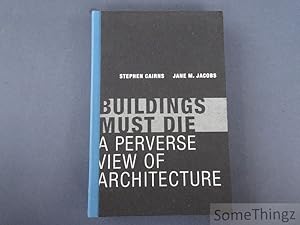
Buildings Must Die: A Perverse View of Architecture.
Da: SomeThingz. Books etcetera., Averbode, Belgio
Valutazione del venditore 5 su 5 stelle
EUR 40,00
Spedizione EUR 42,00
Spedito da Belgio a U.S.A.Quantità: 1 disponibili
Aggiungi al carrelloCambridge The MIT Press 2014 Bound, cloth spine, cardboard covers, 298pp., 15,5x23,5cm., illustr. in colour and b/w., in very good condition. ISBN 9780262026932. Buildings, although inanimate, are often assumed to have 'life'. And the architect, through the act of design, is assumed to be their conceiver and creator. But what of the 'death' of buildings? What of the decay, deterioration, and destruction to which they are inevitably subject? And what might such endings mean for architecture's sense of itself? In Buildings Must Die, Stephen Cairns and Jane Jacobs look awry at core architectural concerns. They examine spalling concrete and creeping rust, contemplate ruins old and new, and pick through the rubble of earthquake-shattered churches, imploded housing projects, and demolished Brutalist office buildings. Their investigation of the death of buildings reorders architectural notions of creativity, reshapes architecture's preoccupation with good form, loosens its vanities of durability, and expands its sense of value. It does so not to kill off architecture as we know it, but to rethink its agency and its capacity to make worlds differently.Cairns and Jacobs offer an original contemplation of architecture that draws on theories of waste and value. Their richly illustrated case studies of building 'deaths' include the planned and the unintended, the lamented and the celebrated. They take us from Moline to Christchurch, from London to Bangkok, from Tokyo to Paris. And they feature the work of such architects as Eero Saarinen, Carlo Scarpa, Cedric Price, Arata Isozaki, Rem Koolhaas and François Roche.Buildings Must Die is both a memento mori for architecture and a call to to reimagine the design values that lay at the heart of its creative purpose.