Importo totale (1 articolo articoli):
Destinazione ordine:

jiyeong lee (20 risultati)
Vai alla pagina principale dei risultati di ricerca
Filtri di ricerca
Tipo di articolo
- Tutti i tipi di prodotto
- Libri (20)
- Riviste e Giornali (Nessun altro risultato corrispondente a questo perfezionamento)
- Fumetti (Nessun altro risultato corrispondente a questo perfezionamento)
- Spartiti (Nessun altro risultato corrispondente a questo perfezionamento)
- Arte, Stampe e Poster (Nessun altro risultato corrispondente a questo perfezionamento)
- Fotografie (Nessun altro risultato corrispondente a questo perfezionamento)
- Mappe (Nessun altro risultato corrispondente a questo perfezionamento)
- Manoscritti e Collezionismo cartaceo (Nessun altro risultato corrispondente a questo perfezionamento)
Condizioni Maggiori informazioni
- Nuovo (14)
- Come nuovo, Ottimo o Quasi ottimo (5)
- Molto buono o Buono (1)
- Discreto o Mediocre (Nessun altro risultato corrispondente a questo perfezionamento)
- Come descritto (Nessun altro risultato corrispondente a questo perfezionamento)
Legatura
Ulteriori caratteristiche
- Prima ed. (Nessun altro risultato corrispondente a questo perfezionamento)
- Copia autograf. (Nessun altro risultato corrispondente a questo perfezionamento)
- Sovracoperta (Nessun altro risultato corrispondente a questo perfezionamento)
- Con foto (13)
- Non Print on Demand (16)
Lingua (1)
Spedizione gratuita
- Spedizione gratuita in U.S.A. (Nessun altro risultato corrispondente a questo perfezionamento)
Paese del venditore
Valutazione venditore
-
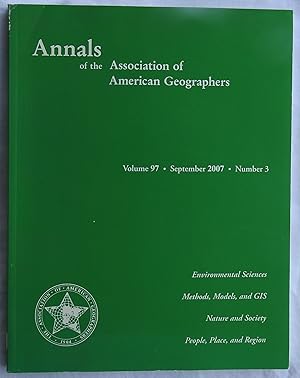
Annals of the Association of American Geographers September 2007 Volume 97 Number 3
Lingua: Inglese
Editore: Association of American Geographers, 2007
Da: Argyl Houser, Bookseller, Altadena, CA, U.S.A.
Valutazione del venditore 4 su 5 stelle

Soft cover. Condizione: Very Good. All pages spotless, unmarked and undamaged. The journal's exterior is also spotless. Light wear to edges of covers and spine. One small glue spot on the back cover where a label may have been removed. Very little wear otherwise. A very nice copy. It will be bubble-wrapped and shipped in a sturdy box to ensure safe transit. This issue includes: "Soils Cool as Climate Warms in the Great Lakes Region: 1951-2000" by S.A. Isard, R.J. Schaetzl and J.A. Andersen; "Stimulating Emergent Urban Form Using Agent-Based Modeling: Desakota in the Suzhou-Wuxian Region in China" by Yichun Xie, Michael Batty and Kang Zhao; "Hierarchical Location-Allocation with Spatial Choice Interaction Modeling" by Vladimir Yasenovskiy and John Hodgson; "A Three-Dimensional Navigable Data Model to Support Emergency Response in Microspatial Built-Environments" by Jiyeong Lee; "Market Environmentalism, New Environmetal Policy Instruments, and Climate Policy in the United States and Germany" by Ian Bailey; "The Gendered Nature of Natural Disasters: The Impact of Catastrophic Events on the Gender Gap in Life Expectancy, 1981-2002" by Eric Neumayer and Thomas Plumper; "The Amazon Land War in the South of Para" by Cynthia S. Simmons, Robert T. Walker, Eugenio Y. Arima, Stephen P. Aldrich, and Marcellus M. Caldas; "Tropes of Indolence and the Cultural Politics of Development in Lhasa, Tibet" by Emily T. Yeh; "'Where the Knots of Narrative are Tied and Untied': The Dialogic Production of Gendered Development Spaces in North India" by Kathleen O'Reilly; "In Memoriam: Mildred Berman, 1926-2000"; "In Memoriam: John Robert Borchert, 1918-2001" and "Book Reviews".
-

3D Geo-Information Sciences (Lecture Notes in Geoinformation and Cartography)
Da: Ria Christie Collections, Uxbridge, Regno Unito
Valutazione del venditore 5 su 5 stelle

EUR 160,25
Spedizione EUR 13,88
Spedito da Regno Unito a U.S.A.Quantità: Più di 20 disponibili
Aggiungi al carrelloCondizione: New. In.
-

3D Geo-Information Sciences (Lecture Notes in Geoinformation and Cartography)
Da: Ria Christie Collections, Uxbridge, Regno Unito
Valutazione del venditore 5 su 5 stelle
EUR 160,61
Spedizione EUR 13,88
Spedito da Regno Unito a U.S.A.Quantità: Più di 20 disponibili
Aggiungi al carrelloCondizione: New. In.
-

3D Geo-Information Sciences
Da: GreatBookPrices, Columbia, MD, U.S.A.
Valutazione del venditore 5 su 5 stelle
EUR 177,18
Spedizione EUR 2,31
Spedito in U.S.A.Quantità: Più di 20 disponibili
Aggiungi al carrelloCondizione: New.
-

3D Geo-Information Sciences
Da: GreatBookPricesUK, Woodford Green, Regno Unito
Valutazione del venditore 5 su 5 stelle
EUR 160,60
Spedizione EUR 17,38
Spedito da Regno Unito a U.S.A.Quantità: Più di 20 disponibili
Aggiungi al carrelloCondizione: New.
-

EUR 141,20
Spedizione EUR 70,00
Spedito da Germania a U.S.A.Quantità: 5 disponibili
Aggiungi al carrelloTaschenbuch. Condizione: Neu. 3D Geo-Information Sciences | Jiyeong Lee (u. a.) | Taschenbuch | xvii | Englisch | 2010 | Springer | EAN 9783642099519 | Verantwortliche Person für die EU: Springer Verlag GmbH, Tiergartenstr. 17, 69121 Heidelberg, juergen[dot]hartmann[at]springer[dot]com | Anbieter: preigu.
-
Affare
EUR 116,76
Spedizione EUR 105,00
Spedito da Germania a U.S.A.Quantità: 1 disponibili
Aggiungi al carrelloCondizione: Sehr gut. Zustand: Sehr gut | Seiten: 436 | Sprache: Englisch | Produktart: Bücher | Keine Beschreibung verfügbar.
-
Affare
EUR 116,76
Spedizione EUR 105,00
Spedito da Germania a U.S.A.Quantità: 1 disponibili
Aggiungi al carrelloCondizione: Sehr gut. Zustand: Sehr gut | Seiten: 436 | Sprache: Englisch | Produktart: Bücher | Keine Beschreibung verfügbar.
-

3D Geo-Information Sciences
Lingua: Inglese
Editore: Springer Berlin Heidelberg, 2010
ISBN 10: 3642099513 ISBN 13: 9783642099519
EUR 160,49
Spedizione EUR 63,43
Spedito da Germania a U.S.A.Quantità: 1 disponibili
Aggiungi al carrelloTaschenbuch. Condizione: Neu. Druck auf Anfrage Neuware - Printed after ordering - In recent years 3D geo-information has become an important research area due to the increased complexity of tasks in many geo-scientific applications, such as sustainable urban planning and development, civil engineering, risk and disaster management and environmental monitoring. Moreover, a paradigm of cross-application merging and integrating of 3D data is observed. The problems and challenges facing today's 3D software, generally application-oriented, focus almost exclusively on 3D data transportability issues - the ability to use data originally developed in one modelling/visualisation system in other and vice versa. Tools for elaborated 3D analysis, simulation and prediction are either missing or, when available, dedicated to specific tasks. In order to respond to this increased demand, a new type of system has to be developed. A fully developed 3D geo-information system should be able to manage 3D geometry and topology, to integrate 3D geometry and thematic information, to analyze both spatial and topological relationships, and to present the data in a suitable form. In addition to the simple geometry types like point line and polygon, a large variety of parametric representations, freeform curves and surfaces or sweep shapes have to be supported. Approaches for seamless conversion between 3D raster and 3D vector representations should be available, they should allow analysis of a representation most suitable for a specific application.
-

3D Geo-Information Sciences
Lingua: Inglese
Editore: Springer Berlin Heidelberg, Springer Berlin Heidelberg Nov 2010, 2010
ISBN 10: 3642099513 ISBN 13: 9783642099519
Da: buchversandmimpf2000, Emtmannsberg, BAYE, Germania
Valutazione del venditore 5 su 5 stelle
EUR 160,49
Spedizione EUR 60,00
Spedito da Germania a U.S.A.Quantità: 2 disponibili
Aggiungi al carrelloTaschenbuch. Condizione: Neu. Neuware -In recent years 3D geo-information has become an important research area due to the increased complexity of tasks in many geo-scientific applications, such as sustainable urban planning and development, civil engineering, risk and disaster management and environmental monitoring. Moreover, a paradigm of cross-application merging and integrating of 3D data is observed. The problems and challenges facing today¿s 3D software, generally application-oriented, focus almost exclusively on 3D data transportability issues ¿ the ability to use data originally developed in one modelling/visualisation system in other and vice versa. Tools for elaborated 3D analysis, simulation and prediction are either missing or, when available, dedicated to specific tasks. In order to respond to this increased demand, a new type of system has to be developed. A fully developed 3D geo-information system should be able to manage 3D geometry and topology, to integrate 3D geometry and thematic information, to analyze both spatial and topological relationships, and to present the data in a suitable form. In addition to the simple geometry types like point line and polygon, a large variety of parametric representations, freeform curves and surfaces or sweep shapes have to be supported. Approaches for seamless conversion between 3D raster and 3D vector representations should be available, they should allow analysis of a representation most suitable for a specific application.Springer Verlag GmbH, Tiergartenstr. 17, 69121 Heidelberg 456 pp. Englisch.
-

3D Geo-Information Sciences
Lingua: Inglese
Editore: Springer Berlin Heidelberg, 2008
ISBN 10: 3540873945 ISBN 13: 9783540873945
EUR 177,18
Spedizione EUR 48,99
Spedito da Germania a U.S.A.Quantità: Più di 20 disponibili
Aggiungi al carrelloCondizione: New. State-of-the-art methods, algorithms, models and systems with regard to the Third DimensionIn recent years 3D geo-information has become an important research area due to the increased complexity of tasks in many geo-scientific applications, such as sus.
-

3D Geo-Information Sciences
Lingua: Inglese
Editore: Springer, Berlin, Springer, 2008
ISBN 10: 3540873945 ISBN 13: 9783540873945
EUR 166,62
Spedizione EUR 64,32
Spedito da Germania a U.S.A.Quantità: 2 disponibili
Aggiungi al carrelloBuch. Condizione: Neu. Druck auf Anfrage Neuware - Printed after ordering - In recent years 3D geo-information has become an important research area due to the increased complexity of tasks in many geo-scientific applications, such as sustainable urban planning and development, civil engineering, risk and disaster management and environmental monitoring. Moreover, a paradigm of cross-application merging and integrating of 3D data is observed. The problems and challenges facing today's 3D software, generally application-oriented, focus almost exclusively on 3D data transportability issues - the ability to use data originally developed in one modelling/visualisation system in other and vice versa. Tools for elaborated 3D analysis, simulation and prediction are either missing or, when available, dedicated to specific tasks. In order to respond to this increased demand, a new type of system has to be developed. A fully developed 3D geo-information system should be able to manage 3D geometry and topology, to integrate 3D geometry and thematic information, to analyze both spatial and topological relationships, and to present the data in a suitable form. In addition to the simple geometry types like point line and polygon, a large variety of parametric representations, freeform curves and surfaces or sweep shapes have to be supported. Approaches for seamless conversion between 3D raster and 3D vector representations should be available, they should allow analysis of a representation most suitable for a specific application.
-

3D Geo-Information Sciences
Da: GreatBookPricesUK, Woodford Green, Regno Unito
Valutazione del venditore 5 su 5 stelle
EUR 226,70
Spedizione EUR 17,38
Spedito da Regno Unito a U.S.A.Quantità: Più di 20 disponibili
Aggiungi al carrelloCondizione: As New. Unread book in perfect condition.
-
3D Geo-Information Sciences (Lecture Notes in Geoinformation and Cartography)
Da: Mispah books, Redhill, SURRE, Regno Unito
Valutazione del venditore 4 su 5 stelle
EUR 217,16
Spedizione EUR 28,96
Spedito da Regno Unito a U.S.A.Quantità: 1 disponibili
Aggiungi al carrelloHardcover. Condizione: Like New. Like New. book.
-

3D Geo-Information Sciences
Da: GreatBookPrices, Columbia, MD, U.S.A.
Valutazione del venditore 5 su 5 stelle
EUR 251,12
Spedizione EUR 2,31
Spedito in U.S.A.Quantità: Più di 20 disponibili
Aggiungi al carrelloCondizione: As New. Unread book in perfect condition.
-
3D Geo-Information Sciences
Lingua: Inglese
Editore: Springer Berlin Heidelberg, 2008
ISBN 10: 3642099513 ISBN 13: 9783642099519
Da: Revaluation Books, Exeter, Regno Unito
Valutazione del venditore 5 su 5 stelle
EUR 237,19
Spedizione EUR 14,48
Spedito da Regno Unito a U.S.A.Quantità: 2 disponibili
Aggiungi al carrelloPaperback. Condizione: Brand New. 454 pages. 9.00x6.00x1.03 inches. In Stock.
-
3D Geo-Information Sciences (eng)
Da: Brook Bookstore On Demand, Napoli, NA, Italia
Valutazione del venditore 4 su 5 stelle
EUR 126,26
Spedizione EUR 6,80
Spedito da Italia a U.S.A.Quantità: Più di 20 disponibili
Aggiungi al carrelloCondizione: new. Questo è un articolo print on demand.
-

3D Geo-Information Sciences
Lingua: Inglese
Editore: Springer Berlin Heidelberg Nov 2010, 2010
ISBN 10: 3642099513 ISBN 13: 9783642099519
Da: BuchWeltWeit Ludwig Meier e.K., Bergisch Gladbach, Germania
Valutazione del venditore 5 su 5 stelle
EUR 160,49
Spedizione EUR 23,00
Spedito da Germania a U.S.A.Quantità: 2 disponibili
Aggiungi al carrelloTaschenbuch. Condizione: Neu. This item is printed on demand - it takes 3-4 days longer - Neuware -In recent years 3D geo-information has become an important research area due to the increased complexity of tasks in many geo-scientific applications, such as sustainable urban planning and development, civil engineering, risk and disaster management and environmental monitoring. Moreover, a paradigm of cross-application merging and integrating of 3D data is observed. The problems and challenges facing today's 3D software, generally application-oriented, focus almost exclusively on 3D data transportability issues - the ability to use data originally developed in one modelling/visualisation system in other and vice versa. Tools for elaborated 3D analysis, simulation and prediction are either missing or, when available, dedicated to specific tasks. In order to respond to this increased demand, a new type of system has to be developed. A fully developed 3D geo-information system should be able to manage 3D geometry and topology, to integrate 3D geometry and thematic information, to analyze both spatial and topological relationships, and to present the data in a suitable form. In addition to the simple geometry types like point line and polygon, a large variety of parametric representations, freeform curves and surfaces or sweep shapes have to be supported. Approaches for seamless conversion between 3D raster and 3D vector representations should be available, they should allow analysis of a representation most suitable for a specific application. 456 pp. Englisch.
-

3D Geo-Information Sciences
Lingua: Inglese
Editore: Springer, Berlin, Springer Berlin Heidelberg, Springer Nov 2008, 2008
ISBN 10: 3540873945 ISBN 13: 9783540873945
Da: BuchWeltWeit Ludwig Meier e.K., Bergisch Gladbach, Germania
Valutazione del venditore 5 su 5 stelle
EUR 160,49
Spedizione EUR 23,00
Spedito da Germania a U.S.A.Quantità: 2 disponibili
Aggiungi al carrelloBuch. Condizione: Neu. This item is printed on demand - it takes 3-4 days longer - Neuware -In recent years 3D geo-information has become an important research area due to the increased complexity of tasks in many geo-scientific applications, such as sustainable urban planning and development, civil engineering, risk and disaster management and environmental monitoring. Moreover, a paradigm of cross-application merging and integrating of 3D data is observed. The problems and challenges facing today's 3D software, generally application-oriented, focus almost exclusively on 3D data transportability issues - the ability to use data originally developed in one modelling/visualisation system in other and vice versa. Tools for elaborated 3D analysis, simulation and prediction are either missing or, when available, dedicated to specific tasks. In order to respond to this increased demand, a new type of system has to be developed. A fully developed 3D geo-information system should be able to manage 3D geometry and topology, to integrate 3D geometry and thematic information, to analyze both spatial and topological relationships, and to present the data in a suitable form. In addition to the simple geometry types like point line and polygon, a large variety of parametric representations, freeform curves and surfaces or sweep shapes have to be supported. Approaches for seamless conversion between 3D raster and 3D vector representations should be available, they should allow analysis of a representation most suitable for a specific application. 435 pp. Englisch.
-

3D Geo-Information Sciences
Lingua: Inglese
Editore: Springer Berlin Heidelberg, 2010
ISBN 10: 3642099513 ISBN 13: 9783642099519
EUR 136,16
Spedizione EUR 48,99
Spedito da Germania a U.S.A.Quantità: Più di 20 disponibili
Aggiungi al carrelloCondizione: New. Dieser Artikel ist ein Print on Demand Artikel und wird nach Ihrer Bestellung fuer Sie gedruckt. State-of-the-art methods, algorithms, models and systems with regard to the Third DimensionIn recent years 3D geo-information has become an important research area due to the increased complexity of tasks in many geo-scientific applications, such as sus.