
Importo totale (1 articolo articoli):
Destinazione ordine:

kroftova olga (9 risultati)
Vai alla pagina principale dei risultati di ricerca
Filtri di ricerca
Tipo di articolo
- Tutti i tipi di prodotto
- Libri (9)
- Riviste e Giornali (Nessun altro risultato corrispondente a questo perfezionamento)
- Fumetti (Nessun altro risultato corrispondente a questo perfezionamento)
- Spartiti (Nessun altro risultato corrispondente a questo perfezionamento)
- Arte, Stampe e Poster (Nessun altro risultato corrispondente a questo perfezionamento)
- Fotografie (Nessun altro risultato corrispondente a questo perfezionamento)
- Mappe (Nessun altro risultato corrispondente a questo perfezionamento)
- Manoscritti e Collezionismo cartaceo (Nessun altro risultato corrispondente a questo perfezionamento)
Condizioni Maggiori informazioni
- Nuovo (6)
- Come nuovo, Ottimo o Quasi ottimo (2)
- Molto buono o Buono (1)
- Discreto o Mediocre (Nessun altro risultato corrispondente a questo perfezionamento)
- Come descritto (Nessun altro risultato corrispondente a questo perfezionamento)
Legatura
Ulteriori caratteristiche
- Prima ed. (Nessun altro risultato corrispondente a questo perfezionamento)
- Copia autograf. (Nessun altro risultato corrispondente a questo perfezionamento)
- Sovracoperta (Nessun altro risultato corrispondente a questo perfezionamento)
- Con foto (5)
- Non Print on Demand (6)
Lingua (1)
Spedizione gratuita
Paese del venditore
Valutazione venditore
-
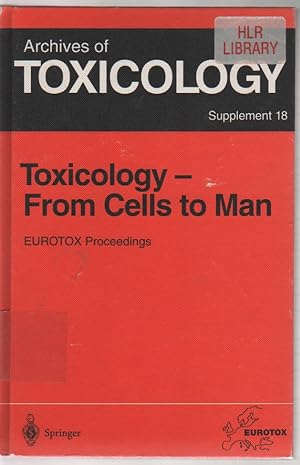
Toxicology- From Cells to Man: Proceedings of the 1995 EUROTOX Congress Meeting Held in Prague, Czech Republic, August 27-l30, 1995: From Cells to Man . 27-30, 1995: Supl 18 (Archives of Toxicology)
Da: Biblio Pursuit, Lenhartsville, PA, U.S.A.
Valutazione del venditore 5 su 5 stelle

Hardcover. Condizione: Very Good. A very clean ex-library. Text has No Markings, No Underlining, No Highlighting.
-

-

Toxicology- From Cells to Man: Proceedings of the 1995 EUROTOX Congress Meeting Held in Prague, Czech Republic, August 27-l30, 1995 (Archives of Toxicology)
Da: Lucky's Textbooks, Dallas, TX, U.S.A.
Valutazione del venditore 5 su 5 stelle
EUR 101,86
Spedizione EUR 3,38
Spedito in U.S.A.Quantità: Più di 20 disponibili
Aggiungi al carrelloCondizione: New.
-
Toxicology- From Cells to Man: Proceedings of the 1995 EUROTOX Congress Meeting Held in Prague, Czech Republic, August 27-l30, 1995 (Archives of Toxicology)
Da: Ria Christie Collections, Uxbridge, Regno Unito
Valutazione del venditore 5 su 5 stelle
EUR 111,84
Spedizione EUR 13,79
Spedito da Regno Unito a U.S.A.Quantità: Più di 20 disponibili
Aggiungi al carrelloCondizione: New. In.
-

Toxicology- From Cells to Man : Proceedings of the 1995 EUROTOX Congress Meeting Held in Prague, Czech Republic, August 27¿l30, 1995
Lingua: Inglese
Editore: Springer Berlin Heidelberg, 2011
ISBN 10: 3642646964 ISBN 13: 9783642646966
EUR 106,99
Spedizione EUR 63,43
Spedito da Germania a U.S.A.Quantità: 1 disponibili
Aggiungi al carrelloTaschenbuch. Condizione: Neu. Druck auf Anfrage Neuware - Printed after ordering - Renal transport and xenobiotic metabolism play an important role in the detoxication and excretion of potentially toxic xenobiotics. However, recent experimental evidence has demonstrated that renal xenobiotic metabolism and renal transport processes also play an important role in the nephrotoxicity of xenobiotics and xenobiotic metabolites. The high blood flow to the kidney combined with its ability to concentrate solutes may expose the kidney to high concentrations of xenobiotics and xenobiotics metabolites present in the systemic circulation. Recently, it has been demonstrated that xenobiotic metabolites formed in the liver and other organs may be targeted to the kidney by selective transport systems~ many xenobiotics require enzymatic transformation to proximate reactive metabolites to elicit their toxic and carcinogenic effects. The enzymatic formation of reactive metabolites is termed bioactivation. The bioactivation mechanisms for many nephrotoxicants have, at least in part, been elucidated in the past 15 years. Many ultimate toxicants formed in the kidney are electrophiles whose interaction with cellular macromolecules may cause a perturbation of normal cell function resulting in necrosis and/or cancer (Anders 1988). Electrophilic metabolites may bind to nucleophilic sites in cellular macromolecules~ the importance of covalent modification of protein and DNA in cell killing and in the induction of tumors is established (Miller and Miller 1981~ Nelson and Pearson 1990~ Hinson and Roberts 1992). The objective of this review is to summarize new information about renal transport, renal bioactivation and their relation to nephrotoxicity using two relevant example for the basic mechanisms outlined above.
-
Toxicology- From Cells to Man: Proceedings of the 1995 EUROTOX Congress Meeting Held in Prague, Czech Republic, August 27l30, 1995 (Archives of Toxicology, 18)
Da: Mispah books, Redhill, SURRE, Regno Unito
Valutazione del venditore 4 su 5 stelle

EUR 163,66
Spedizione EUR 28,79
Spedito da Regno Unito a U.S.A.Quantità: 1 disponibili
Aggiungi al carrelloPaperback. Condizione: Like New. LIKE NEW. SHIPS FROM MULTIPLE LOCATIONS. book.
-

Toxicology- From Cells to Man
Lingua: Inglese
Editore: Springer, Springer Sep 2011, 2011
ISBN 10: 3642646964 ISBN 13: 9783642646966
Da: BuchWeltWeit Ludwig Meier e.K., Bergisch Gladbach, Germania
Valutazione del venditore 5 su 5 stelle
EUR 106,99
Spedizione EUR 23,00
Spedito da Germania a U.S.A.Quantità: 2 disponibili
Aggiungi al carrelloTaschenbuch. Condizione: Neu. This item is printed on demand - it takes 3-4 days longer - Neuware -Renal transport and xenobiotic metabolism play an important role in the detoxication and excretion of potentially toxic xenobiotics. However, recent experimental evidence has demonstrated that renal xenobiotic metabolism and renal transport processes also play an important role in the nephrotoxicity of xenobiotics and xenobiotic metabolites. The high blood flow to the kidney combined with its ability to concentrate solutes may expose the kidney to high concentrations of xenobiotics and xenobiotics metabolites present in the systemic circulation. Recently, it has been demonstrated that xenobiotic metabolites formed in the liver and other organs may be targeted to the kidney by selective transport systems~ many xenobiotics require enzymatic transformation to proximate reactive metabolites to elicit their toxic and carcinogenic effects. The enzymatic formation of reactive metabolites is termed bioactivation. The bioactivation mechanisms for many nephrotoxicants have, at least in part, been elucidated in the past 15 years. Many ultimate toxicants formed in the kidney are electrophiles whose interaction with cellular macromolecules may cause a perturbation of normal cell function resulting in necrosis and/or cancer (Anders 1988). Electrophilic metabolites may bind to nucleophilic sites in cellular macromolecules~ the importance of covalent modification of protein and DNA in cell killing and in the induction of tumors is established (Miller and Miller 1981~ Nelson and Pearson 1990~ Hinson and Roberts 1992). The objective of this review is to summarize new information about renal transport, renal bioactivation and their relation to nephrotoxicity using two relevant example for the basic mechanisms outlined above. 456 pp. Englisch.
-

Toxicology- From Cells to Man
Lingua: Inglese
Editore: Springer Berlin Heidelberg, 2011
ISBN 10: 3642646964 ISBN 13: 9783642646966
EUR 92,27
Spedizione EUR 48,99
Spedito da Germania a U.S.A.Quantità: Più di 20 disponibili
Aggiungi al carrelloCondizione: New. Dieser Artikel ist ein Print on Demand Artikel und wird nach Ihrer Bestellung fuer Sie gedruckt. Renal transport and xenobiotic metabolism play an important role in the detoxication and excretion of potentially toxic xenobiotics. However, recent experimental evidence has demonstrated that renal xenobiotic metabolism and renal transport processes also p.
-

Toxicology- From Cells to Man
Lingua: Inglese
Editore: Springer Berlin Heidelberg, Springer Berlin Heidelberg Sep 2011, 2011
ISBN 10: 3642646964 ISBN 13: 9783642646966
Da: buchversandmimpf2000, Emtmannsberg, BAYE, Germania
Valutazione del venditore 5 su 5 stelle
EUR 106,99
Spedizione EUR 60,00
Spedito da Germania a U.S.A.Quantità: 1 disponibili
Aggiungi al carrelloTaschenbuch. Condizione: Neu. This item is printed on demand - Print on Demand Titel. Neuware -Renal transport and xenobiotic metabolism play an important role in the detoxication and excretion of potentially toxic xenobiotics. However, recent experimental evidence has demonstrated that renal xenobiotic metabolism and renal transport processes also play an important role in the nephrotoxicity of xenobiotics and xenobiotic metabolites. The high blood flow to the kidney combined with its ability to concentrate solutes may expose the kidney to high concentrations of xenobiotics and xenobiotics metabolites present in the systemic circulation. Recently, it has been demonstrated that xenobiotic metabolites formed in the liver and other organs may be targeted to the kidney by selective transport systems~ many xenobiotics require enzymatic transformation to proximate reactive metabolites to elicit their toxic and carcinogenic effects. The enzymatic formation of reactive metabolites is termed bioactivation. The bioactivation mechanisms for many nephrotoxicants have, at least in part, been elucidated in the past 15 years. Many ultimate toxicants formed in the kidney are electrophiles whose interaction with cellular macromolecules may cause a perturbation of normal cell function resulting in necrosis and/or cancer (Anders 1988). Electrophilic metabolites may bind to nucleophilic sites in cellular macromolecules~ the importance of covalent modification of protein and DNA in cell killing and in the induction of tumors is established (Miller and Miller 1981~ Nelson and Pearson 1990~ Hinson and Roberts 1992). The objective of this review is to summarize new information about renal transport, renal bioactivation and their relation to nephrotoxicity using two relevant example for the basic mechanisms outlined above.Springer Verlag GmbH, Tiergartenstr. 17, 69121 Heidelberg 456 pp. Englisch.

