
Importo totale (1 articolo articoli):
Destinazione ordine:

noriko aso (34 risultati)
Vai alla pagina principale dei risultati di ricerca
Filtri di ricerca
Tipo di articolo
- Tutti i tipi di prodotto
- Libri (34)
- Riviste e Giornali (Nessun altro risultato corrispondente a questo perfezionamento)
- Fumetti (Nessun altro risultato corrispondente a questo perfezionamento)
- Spartiti (Nessun altro risultato corrispondente a questo perfezionamento)
- Arte, Stampe e Poster (Nessun altro risultato corrispondente a questo perfezionamento)
- Fotografie (Nessun altro risultato corrispondente a questo perfezionamento)
- Mappe (Nessun altro risultato corrispondente a questo perfezionamento)
- Manoscritti e Collezionismo cartaceo (Nessun altro risultato corrispondente a questo perfezionamento)
Condizioni Maggiori informazioni
- Nuovo (25)
- Come nuovo, Ottimo o Quasi ottimo (6)
- Molto buono o Buono (1)
- Discreto o Mediocre (Nessun altro risultato corrispondente a questo perfezionamento)
- Come descritto (2)
Legatura
Ulteriori caratteristiche
- Prima ed. (Nessun altro risultato corrispondente a questo perfezionamento)
- Copia autograf. (Nessun altro risultato corrispondente a questo perfezionamento)
- Sovracoperta (Nessun altro risultato corrispondente a questo perfezionamento)
- Con foto (13)
- Non Print on Demand (31)
Lingua (1)
Spedizione gratuita
Paese del venditore
Valutazione venditore
-

Public Properties: Museums in Imperial Japan (Asia-Pacific: Culture, Politics, and Society)
Libro 43 di 49: Asia-Pacific: Culture, Politics, and SocietyLingua: Inglese
Editore: Duke University Press Books, 2013
ISBN 10: 0822354292 ISBN 13: 9780822354291
Da: Chaparral Books, Portland, OR, U.S.A.
Membro dell'associazione: CBA
Valutazione del venditore 5 su 5 stelle

Paperback. Condizione: Very Good. Text and images unmarked. The wrapper shows some very light handling. 8vo. xiii, 301pp.
-
Softcover, 302 pages, as new condition, clean and crisp; no internal marks. Foreign shipping may be extra.
-

Public Properties : Museums in Imperial Japan
Libro 43 di 49: Asia-Pacific: Culture, Politics, and SocietyDa: GreatBookPrices, Columbia, MD, U.S.A.
Valutazione del venditore 5 su 5 stelle
Condizione: New.
-
Public Properties: Museums in Imperial Japan (Asia-Pacific: Culture, Politics, and Society)
Libro 43 di 49: Asia-Pacific: Culture, Politics, and SocietyDa: Lucky's Textbooks, Dallas, TX, U.S.A.
Valutazione del venditore 5 su 5 stelle
EUR 28,42
Spedizione EUR 3,38
Spedito in U.S.A.Quantità: Più di 20 disponibili
Aggiungi al carrelloCondizione: New.
-
Public Properties: Museums in Imperial Japan (Asia-Pacific: Culture, Politics, and Society)
Libro 43 di 49: Asia-Pacific: Culture, Politics, and SocietyDa: California Books, Miami, FL, U.S.A.
Valutazione del venditore 5 su 5 stelle
EUR 32,24
Spedizione gratuita
Spedito in U.S.A.Quantità: Più di 20 disponibili
Aggiungi al carrelloCondizione: New.
-
Public Properties - Museums in Imperial Japan
Libro 43 di 49: Asia-Pacific: Culture, Politics, and SocietyLingua: Inglese
Editore: MD - Duke University Press, 2013
ISBN 10: 0822354292 ISBN 13: 9780822354291
Da: PBShop.store UK, Fairford, GLOS, Regno Unito
Valutazione del venditore 4 su 5 stelle

EUR 29,55
Spedizione EUR 4,79
Spedito da Regno Unito a U.S.A.Quantità: 1 disponibili
Aggiungi al carrelloPAP. Condizione: New. New Book. Shipped from UK. Established seller since 2000.
-

Public Properties: Museums in Imperial Japan
Libro 43 di 49: Asia-Pacific: Culture, Politics, and SocietyDa: Book Grocer, Tullamarine, VIC, Australia
Valutazione del venditore 5 su 5 stelle
EUR 15,28
Spedizione EUR 25,38
Spedito da Australia a U.S.A.Quantità: 7 disponibili
Aggiungi al carrelloPaperback. Noriko Aso, Duke University Press. In the late nineteenth century, Japan's new Meiji government established museums to showcase a national aesthetic heritage. Inspired by Western museums and expositions, these institutions were introduced by government officials hoping to spur industrialization and self-disciplined public behavior, and to cultivate an "imperial public" loyal to the emperor. Japan's network of museums expanded along with its colonies. By the mid-1930s, the Japanese museum system had established or absorbed institutions in Taiwan, Korea, Sakhalin, and Manchuria. Not surprising, colonial subjects' views of Japanese imperialism differed from those promulgated by the Japanese state. Meanwhile, in Japan, philanthropic and commercial museums were expanding, revising, and even questioning the state-sanctioned aesthetic canon. Public Properties describes how museums in Japan and its empire contributed to the reimagining of state and society during the imperial era, despite vigorous disagreements about what was to be displayed, how, and by whom it was to be seen.Noriko Aso is Associate Professor of History at the University of California, Santa Cruz. Paperback.
-
Public Properties: Museums in Imperial Japan
Libro 43 di 49: Asia-Pacific: Culture, Politics, and SocietyDa: Kennys Bookshop and Art Galleries Ltd., Galway, GY, Irlanda
Valutazione del venditore 5 su 5 stelle
EUR 32,45
Spedizione EUR 10,50
Spedito da Irlanda a U.S.A.Quantità: 1 disponibili
Aggiungi al carrelloCondizione: New. 2013. Paperback. . . . . .
-
Public Properties: Museums in Imperial Japan
Libro 43 di 49: Asia-Pacific: Culture, Politics, and SocietyDa: THE SAINT BOOKSTORE, Southport, Regno Unito
Valutazione del venditore 5 su 5 stelle
EUR 29,43
Spedizione EUR 17,69
Spedito da Regno Unito a U.S.A.Quantità: 1 disponibili
Aggiungi al carrelloPaperback / softback. Condizione: New. New copy - Usually dispatched within 4 working days.
-

Public Properties : Museums in Imperial Japan
Libro 43 di 49: Asia-Pacific: Culture, Politics, and SocietyDa: GreatBookPricesUK, Woodford Green, Regno Unito
Valutazione del venditore 5 su 5 stelle
EUR 29,42
Spedizione EUR 17,27
Spedito da Regno Unito a U.S.A.Quantità: 3 disponibili
Aggiungi al carrelloCondizione: New.
-
Public Properties: Museums in Imperial Japan
Libro 43 di 49: Asia-Pacific: Culture, Politics, and SocietyDa: Kennys Bookstore, Olney, MD, U.S.A.
Valutazione del venditore 4 su 5 stelle
Condizione: New. 2013. Paperback. . . . . . Books ship from the US and Ireland.
-

Public Properties : Museums in Imperial Japan
Libro 43 di 49: Asia-Pacific: Culture, Politics, and SocietyDa: GreatBookPricesUK, Woodford Green, Regno Unito
Valutazione del venditore 5 su 5 stelle
EUR 36,70
Spedizione EUR 17,27
Spedito da Regno Unito a U.S.A.Quantità: 3 disponibili
Aggiungi al carrelloCondizione: As New. Unread book in perfect condition.
-
Public properties : museums in imperial Japan.
Libro 43 di 49: Asia-Pacific: Culture, Politics, and SocietyDa: Kloof Booksellers & Scientia Verlag, Amsterdam, Paesi Bassi
Membro dell'associazione: ILAB NVVA
Valutazione del venditore 4 su 5 stelle
EUR 22,95
Spedizione EUR 30,00
Spedito da Paesi Bassi a U.S.A.Quantità: 1 disponibili
Aggiungi al carrelloCondizione: as new. Durham : Duke University Press, 2014. Paperback. xiii, 301 pp. Ills. 23 cm. - In the late nineteenth century, Japan's new Meiji government established museums to showcase a national aesthetic heritage. Inspired by Western museums and expositions, these institutions were introduced by government officials hoping to spur industrialization and self-disciplined public behavior, and to cultivate an "imperial public" loyal to the emperor. Japan's network of museums expanded along with its colonies. By the mid-1930s, the Japanese museum system had established or absorbed institutions in Taiwan, Korea, Sakhalin, and Manchuria. Not surprising, colonial subjects' views of Japanese imperialism differed from those promulgated by the Japanese state. Meanwhile, in Japan, philanthropic and commercial museums were expanding, revising, and even questioning the state-sanctioned aesthetic canon. Public Properties describes how museums in Japan and its empire contributed to the reimagining of state and society during the imperial era, despite vigorous disagreements about what was to be displayed, how, and by whom it was to be seen. Condition : as new copy. ISBN 9780822354291. Keywords : CULTURAL STUDIES,
-
Public Properties Museums in Imperial Japan
Libro 43 di 49: Asia-Pacific: Culture, Politics, and SocietyDa: Revaluation Books, Exeter, Regno Unito
Valutazione del venditore 5 su 5 stelle
EUR 43,29
Spedizione EUR 11,51
Spedito da Regno Unito a U.S.A.Quantità: 2 disponibili
Aggiungi al carrelloPaperback. Condizione: Brand New. 312 pages. 9.25x6.00x0.75 inches. In Stock.
-

Public Properties : Museums in Imperial Japan
Libro 43 di 49: Asia-Pacific: Culture, Politics, and SocietyDa: GreatBookPrices, Columbia, MD, U.S.A.
Valutazione del venditore 5 su 5 stelle
Condizione: As New. Unread book in perfect condition.
-

WHEN WORLDS ELIDE Classics, Politics, Culture
Da: Ancient World Books, Toronto, ON, Canada
Valutazione del venditore 5 su 5 stelle
EUR 58,38
Spedizione EUR 6,34
Spedito da Canada a U.S.A.Quantità: 1 disponibili
Aggiungi al carrelloSoftcover. Condizione: Fine. For better or worse, the ancient Greeks retain their cultural, political, and philosophical authority for contemporary educators and actors. Maureen Dowd has talked about the Hellenization of the Bush administration, Thucydides has been used as a template to analyze the Iraqi War and the War on Terror, Greek drama has been repeatedly performed in sometimes spectacular if unconventional ways, while the Trojan War, the battle of Thermopylae, the Spartans, and Alexander have all been the subjects of recent films. Last year the New York Times carried a front page story about "conservatives" taking a "new tack" by establishing "beachheads" for programs in Western Civilization and American Institutions in which the ancient Greeks hold pride of place. The contributors to When Worlds Elide are also invested in having Greek philosophy, literature, and political theory taken seriously in contemporary debates-whether over modes of interpreting Plato, Athenian democracy, gender, ethnicity, or materiality. What distinguishes this book is the substantive range of the essays in it and the generative potentialities of "using" ancient authors and events in analyzing these debates. It begins from the premise that "the Greeks" (like "the French" or "the Chinese") obscures the contested histories of ethnic, geographic, and political formations in favor of an idealized dehistoricized collectivity. The also book also illustrates the ways in which ancient texts must be understood within the history of interpretative practices, which means that "the Greeks" are more a moving target than a stable entity, and that each generation of interlocutors formulates continually transforming questions, readings, and arguments. Finally, this book supposes that an interrogation of "the Greek legacy" depends on interdisciplinary work where interdisciplinarity functions as a verb-that is, something that is always in the process of being achieved. ; Greek Studies: Interdisciplinary Approaches; 152.4 X 0.99 X 9 inches; 490 pages.
-

Public Properties: Museums in Imperial Japan
Libro 43 di 49: Asia-Pacific: Culture, Politics, and SocietyEUR 35,27
Spedizione EUR 48,99
Spedito da Germania a U.S.A.Quantità: Più di 20 disponibili
Aggiungi al carrelloCondizione: New. Public Properties is a historical account of how museums in Japan and its empire contributed to the reimagining of state and society during Japan s imperial era, from 1868 until 1945.Über den AutorNoriko Aso is Associate.
-

Public Properties: Museums in Imperial Japan (Asia-Pacific: Culture, Politics, and Society)
Libro 43 di 49: Asia-Pacific: Culture, Politics, and SocietyDa: California Books, Miami, FL, U.S.A.
Valutazione del venditore 5 su 5 stelle
EUR 102,82
Spedizione gratuita
Spedito in U.S.A.Quantità: Più di 20 disponibili
Aggiungi al carrelloCondizione: New.
-
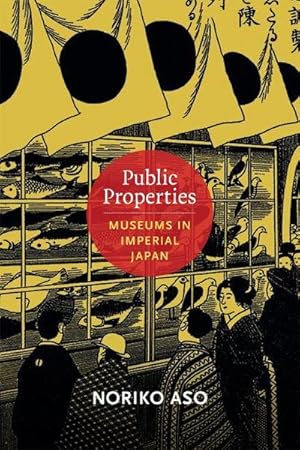
Public Properties : Museums in Imperial Japan
Libro 43 di 49: Asia-Pacific: Culture, Politics, and SocietyLingua: Inglese
Editore: Duke University Press Nov 2013, 2013
ISBN 10: 0822354292 ISBN 13: 9780822354291
EUR 44,53
Spedizione EUR 62,19
Spedito da Germania a U.S.A.Quantità: 1 disponibili
Aggiungi al carrelloTaschenbuch. Condizione: Neu. Neuware - In the late nineteenth century, Japan's new Meiji government established museums to showcase a national aesthetic heritage. Inspired by Western museums and expositions, these institutions were introduced by government officials hoping to spur industrialization and self-disciplined public behavior, and to cultivate an 'imperial public' loyal to the emperor. Japan's network of museums expanded along with its colonies. By the mid-1930s, the Japanese museum system had established or absorbed institutions in Taiwan, Korea, Sakhalin, and Manchuria. Not surprising, colonial subjects' views of Japanese imperialism differed from those promulgated by the Japanese state. Meanwhile, in Japan, philanthropic and commercial museums were expanding, revising, and even questioning the state-sanctioned aesthetic canon. Public Properties describes how museums in Japan and its empire contributed to the reimagining of state and society during the imperial era, despite vigorous disagreements about what was to be displayed, how, and by whom it was to be seen.
-

Public Properties : Museums in Imperial Japan
Libro 43 di 49: Asia-Pacific: Culture, Politics, and SocietyDa: GreatBookPrices, Columbia, MD, U.S.A.
Valutazione del venditore 5 su 5 stelle
Condizione: New.
-
Public Properties: Museums in Imperial Japan (Asia-Pacific: Culture, Politics, and Society)
Libro 43 di 49: Asia-Pacific: Culture, Politics, and SocietyDa: Lucky's Textbooks, Dallas, TX, U.S.A.
Valutazione del venditore 5 su 5 stelle
EUR 108,64
Spedizione EUR 3,38
Spedito in U.S.A.Quantità: Più di 20 disponibili
Aggiungi al carrelloCondizione: New.
-
Public Properties - Museums in Imperial Japan
Libro 43 di 49: Asia-Pacific: Culture, Politics, and SocietyLingua: Inglese
Editore: MD - Duke University Press, 2013
ISBN 10: 0822354136 ISBN 13: 9780822354130
Da: PBShop.store UK, Fairford, GLOS, Regno Unito
Valutazione del venditore 4 su 5 stelle
EUR 123,26
Spedizione EUR 5,78
Spedito da Regno Unito a U.S.A.Quantità: 1 disponibili
Aggiungi al carrelloHRD. Condizione: New. New Book. Shipped from UK. Established seller since 2000.
-

Public Properties : Museums in Imperial Japan
Libro 43 di 49: Asia-Pacific: Culture, Politics, and SocietyDa: GreatBookPrices, Columbia, MD, U.S.A.
Valutazione del venditore 5 su 5 stelle
Condizione: As New. Unread book in perfect condition.
-

Public Properties : Museums in Imperial Japan
Libro 43 di 49: Asia-Pacific: Culture, Politics, and SocietyDa: GreatBookPricesUK, Woodford Green, Regno Unito
Valutazione del venditore 5 su 5 stelle
EUR 114,61
Spedizione EUR 17,27
Spedito da Regno Unito a U.S.A.Quantità: 1 disponibili
Aggiungi al carrelloCondizione: New.
-
Public Properties: Museums in Imperial Japan
Libro 43 di 49: Asia-Pacific: Culture, Politics, and SocietyDa: THE SAINT BOOKSTORE, Southport, Regno Unito
Valutazione del venditore 5 su 5 stelle
EUR 115,55
Spedizione EUR 19,12
Spedito da Regno Unito a U.S.A.Quantità: 1 disponibili
Aggiungi al carrelloHardback. Condizione: New. New copy - Usually dispatched within 4 working days.
-
Public Properties : Museums in Imperial Japan
Libro 43 di 49: Asia-Pacific: Culture, Politics, and SocietyDa: GreatBookPricesUK, Woodford Green, Regno Unito
Valutazione del venditore 5 su 5 stelle
EUR 133,19
Spedizione EUR 17,27
Spedito da Regno Unito a U.S.A.Quantità: 1 disponibili
Aggiungi al carrelloCondizione: As New. Unread book in perfect condition.
-

Public Properties: Museums in Imperial Japan
Libro 43 di 49: Asia-Pacific: Culture, Politics, and SocietyEUR 104,34
Spedizione EUR 48,99
Spedito da Germania a U.S.A.Quantità: Più di 20 disponibili
Aggiungi al carrelloCondizione: New. Public Properties is a historical account of how museums in Japan and its empire contributed to the reimagining of state and society during Japan s imperial era, from 1868 until 1945.Über den AutorNoriko Aso is Associate.
-
Public Properties Museums in Imperial Japan
Libro 43 di 49: Asia-Pacific: Culture, Politics, and SocietyDa: Revaluation Books, Exeter, Regno Unito
Valutazione del venditore 5 su 5 stelle
EUR 162,60
Spedizione EUR 14,39
Spedito da Regno Unito a U.S.A.Quantità: 2 disponibili
Aggiungi al carrelloHardcover. Condizione: Brand New. 312 pages. 9.25x6.25x1.00 inches. In Stock.
-

Public Properties : Museums in Imperial Japan
Libro 43 di 49: Asia-Pacific: Culture, Politics, and SocietyLingua: Inglese
Editore: Duke University Press Nov 2013, 2013
ISBN 10: 0822354136 ISBN 13: 9780822354130
EUR 142,69
Spedizione EUR 62,72
Spedito da Germania a U.S.A.Quantità: 1 disponibili
Aggiungi al carrelloBuch. Condizione: Neu. Neuware - In the late nineteenth century, Japan's new Meiji government established museums to showcase a national aesthetic heritage. Inspired by Western museums and expositions, these institutions were introduced by government officials hoping to spur industrialization and self-disciplined public behavior, and to cultivate an 'imperial public' loyal to the emperor. Japan's network of museums expanded along with its colonies. By the mid-1930s, the Japanese museum system had established or absorbed institutions in Taiwan, Korea, Sakhalin, and Manchuria. Not surprising, colonial subjects' views of Japanese imperialism differed from those promulgated by the Japanese state. Meanwhile, in Japan, philanthropic and commercial museums were expanding, revising, and even questioning the state-sanctioned aesthetic canon. Public Properties describes how museums in Japan and its empire contributed to the reimagining of state and society during the imperial era, despite vigorous disagreements about what was to be displayed, how, and by whom it was to be seen.
-
Public Properties: Museums in Imperial Japan
Libro 43 di 49: Asia-Pacific: Culture, Politics, and SocietyDa: Kennys Bookstore, Olney, MD, U.S.A.
Valutazione del venditore 4 su 5 stelle
Condizione: New. 2013. Illustrated. Hardback. . . . . . Books ship from the US and Ireland.

