
Importo totale (1 articolo articoli):
Destinazione ordine:

robin canup (4 risultati)
Vai alla pagina principale dei risultati di ricerca
Filtri di ricerca
Tipo di articolo
- Tutti i tipi di prodotto
- Libri (4)
- Riviste e Giornali (Nessun altro risultato corrispondente a questo perfezionamento)
- Fumetti (Nessun altro risultato corrispondente a questo perfezionamento)
- Spartiti (Nessun altro risultato corrispondente a questo perfezionamento)
- Arte, Stampe e Poster (Nessun altro risultato corrispondente a questo perfezionamento)
- Fotografie (Nessun altro risultato corrispondente a questo perfezionamento)
- Mappe (Nessun altro risultato corrispondente a questo perfezionamento)
- Manoscritti e Collezionismo cartaceo (Nessun altro risultato corrispondente a questo perfezionamento)
Condizioni Maggiori informazioni
- Nuovo (Nessun altro risultato corrispondente a questo perfezionamento)
- Come nuovo, Ottimo o Quasi ottimo (2)
- Molto buono o Buono (Nessun altro risultato corrispondente a questo perfezionamento)
- Discreto o Mediocre (1)
- Come descritto (1)
Legatura
Ulteriori caratteristiche
- Prima ed. (1)
- Copia autograf. (Nessun altro risultato corrispondente a questo perfezionamento)
- Sovracoperta (1)
- Con foto (1)
- Non Print on Demand (4)
Lingua (2)
Spedizione gratuita
- Spedizione gratuita in U.S.A. (Nessun altro risultato corrispondente a questo perfezionamento)
Paese del venditore
Valutazione venditore
-

Physics Today April 2004 Vol. 57 No. 4
Lingua: Inglese
Editore: American Institute of Physics, 2004
Da: Argyl Houser, Bookseller, Altadena, CA, U.S.A.
Valutazione del venditore 4 su 5 stelle

Soft cover. Condizione: Fine. Clean, unmarked and undamaged inside and out. It will be packed with a backing card, bubble-wrapped and shipped in a sturdy, flat box to ensure safe transit. This issue includes: "Special Issue: Planetary Diversity" (Planets come in a wide variety of types and exhibit a wide range of complex behavior. Still, we can ask--and answer--some fundamental questions about them) by David J. Stevenson; "The Kuiper Belt" (The hundreds of objects lying beyond Neptune's orbit provide data that enable scientists to trace the history of the outer planets. They also present an intriguing mystery) by Michael E. Brown; "Origin of the Terrestrial Planets and the Earth-Moon System" (Increasingly sophisticated computer simulations show how the four solid planets could have emerged through collisions and accretion. One late, giant collision with Earth is the likely origin of the Moon" by Robin M. Canup; "Probing the Giant Planets" (More than a hundred extrasolar giant planets have been discovered in the past few years. To understand how they were formed, we must study in detail the giants closest to us: Jupiter and Saturn) by Tristan Guillot; "Water on Mars" (Mars is cold enough that its meager water content appears to exist today simply in frozen and gas phases. But as recent evidence suggests, that may not have always been the case) by Bruce M. Jakosky and Michael T. Mellon; "A Look at the Galilean Satellites after the Galileo Mission" (From volcanic eruptions hotter than those typically found on Earth to ocean sandwiches with water trapped between ice layers, the Galileo mission revealed fascinating phenomena on Jupiter's four largest moons) by Torrence V. Johnson; plus "Physics Update"; "Reference Frame: Total relativity: March 2004" by Frank Wilczek; "Letters"; and "Search and Discovery" (Evidence reported for a 'supersolid' phase of helium-4.Lubna-Livermore collaboration forms two new superheavy elements.New silicon-based device modulates light at 1 GHz".
-

Origin of the Earth and Moon
Lingua: Inglese
Editore: University of Arizona Press November 2000, 2000
ISBN 10: 0816520739 ISBN 13: 9780816520732
Da: Dunaway Books, St. Louis, MO, U.S.A.
Valutazione del venditore 4 su 5 stelle
Hardcover. Condizione: Near Fine. Condizione sovraccoperta: No Jacket. Pages are very clean and bright with no markings. Binding is tight and square. Trivial shelving wear.
-
Origin of the Earth and Moon (Space Science)
Lingua: Inglese
Editore: University Of Arizona Press, 2000
ISBN 10: 0816520739 ISBN 13: 9780816520732
EUR 65,10
Spedizione EUR 18,33
Spedito da Regno Unito a U.S.A.Quantità: 1 disponibili
Aggiungi al carrelloCondizione: Fair. This is an ex-library book and may have the usual library/used-book markings inside.This book has hardback covers. In fair condition, suitable as a study copy. No dust jacket. Please note the Image in this listing is a stock photo and may not match the covers of the actual item,1750grams, ISBN:9780816520732.
-
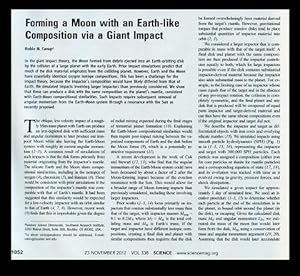
Forming a Moon with an Earth-like composition via a Giant Impact (Canup, pp. 1052-1055) WITH Making the Moon From a Fast-Spinning Earth: A Giant Impact Followed by Resonant Despinning ( uk, pp. 1047-1052 in Science 338, 6110, November 23, 2012
Editore: AAAS, New York, 2012
Da: Atticus Rare Books, West Branch, IA, U.S.A.
Valutazione del venditore 5 su 5 stelle

Prima edizione
1st Edition. FIRST EDITION IN ORIGINAL WRAPS OF TWO IMPORTANT PAPERS ON THE GIANT-IMPACT THEORY, THE CURRENTLY FAVORED SCIENTIFIC HYPOTHESIS FOR THE FORMATION OF THE MOON. The Giant-Impact Theory is also know as the Giant-Impact Hypothesis, the Big Splash, and the The Impact. "The giant impact believed to have formed the Earth-Moon system has long been accepted as canon. However, a major challenge to the theory has been that the Earth and Moon have identical oxygen isotope compositions, even though earlier impact models indicated they should differ substantially" (Phys Org Web Portal, 17 October 2012). The significance of Canup's paper is that it "accounts for this similarity in composition while also yielding an appropriate mass for Earth and the Moon" (ibid). Motivated by the work of others on the early dynamical history of the Moon, Robin Canup, working at the Southwest Research Institute in Boulder, CO, developed new models that involve much larger impactors than were previously considered. In the new simulations, both the impactor and the target are of comparable mass, with each containing about 4 to 5 times the mass of Mars. The near symmetry of the collision causes the disk's composition to be extremely similar to that of the final planet's mantle over a relatively broad range of impact angles and speeds, consistent with the Earth-Moon compositional similarities. The new impacts produce an Earth that is rotating 2 to 2.5 times faster than implied by the current angular momentum of the Earth-Moon system, which is contained in both the Earth's rotation and the Moon's orbit" (PHYS ORG, New Model, Oct. 17, 2012). WITHBOUND: This paper by Dr. Matija uk,SETI Institute, and Dr. Sarah T. Stewart at Harvard University proposed that the angular momentum of the early Earth was larger than the present day system. If so, different types of impact events could generatea lunar disk from the same materials that formedthe young Earth's mantle. After the impact, an orbital resonance transferred angular momentum away from the Earth-Moon system to reach the present day value" (Stewart, Origin of the Earth and Moon, Web Portal). In other words, in addition to the impacts identified in Canup's paper, uk and Stewart show that impacts involving a much smaller, high-velocity impactor colliding into a target that is rotating very rapidly due to a prior impact can also produce a disk-planet system with similar compositions. "The ultimate likelihood of eachimpact scenariowill need to be assessed by improved models of terrestrial planet formation, as well as by a better understanding of the conditions required for the evection resonance mechanism" (ibid). CONDITION & DETAILS: New York: AAAS. Complete 1st edition in original wraps, complete. 8vo. Fine condition. Pristine.


