Importo totale (1 articolo articoli):
Destinazione ordine:

rodionov a a (74 risultati)
Vai alla pagina principale dei risultati di ricerca
Filtri di ricerca
Tipo di articolo
- Tutti i tipi di prodotto
- Libri (74)
- Riviste e Giornali (Nessun altro risultato corrispondente a questo perfezionamento)
- Fumetti (Nessun altro risultato corrispondente a questo perfezionamento)
- Spartiti (Nessun altro risultato corrispondente a questo perfezionamento)
- Arte, Stampe e Poster (Nessun altro risultato corrispondente a questo perfezionamento)
- Fotografie (Nessun altro risultato corrispondente a questo perfezionamento)
- Mappe (Nessun altro risultato corrispondente a questo perfezionamento)
- Manoscritti e Collezionismo cartaceo (Nessun altro risultato corrispondente a questo perfezionamento)
Condizioni Maggiori informazioni
Legatura
Ulteriori caratteristiche
- Prima ed. (Nessun altro risultato corrispondente a questo perfezionamento)
- Copia autograf. (Nessun altro risultato corrispondente a questo perfezionamento)
- Sovracoperta (Nessun altro risultato corrispondente a questo perfezionamento)
- Con foto (45)
- Non Print on Demand (56)
Lingua (5)
Spedizione gratuita
Paese del venditore
Valutazione venditore
-

A Second in Moscow
Editore: Progress Publishers, Moscow, 1968
Da: Liberty Book Shop, Avis, PA, U.S.A.
Valutazione del venditore 4 su 5 stelle

Paperback. Condizione: Very Good-. Slight edge wear, with one 1" closed tear on side edge of cover. Filled with photos of Moscow in the late 1960's. ; Large 8vo 9" - 10" tall; Unpaginated pages.
-
The Fascinating World of Bees;
Lingua: Inglese
Editore: Mir Publishers, Moscow, Mir Publishers, 1986., 1986
Da: Fossilbooks, Whissonsett, NORFO, Regno Unito
Valutazione del venditore 5 su 5 stelle

EUR 11,84
Spedizione EUR 24,14
Spedito da Regno Unito a U.S.A.Quantità: 1 disponibili
Aggiungi al carrelloHardcover. Condizione: Fine. HARDBACK original printed pictorial boards pages: 309 [iii] many text-figs. 122mm x 198mm (4.75 x 7.75") spine very slightly faded.
-

Tretyakov Gallery : an illustrated guide-book
Lingua: Inglese
Editore: P-2 Art Publishers, St. Petersburg, Russia, 2003, 2003
ISBN 10: 5938931711 ISBN 13: 9785938931718
Da: Joseph Valles - Books, Stockbridge, GA, U.S.A.
Valutazione del venditore 5 su 5 stelle
Soft cover. Condizione: Fine. No Jacket. 4th Edition. 136 pages : illustrations (chiefly color) ; 26 cm ISBN 9785938931718, 5938931711 OCLC 57592624 LCCN 2008479507 LC ND681 .G675 2006 ; color photographic stiff paper wrappers ; Very good quality color reproductions (all plates are color) of many of the masterpieces of the Tretyakov collections --Goodreads ; FINE. Book.
-
?????? ??????, 1917-1927: ?????? ? ?????????
Editore: ???. ???????? ?????. ????
Da: Wonder Book, Frederick, MD, U.S.A.
Membro dell'associazione: ABAA ILAB
Valutazione del venditore 5 su 5 stelle
Condizione: Fair. Acceptable condition. Russian edition. (Russian Theater, Books in Russian) A readable, intact copy that may have noticeable tears and wear to the spine. All pages of text are present, but they may include extensive notes and highlighting or be heavily stained. Includes reading copy only books.
-
EUR 10,00
Spedizione EUR 19,90
Spedito da Spagna a U.S.A.Quantità: 1 disponibili
Aggiungi al carrello273 p 20 cm Traducción del ruso Tatiana Enco de Valero y José María Quiroga Plá. Encuadernación editorial en rústica con huellas de uso en la cubierta. Estado de conservación: Regular.
-
A Second in Moscow
Editore: Progress Publishers, Moscow, USSR, 1968
Da: RIVERLEE BOOKS, Waltham Cross, HERTS, Regno Unito
Valutazione del venditore 5 su 5 stelle
EUR 18,93
Spedizione EUR 13,85
Spedito da Regno Unito a U.S.A.Quantità: 1 disponibili
Aggiungi al carrelloSoft cover. Condizione: Good. Good for year, paperback. Generally clean, bright and tight. Some marks and age tanning but otherwise in good condition.
-
Tradicionnoe mirovozzrenie u narodov perednej azii. Sbornik statej.
Editore: Moskva, Nauka, ,, 1992
Da: Antiquariat Gothow & Motzke, Berlin, Germania
Valutazione del venditore 3 su 5 stelle

EUR 24,00
Spedizione EUR 9,95
Spedito da Germania a U.S.A.Quantità: 1 disponibili
Aggiungi al carrello220 S./pp., Originalbroschur (publisher's paper covers), gutes Exemplar (fine), Sprache: russisch.
-

Soborno / Traducción del ruso, por Tatiana Enco de Valero y José María Quiroga Plá
Editore: Ed. España, 1930
Da: Librería Miguel Miranda, Lope de Vega n.º XIX, Madrid, M, Spagna
Valutazione del venditore 5 su 5 stelle
EUR 20,00
Spedizione EUR 14,95
Spedito da Spagna a U.S.A.Quantità: 1 disponibili
Aggiungi al carrelloCondizione: Fair / Aceptable. Madrid: Ed. España, 1930.- 273 p.; 8º mayor (19,2 x 12,9 cm); Rústica Ed. ilustrada. Ligeramente fatigado. Libro en español LITERATURA Y ESTUDIOS LITERARIOS EXTRANJEROS DE LOS SIGLOS XVI-XXI.
-
Primitiv v izobrazitel'nom iskusstve. Materialy nauchnoi konferentsii 1995.
Lingua: Russo
Data di pubblicazione: 1997
Da: Oriental Research Partners, Newtonville, MA, U.S.A.
Valutazione del venditore 4 su 5 stelle
Soft cover. Condizione: As New. /Mos. -Treiakovskaia. Galereia-1997/, pp. 182, ill.19th C. Russian art. [No library stamps/markings].
-

EUR 23,00
Spedizione EUR 15,00
Spedito da Finlandia a U.S.A.Quantità: 10 disponibili
Aggiungi al carrelloCondizione: new. Pages: 496 Language: Russian. 9785448451072.
-

EUR 23,00
Spedizione EUR 15,00
Spedito da Finlandia a U.S.A.Quantità: 10 disponibili
Aggiungi al carrelloCondizione: new. Pages: 400 Language: Russian. 9785448451676.
-
Kunstkamera. Etnograficheskie tetradi
Editore: Izdatelstvo Vostochnoj literatury, 1994
Da: ISIA Media Verlag UG | Bukinist, Leipzig, Germania
Valutazione del venditore 5 su 5 stelle
EUR 1,98
Spedizione EUR 36,50
Spedito da Germania a U.S.A.Quantità: 2 disponibili
Aggiungi al carrelloSoftcover/Paperback. Condizione: Good. Nauchnyj zhurnal Kunstkamera. Etnograficheskie tetradi predstavlyaet soboj izdanie, posvyashchennoe izucheniyu kultur raznykh narodov. Stati zhurnala okhvatyvayut voprosy kultury, istorii i etnografii razlichnykh regionov mira.
-

Metallogenesis and Tectonics of the Russian Far East, Alaska, and the Canadian Cordillera Professional Paper 1697
Editore: USGS, 2005
ISBN 10: 0607984074 ISBN 13: 9780607984071
Da: Crossroads Books, Reno, NV, U.S.A.
Membro dell'associazione: IOBA
Valutazione del venditore 5 su 5 stelle
Condizione: new. "The Proterozoic and Phanerozoic metallogenic and tectonic evolution of the Russian Far East, Alaska, and the Canadian Cordillera is recorded in the cratons, craton margins, and orogenic collages of the Circum-North Pacific mountain belts that separate the North Pacific from the eastern North Asian and western North American Cratons. The collages consist of tectonostratigraphic terranes and contained metallogenic belts, which are composed of fragments of igneous arcs, accretionary-wedge and subduction-zone complexes, passive continental margins, and cratons. The terranes are overlapped by continental-margin-arc and sedimentary-basin assemblages and contained metallogenic belts. The metallogenic and geologic history of terranes, overlap assemblages, cratons, and craton margins has been complicated by postaccretion dismemberment and translation during strike-slip faulting that occurred subparallel to continental margins. Seven processes overlapping in time were responsible for most of metallogenic and geologic complexities of the region (1) In the Early and Middle Proterozoic, marine sedimentary basins developed on major cratons and were the loci for ironstone (Superior Fe) deposits and sediment-hosted Cu deposits that occur along both the North Asia Craton and North American Craton Margin. (2) In the Late Proterozoic, Late Devonian, and Early Carboniferous, major periods of rifting occurred along the ancestral margins of present-day Northeast Asia and northwestern North America. The rifting resulted in fragmentation of each continent, and formation of cratonal and passive continental-margin terranes that eventually migrated and accreted to other sites along the evolving margins of the original or adjacent continents. The rifting also resulted in formation of various massive-sulfide metallogenic belts. (3) From about the late Paleozoic through the mid-Cretaceous, a succession of island arcs and contained igneous-arc-related metallogenic belts and tectonically paired subduction zones formed near continental margins. (4) From about mainly the mid-Cretaceous through the present, a succession of continental-margin igneous arcs (some extending offshore into island arcs) and contained metallogenic belts, and tectonically paired subduction zones formed along the continental margins. (5) From about the Jurassic to the present, oblique convergence and rotations caused orogen-parallel sinistral, and then dextral displacements within the plate margins of the Northeast Asian and North American Cratons. The oblique convergences and rotations resulted in the fragmentation, displacement, and duplication of formerly more continuous arcs, subduction zones, passive continental margins, and contained metallogenic belts. These fragments were subsequently accreted along the margins of the expanding continental margins. (6) From the Early Jurassic through Tertiary, movement of the upper continental plates toward subduction zones resulted in strong plate coupling and accretion of the former island arcs, subduction zones, and contained metallogenic belts to continental margins. In this region, the multiple arc accretions were accompanied and followed by crustal thickening, anatexis, metamorphism, formation of collision-related metallogenic belts, and uplift; this resulted in the substantial growth of the North Asian and North American continents. (7) In the middle and late Cenozoic, oblique to orthogonal convergence of the Pacific Plate with present-day Alaska and Northeast Asia resulted in formation of the present ring of volcanoes and contained metallogenic belts around the Circum-North Pacific. Oblique convergence between the Pacific Plate and Alaska also resulted in major dextral-slip faulting in interior and southern Alaska and along the western part of the Aleutian- Wrangell arc. Associated with dextral-slip faulting was crustal extrusion of terranes from western Alaska into the Bering Sea. " DV2. softcover, wrapped in shrink wrap, tight, crisp, 429 pages.
-

Metallogenesis and Tectonics of the Russian Far East, Alaska, and the Canadian Cordillera Professional Paper 1697
Editore: USGS, 2005
ISBN 10: 0607984074 ISBN 13: 9780607984071
Da: Crossroads Books, Reno, NV, U.S.A.
Membro dell'associazione: IOBA
Valutazione del venditore 5 su 5 stelle
Condizione: new. "The Proterozoic and Phanerozoic metallogenic and tectonic evolution of the Russian Far East, Alaska, and the Canadian Cordillera is recorded in the cratons, craton margins, and orogenic collages of the Circum-North Pacific mountain belts that separate the North Pacific from the eastern North Asian and western North American Cratons. The collages consist of tectonostratigraphic terranes and contained metallogenic belts, which are composed of fragments of igneous arcs, accretionary-wedge and subduction-zone complexes, passive continental margins, and cratons. The terranes are overlapped by continental-margin-arc and sedimentary-basin assemblages and contained metallogenic belts. The metallogenic and geologic history of terranes, overlap assemblages, cratons, and craton margins has been complicated by postaccretion dismemberment and translation during strike-slip faulting that occurred subparallel to continental margins. Seven processes overlapping in time were responsible for most of metallogenic and geologic complexities of the region (1) In the Early and Middle Proterozoic, marine sedimentary basins developed on major cratons and were the loci for ironstone (Superior Fe) deposits and sediment-hosted Cu deposits that occur along both the North Asia Craton and North American Craton Margin. (2) In the Late Proterozoic, Late Devonian, and Early Carboniferous, major periods of rifting occurred along the ancestral margins of present-day Northeast Asia and northwestern North America. The rifting resulted in fragmentation of each continent, and formation of cratonal and passive continental-margin terranes that eventually migrated and accreted to other sites along the evolving margins of the original or adjacent continents. The rifting also resulted in formation of various massive-sulfide metallogenic belts. (3) From about the late Paleozoic through the mid-Cretaceous, a succession of island arcs and contained igneous-arc-related metallogenic belts and tectonically paired subduction zones formed near continental margins. (4) From about mainly the mid-Cretaceous through the present, a succession of continental-margin igneous arcs (some extending offshore into island arcs) and contained metallogenic belts, and tectonically paired subduction zones formed along the continental margins. (5) From about the Jurassic to the present, oblique convergence and rotations caused orogen-parallel sinistral, and then dextral displacements within the plate margins of the Northeast Asian and North American Cratons. The oblique convergences and rotations resulted in the fragmentation, displacement, and duplication of formerly more continuous arcs, subduction zones, passive continental margins, and contained metallogenic belts. These fragments were subsequently accreted along the margins of the expanding continental margins. (6) From the Early Jurassic through Tertiary, movement of the upper continental plates toward subduction zones resulted in strong plate coupling and accretion of the former island arcs, subduction zones, and contained metallogenic belts to continental margins. In this region, the multiple arc accretions were accompanied and followed by crustal thickening, anatexis, metamorphism, formation of collision-related metallogenic belts, and uplift; this resulted in the substantial growth of the North Asian and North American continents. (7) In the middle and late Cenozoic, oblique to orthogonal convergence of the Pacific Plate with present-day Alaska and Northeast Asia resulted in formation of the present ring of volcanoes and contained metallogenic belts around the Circum-North Pacific. Oblique convergence between the Pacific Plate and Alaska also resulted in major dextral-slip faulting in interior and southern Alaska and along the western part of the Aleutian- Wrangell arc. Associated with dextral-slip faulting was crustal extrusion of terranes from western Alaska into the Bering Sea. " DV1. softcover, wrapped in shrink wrap, tight, crisp, 429 pages.
-

Metallogenesis and Tectonics of the Russian Far East, Alaska, and the Canadian Cordillera Professional Paper 1697
Editore: USGS, 2005
ISBN 10: 0607984074 ISBN 13: 9780607984071
Da: Crossroads Books, Reno, NV, U.S.A.
Membro dell'associazione: IOBA
Valutazione del venditore 5 su 5 stelle
Condizione: new. "The Proterozoic and Phanerozoic metallogenic and tectonic evolution of the Russian Far East, Alaska, and the Canadian Cordillera is recorded in the cratons, craton margins, and orogenic collages of the Circum-North Pacific mountain belts that separate the North Pacific from the eastern North Asian and western North American Cratons. The collages consist of tectonostratigraphic terranes and contained metallogenic belts, which are composed of fragments of igneous arcs, accretionary-wedge and subduction-zone complexes, passive continental margins, and cratons. The terranes are overlapped by continental-margin-arc and sedimentary-basin assemblages and contained metallogenic belts. The metallogenic and geologic history of terranes, overlap assemblages, cratons, and craton margins has been complicated by postaccretion dismemberment and translation during strike-slip faulting that occurred subparallel to continental margins. Seven processes overlapping in time were responsible for most of metallogenic and geologic complexities of the region (1) In the Early and Middle Proterozoic, marine sedimentary basins developed on major cratons and were the loci for ironstone (Superior Fe) deposits and sediment-hosted Cu deposits that occur along both the North Asia Craton and North American Craton Margin. (2) In the Late Proterozoic, Late Devonian, and Early Carboniferous, major periods of rifting occurred along the ancestral margins of present-day Northeast Asia and northwestern North America. The rifting resulted in fragmentation of each continent, and formation of cratonal and passive continental-margin terranes that eventually migrated and accreted to other sites along the evolving margins of the original or adjacent continents. The rifting also resulted in formation of various massive-sulfide metallogenic belts. (3) From about the late Paleozoic through the mid-Cretaceous, a succession of island arcs and contained igneous-arc-related metallogenic belts and tectonically paired subduction zones formed near continental margins. (4) From about mainly the mid-Cretaceous through the present, a succession of continental-margin igneous arcs (some extending offshore into island arcs) and contained metallogenic belts, and tectonically paired subduction zones formed along the continental margins. (5) From about the Jurassic to the present, oblique convergence and rotations caused orogen-parallel sinistral, and then dextral displacements within the plate margins of the Northeast Asian and North American Cratons. The oblique convergences and rotations resulted in the fragmentation, displacement, and duplication of formerly more continuous arcs, subduction zones, passive continental margins, and contained metallogenic belts. These fragments were subsequently accreted along the margins of the expanding continental margins. (6) From the Early Jurassic through Tertiary, movement of the upper continental plates toward subduction zones resulted in strong plate coupling and accretion of the former island arcs, subduction zones, and contained metallogenic belts to continental margins. In this region, the multiple arc accretions were accompanied and followed by crustal thickening, anatexis, metamorphism, formation of collision-related metallogenic belts, and uplift; this resulted in the substantial growth of the North Asian and North American continents. (7) In the middle and late Cenozoic, oblique to orthogonal convergence of the Pacific Plate with present-day Alaska and Northeast Asia resulted in formation of the present ring of volcanoes and contained metallogenic belts around the Circum-North Pacific. Oblique convergence between the Pacific Plate and Alaska also resulted in major dextral-slip faulting in interior and southern Alaska and along the western part of the Aleutian- Wrangell arc. Associated with dextral-slip faulting was crustal extrusion of terranes from western Alaska into the Bering Sea." DV4. softcover, wrapped in shrink wrap, tight, crisp, 429 pages.
-

Metallogenesis and Tectonics of the Russian Far East, Alaska, and the Canadian Cordillera Professional Paper 1697
Editore: USGS, 2005
ISBN 10: 0607984074 ISBN 13: 9780607984071
Da: Crossroads Books, Reno, NV, U.S.A.
Membro dell'associazione: IOBA
Valutazione del venditore 5 su 5 stelle
Condizione: new. The Proterozoic and Phanerozoic metallogenic and tectonic evolution of the Russian Far East, Alaska, and the Canadian Cordillera is recorded in the cratons, craton margins, and orogenic collages of the Circum-North Pacific mountain belts that separate the North Pacific from the eastern North Asian and western North American Cratons. The collages consist of tectonostratigraphic terranes and contained metallogenic belts, which are composed of fragments of igneous arcs, accretionary-wedge and subduction-zone complexes, passive continental margins, and cratons. The terranes are overlapped by continental-margin-arc and sedimentary-basin assemblages and contained metallogenic belts. The metallogenic and geologic history of terranes, overlap assemblages, cratons, and craton margins has been complicated by postaccretion dismemberment and translation during strike-slip faulting that occurred subparallel to continental margins. Seven processes overlapping in time were responsible for most of metallogenic and geologic complexities of the region (1) In the Early and Middle Proterozoic, marine sedimentary basins developed on major cratons and were the loci for ironstone (Superior Fe) deposits and sediment-hosted Cu deposits that occur along both the North Asia Craton and North American Craton Margin. (2) In the Late Proterozoic, Late Devonian, and Early Carboniferous, major periods of rifting occurred along the ancestral margins of present-day Northeast Asia and northwestern North America. The rifting resulted in fragmentation of each continent, and formation of cratonal and passive continental-margin terranes that eventually migrated and accreted to other sites along the evolving margins of the original or adjacent continents. The rifting also resulted in formation of various massive-sulfide metallogenic belts. (3) From about the late Paleozoic through the mid-Cretaceous, a succession of island arcs and contained igneous-arc-related metallogenic belts and tectonically paired subduction zones formed near continental margins. (4) From about mainly the mid-Cretaceous through the present, a succession of continental-margin igneous arcs (some extending offshore into island arcs) and contained metallogenic belts, and tectonically paired subduction zones formed along the continental margins. (5) From about the Jurassic to the present, oblique convergence and rotations caused orogen-parallel sinistral, and then dextral displacements within the plate margins of the Northeast Asian and North American Cratons. The oblique convergences and rotations resulted in the fragmentation, displacement, and duplication of formerly more continuous arcs, subduction zones, passive continental margins, and contained metallogenic belts. These fragments were subsequently accreted along the margins of the expanding continental margins. (6) From the Early Jurassic through Tertiary, movement of the upper continental plates toward subduction zones resulted in strong plate coupling and accretion of the former island arcs, subduction zones, and contained metallogenic belts to continental margins. In this region, the multiple arc accretions were accompanied and followed by crustal thickening, anatexis, metamorphism, formation of collision-related metallogenic belts, and uplift; this resulted in the substantial growth of the North Asian and North American continents. (7) In the middle and late Cenozoic, oblique to orthogonal convergence of the Pacific Plate with present-day Alaska and Northeast Asia resulted in formation of the present ring of volcanoes and contained metallogenic belts around the Circum-North Pacific. Oblique convergence between the Pacific Plate and Alaska also resulted in major dextral-slip faulting in interior and southern Alaska and along the western part of the Aleutian- Wrangell arc. Associated with dextral-slip faulting was crustal extrusion of terranes from western Alaska into the Bering Sea. DX1. softcover, wrapped in shrink wrap, tight, crisp, 429 pages.
-
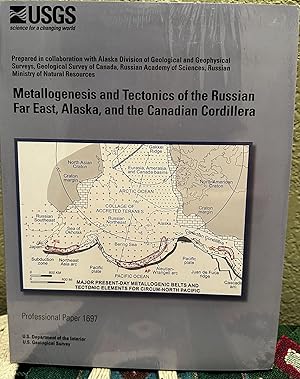
Metallogenesis and Tectonics of the Russian Far East, Alaska, and the Canadian Cordillera Professional Paper 1697
Editore: USGS, 2005
ISBN 10: 0607984074 ISBN 13: 9780607984071
Da: Crossroads Books, Reno, NV, U.S.A.
Membro dell'associazione: IOBA
Valutazione del venditore 5 su 5 stelle
Condizione: new. The Proterozoic and Phanerozoic metallogenic and tectonic evolution of the Russian Far East, Alaska, and the Canadian Cordillera is recorded in the cratons, craton margins, and orogenic collages of the Circum-North Pacific mountain belts that separate the North Pacific from the eastern North Asian and western North American Cratons. The collages consist of tectonostratigraphic terranes and contained metallogenic belts, which are composed of fragments of igneous arcs, accretionary-wedge and subduction-zone complexes, passive continental margins, and cratons. The terranes are overlapped by continental-margin-arc and sedimentary-basin assemblages and contained metallogenic belts. The metallogenic and geologic history of terranes, overlap assemblages, cratons, and craton margins has been complicated by postaccretion dismemberment and translation during strike-slip faulting that occurred subparallel to continental margins. Seven processes overlapping in time were responsible for most of metallogenic and geologic complexities of the region (1) In the Early and Middle Proterozoic, marine sedimentary basins developed on major cratons and were the loci for ironstone (Superior Fe) deposits and sediment-hosted Cu deposits that occur along both the North Asia Craton and North American Craton Margin. (2) In the Late Proterozoic, Late Devonian, and Early Carboniferous, major periods of rifting occurred along the ancestral margins of present-day Northeast Asia and northwestern North America. The rifting resulted in fragmentation of each continent, and formation of cratonal and passive continental-margin terranes that eventually migrated and accreted to other sites along the evolving margins of the original or adjacent continents. The rifting also resulted in formation of various massive-sulfide metallogenic belts. (3) From about the late Paleozoic through the mid-Cretaceous, a succession of island arcs and contained igneous-arc-related metallogenic belts and tectonically paired subduction zones formed near continental margins. (4) From about mainly the mid-Cretaceous through the present, a succession of continental-margin igneous arcs (some extending offshore into island arcs) and contained metallogenic belts, and tectonically paired subduction zones formed along the continental margins. (5) From about the Jurassic to the present, oblique convergence and rotations caused orogen-parallel sinistral, and then dextral displacements within the plate margins of the Northeast Asian and North American Cratons. The oblique convergences and rotations resulted in the fragmentation, displacement, and duplication of formerly more continuous arcs, subduction zones, passive continental margins, and contained metallogenic belts. These fragments were subsequently accreted along the margins of the expanding continental margins. (6) From the Early Jurassic through Tertiary, movement of the upper continental plates toward subduction zones resulted in strong plate coupling and accretion of the former island arcs, subduction zones, and contained metallogenic belts to continental margins. In this region, the multiple arc accretions were accompanied and followed by crustal thickening, anatexis, metamorphism, formation of collision-related metallogenic belts, and uplift; this resulted in the substantial growth of the North Asian and North American continents. (7) In the middle and late Cenozoic, oblique to orthogonal convergence of the Pacific Plate with present-day Alaska and Northeast Asia resulted in formation of the present ring of volcanoes and contained metallogenic belts around the Circum-North Pacific. Oblique convergence between the Pacific Plate and Alaska also resulted in major dextral-slip faulting in interior and southern Alaska and along the western part of the Aleutian- Wrangell arc. Associated with dextral-slip faulting was crustal extrusion of terranes from western Alaska into the Bering Sea. softcover, wrapped in shrink wrap, tight, crisp, 429 pages.
-
SOBORNO.
Editore: Fenix., Madrid., 1933
Da: Gulliver's Books Never Die, Madrid, M, Spagna
Valutazione del venditore 5 su 5 stelle
EUR 7,00
Spedizione EUR 25,00
Spedito da Spagna a U.S.A.Quantità: 1 disponibili
Aggiungi al carrello20x14. 61 pags. Cub. de Mauricio Amster. Trad. Ventura Bagues.
-
The Fascinating World of Bees
Editore: Mir Publishers, Moscow, 1986
Da: Vashon Island Books, Vashon, WA, U.S.A.
Valutazione del venditore 5 su 5 stelle
Hardcover. Condizione: Very Good. Condizione sovraccoperta: No Dust Jacket. Revised Edition. In pictorial glossy boards, 8vo, 308pp. A scarce Russian publication about Bees. Text in English. Size: 8vo - over 7¾" - 9¾". Book.
-

Osnovy khimii dlja detej i vzroslykh
Editore: Tsentrpoligraf, 2021
ISBN 10: 5227096538 ISBN 13: 9785227096531
EUR 29,00
Spedizione EUR 15,00
Spedito da Finlandia a U.S.A.Quantità: 10 disponibili
Aggiungi al carrelloCondizione: new. Pages: 416 Language: Russian. 9785227096531.
-
Trudnye povesti
Editore: Molodaya gvardiya, 1990
ISBN 10: 5235009363 ISBN 13: 9785235009363
Da: ISIA Media Verlag UG | Bukinist, Leipzig, Germania
Valutazione del venditore 5 su 5 stelle
EUR 7,27
Spedizione EUR 36,50
Spedito da Germania a U.S.A.Quantità: 1 disponibili
Aggiungi al carrelloHardcover/Hardback. Condizione: Fair. M.Bulgakov - Sobache serdtseA.Vanyukov - Russkie povesti trudnoj sudby: 1920-e godyI.Volnov - VstrechaS.Sergeev-Tsenskij - ZhestokostA.Tarasov-Rodionov - ShokoladB.Pilnyak - Povest nepogashennoj lunyS.Malashkin - Luna s pravoj storony, ili neobyknovennaya lyubov.
-
Trudnye povesti
Editore: Molodaya gvardiya, 1990
ISBN 10: 5235009363 ISBN 13: 9785235009363
Da: ISIA Media Verlag UG | Bukinist, Leipzig, Germania
Valutazione del venditore 5 su 5 stelle
EUR 7,74
Spedizione EUR 36,50
Spedito da Germania a U.S.A.Quantità: 1 disponibili
Aggiungi al carrelloHardcover/Hardback. Condizione: Good. M. Bulgakov - Sobache serdtse.A. Vanyukov - Russkie povesti trudnoj sudby: 1920-e gody.I. Volnov - Vstrecha.S. Sergeev-Tsenskij - Zhestokost.A. Tarasov-Rodionov - Shokolad.B. Pilnyak - Povest nepogashennoj luny.S. Malashkin - Luna s pravoj storony, ili neobyknovennaya lyubov.
-
Trudnye povesti
Editore: Molodaya gvardiya, 1990
ISBN 10: 5235009363 ISBN 13: 9785235009363
Da: ISIA Media Verlag UG | Bukinist, Leipzig, Germania
Valutazione del venditore 5 su 5 stelle
EUR 8,80
Spedizione EUR 36,50
Spedito da Germania a U.S.A.Quantità: 1 disponibili
Aggiungi al carrelloHardcover/Hardback. Condizione: Good. M.Bulgakov - Sobache serdtseA.Vanyukov - Russkie povesti trudnoj sudby: 1920-e godyI.Volnov - VstrechaS.Sergeev-Tsenskij - ZhestokostA.Tarasov-Rodionov - ShokoladB.Pilnyak - Povest nepogashennoj lunyS.Malashkin - Luna s pravoj storony, ili neobyknovennaya lyubov.
-
Problemy ekonomicheskoj i sotsialno-politicheskoj istorii Udmurtii
Lingua: Russo
Editore: Udmurtskij institut istorii, yazyka i literatury UrO RAN, 2001
ISBN 10: 5769111437 ISBN 13: 9785769111433
Da: ISIA Media Verlag UG | Bukinist, Leipzig, Germania
Valutazione del venditore 5 su 5 stelle
EUR 3,30
Spedizione EUR 36,50
Spedito da Germania a U.S.A.Quantità: 6 disponibili
Aggiungi al carrelloHardcover/Hardback. Condizione: Good. Sbornik statej po istorii ekonomicheskogo, sotsialnogo i politicheskogo razvitiya Udmurtii, okhvatyvayushchij razlichnye aspekty i periody vremeni, primenyayutsya printsipy marksistskogo istoricheskogo poznaniya, osveshchayutsya rol i uroven razvitiya krestyanstva na razlichnykh etapakh istorii.
-
Zarubezhnye svyazi Udmurtii
Lingua: Russo
Editore: Udmurtskij institut istorii, yazyka i literatury UrO RAN, 1999
ISBN 10: 5769108681 ISBN 13: 9785769108686
Da: ISIA Media Verlag UG | Bukinist, Leipzig, Germania
Valutazione del venditore 5 su 5 stelle
EUR 4,40
Spedizione EUR 36,50
Spedito da Germania a U.S.A.Quantità: 1 disponibili
Aggiungi al carrelloHardcover/Hardback. Condizione: Good. Kniga posvyashchena issledovaniyu zarubezhnykh svyazej Udmurtii v XIXNr.XX vekakh. Avtor analiziruet vzaimodejstvie Udmurtii s razlichnymi stranami i regionami mira v etot period, vklyuchaya momenty kulturnogo, politicheskogo i ekonomicheskogo obmena.
-

A Second in Moscow.
Editore: Progress Publishers, Moscow, 1968
Da: John Roberts, A.B.A., Bristol, Regno Unito
Membro dell'associazione: ABA
Valutazione del venditore 5 su 5 stelle
EUR 17,76
Spedizione EUR 29,92
Spedito da Regno Unito a U.S.A.Quantità: 1 disponibili
Aggiungi al carrelloOriginal Printed Paper Covers. Condizione: Good Plus. (54) pages, slight ring-stain on the front cover otherwise in good plus condition. Size: 22.5 x 16.5 cm.
-

EUR 12,90
Spedizione EUR 40,00
Spedito da Spagna a U.S.A.Quantità: 1 disponibili
Aggiungi al carrellotapa blanda. Condizione: Bien. Literatura.(82) España. 1930. 19 cm. 265 p. Encuadernación en tapa blanda de editorial ilustrada. Cubierta deslucida. (=3630239=) VA189.
-

Probabilistic Safety Assessment for Optimum Nuclear Power Plant Life Management (PLIM)
Lingua: Inglese
Editore: Woodhead Publishing Limited, 2012
ISBN 10: 0857093983 ISBN 13: 9780857093981
Da: Books Puddle, New York, NY, U.S.A.
Valutazione del venditore 4 su 5 stelle
Condizione: New. pp. 368.
-
Probabilistic Safety Assessment for Optimum Nuclear Power Plant Life Management (PLIM)
Lingua: Inglese
Editore: Woodhead Publishing Limited, 2012
ISBN 10: 0857093983 ISBN 13: 9780857093981
Da: Majestic Books, Hounslow, Regno Unito
Valutazione del venditore 4 su 5 stelle
EUR 93,53
Spedizione EUR 7,47
Spedito da Regno Unito a U.S.A.Quantità: 1 disponibili
Aggiungi al carrelloCondizione: New. pp. 368.
-

Physical Oceanography of the Frontal Zones in Sub-Arctic Seas (Volume 71) (Elsevier Oceanography Series, Volume 71)
Da: BennettBooksLtd, Los Angeles, CA, U.S.A.
Valutazione del venditore 5 su 5 stelle
Hardcover. Condizione: New. In shrink wrap. Looks like an interesting title!