
Importo totale (1 articolo articoli):
Destinazione ordine:

silva prasanna (25 risultati)
Vai alla pagina principale dei risultati di ricerca
Filtri di ricerca
Tipo di articolo
- Tutti i tipi di prodotto
- Libri (25)
- Riviste e Giornali (Nessun altro risultato corrispondente a questo perfezionamento)
- Fumetti (Nessun altro risultato corrispondente a questo perfezionamento)
- Spartiti (Nessun altro risultato corrispondente a questo perfezionamento)
- Arte, Stampe e Poster (Nessun altro risultato corrispondente a questo perfezionamento)
- Fotografie (Nessun altro risultato corrispondente a questo perfezionamento)
- Mappe (Nessun altro risultato corrispondente a questo perfezionamento)
- Manoscritti e Collezionismo cartaceo (Nessun altro risultato corrispondente a questo perfezionamento)
Condizioni Maggiori informazioni
- Nuovo (22)
- Come nuovo, Ottimo o Quasi ottimo (3)
- Molto buono o Buono (Nessun altro risultato corrispondente a questo perfezionamento)
- Discreto o Mediocre (Nessun altro risultato corrispondente a questo perfezionamento)
- Come descritto (Nessun altro risultato corrispondente a questo perfezionamento)
Legatura
Ulteriori caratteristiche
- Prima ed. (Nessun altro risultato corrispondente a questo perfezionamento)
- Copia autograf. (Nessun altro risultato corrispondente a questo perfezionamento)
- Sovracoperta (Nessun altro risultato corrispondente a questo perfezionamento)
- Con foto (11)
- Non Print on Demand (25)
Lingua (1)
Prezzo
- Qualsiasi prezzo
- Inferiore a EUR 20 (Nessun altro risultato corrispondente a questo perfezionamento)
- EUR 20 a EUR 45 (Nessun altro risultato corrispondente a questo perfezionamento)
- Superiore a EUR 45
Spedizione gratuita
Paese del venditore
Valutazione venditore
-
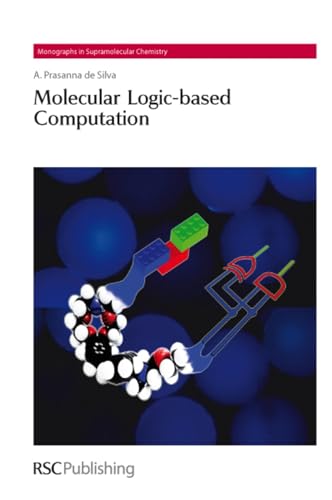
MOLECULAR LOGIC-BASED COMPUTATION (MONOGRAPHS IN SUPRAMOLECULAR CHEMISTRY)
Editore: Royal Society of Chemistry, 2012
ISBN 10: 1849731489 ISBN 13: 9781849731485
Lingua: Inglese
Da: Basi6 International, Irving, TX, U.S.A.
Valutazione del venditore 5 su 5 stelle

Condizione: Brand New. New. US edition. Expediting shipping for all USA and Europe orders excluding PO Box. Excellent Customer Service.
-
Molecular Logic-Based Computation
Editore: Royal Society of Chemistry RSC, 2012
ISBN 10: 1849731489 ISBN 13: 9781849731485
Lingua: Inglese
Da: Books Puddle, New York, NY, U.S.A.
Valutazione del venditore 4 su 5 stelle

Condizione: New. pp. 416.
-
Molecular Logic-Based Computation (Monographs In Supramolecular Chemistry)
Editore: Royal Society of Chemistry, 2012
ISBN 10: 1849731489 ISBN 13: 9781849731485
Lingua: Inglese
Da: Romtrade Corp., STERLING HEIGHTS, MI, U.S.A.
Valutazione del venditore 5 su 5 stelle
Condizione: New. This is a Brand-new US Edition. This Item may be shipped from US or any other country as we have multiple locations worldwide.
-

Molecular logic calculation(Chinese Edition)
Editore: East China University of Technology Press, 2014
ISBN 10: 7562840369 ISBN 13: 9787562840367
Lingua: Inglese
EUR 110,21
EUR 15,43 shipping
Ships from Cina to U.S.A.Quantità: 5 disponibili
Aggiungi al carrellopaperback. Condizione: New. Pub Date: 2014-11-01 Pages: 384 Language: Chinese. English Publisher: East China University of Technology Press. after a brief introduction to the field of development. the author introduces some basic knowledge of logic. calculations. and photochemical principles. The book describes in detail based on Boolean logic and dual-input single-input-driven all types of logic gates. Each logic gate systems are used to illustrate specific examples. this is the biggest highlight of the book. Especiall.
-
Molecular Logic-Based Computation
Editore: Royal Society of Chemistry, 2012
ISBN 10: 1849731489 ISBN 13: 9781849731485
Lingua: Inglese
Da: Majestic Books, Hounslow, Regno Unito
Valutazione del venditore 4 su 5 stelle
EUR 119,75
EUR 7,44 shipping
Ships from Regno Unito to U.S.A.Quantità: 1 disponibili
Aggiungi al carrelloCondizione: New. pp. 416.
-
Molecular Logic-based Computation (Monographs in Supramolecular Chemistry)
Editore: Royal Society of Chemistry, 2012
ISBN 10: 1849731489 ISBN 13: 9781849731485
Lingua: Inglese
EUR 132,88
Spedizione gratuita
Ships from Australia to U.S.A.Quantità: 3 disponibili
Aggiungi al carrelloBrand new book. Fast ship. Please provide full street address as we are not able to ship to P O box address.
-
Molecular Logic-Based Computation
Editore: Royal Society of Chemistry, 2012
ISBN 10: 1849731489 ISBN 13: 9781849731485
Lingua: Inglese
Da: Biblios, Frankfurt am main, HESSE, Germania
Valutazione del venditore 4 su 5 stelle
EUR 120,90
EUR 9,95 shipping
Ships from Germania to U.S.A.Quantità: 1 disponibili
Aggiungi al carrelloCondizione: New. pp. 416.
-

Molecular Logic-based Computation
Editore: Royal Society of Chemistry, 2012
ISBN 10: 1849731489 ISBN 13: 9781849731485
Lingua: Inglese
Da: GreatBookPrices, Columbia, MD, U.S.A.
Valutazione del venditore 5 su 5 stelle
EUR 190,71
EUR 2,26 shipping
Ships within U.S.A.Quantità: Più di 20 disponibili
Aggiungi al carrelloCondizione: New.
-
Molecular Logic-based Computation (Monographs in Supramolecular Chemistry)
Editore: Royal Society of Chemistry, 2012
ISBN 10: 1849731489 ISBN 13: 9781849731485
Lingua: Inglese
Da: Lucky's Textbooks, Dallas, TX, U.S.A.
Valutazione del venditore 5 su 5 stelle
EUR 189,53
EUR 3,42 shipping
Ships within U.S.A.Quantità: Più di 20 disponibili
Aggiungi al carrelloCondizione: New.
-
Molecular Logic-based Computation
Editore: Royal Society of Chemistry, 2012
ISBN 10: 1849731489 ISBN 13: 9781849731485
Lingua: Inglese
Da: PBShop.store UK, Fairford, GLOS, Regno Unito
Valutazione del venditore 5 su 5 stelle
EUR 193,96
EUR 7,73 shipping
Ships from Regno Unito to U.S.A.Quantità: 15 disponibili
Aggiungi al carrelloHRD. Condizione: New. New Book. Shipped from UK. Established seller since 2000.
-
Molecular Logic-based Computation
Editore: Royal Society of Chemistry, 2012
ISBN 10: 1849731489 ISBN 13: 9781849731485
Lingua: Inglese
Da: PBShop.store US, Wood Dale, IL, U.S.A.
Valutazione del venditore 5 su 5 stelle
HRD. Condizione: New. New Book. Shipped from UK. Established seller since 2000.
-

Molecular Logic-based Computation
Editore: Royal Society of Chemistry, 2012
ISBN 10: 1849731489 ISBN 13: 9781849731485
Lingua: Inglese
Da: GreatBookPricesUK, Woodford Green, Regno Unito
Valutazione del venditore 5 su 5 stelle
EUR 193,95
EUR 17,16 shipping
Ships from Regno Unito to U.S.A.Quantità: Più di 20 disponibili
Aggiungi al carrelloCondizione: New.
-

Molecular Logic-based Computation
Editore: Royal Society of Chemistry, GB, 2012
ISBN 10: 1849731489 ISBN 13: 9781849731485
Lingua: Inglese
EUR 215,50
Spedizione gratuita
Ships within U.S.A.Quantità: Più di 20 disponibili
Aggiungi al carrelloHardback. Condizione: New. We all learn - in schools, factories, bars and streets. We gather, store, process and transmit information in society. Molecular systems involved in our senses and within our brains allow all this to happen and molecular systems allow living things of all kinds to handle information for the purpose of survival and growth. Nevertheless, the vital link between molecules and computation was not generally appreciated until a few decades ago. Semiconductor-based information technology had penetrated society at many levels and the interest in maintaining momentum of this revolution led to the consideration of molecules, among others, as possible information handlers. Such an overlap between the recent engineering-oriented revolution with the ancient biology-oriented success story is very interesting and George Boole's times in Ireland 150 years ago produced the logic ideas that provide the foundations of computation to this day. Molecular logic and computation is a field which is 17 years young, has had a healthy growth and is a story which deserves to be told. It is a growing branch of chemical science which highlights the connection between information technology (engineering and biological) and chemistry. The author and co-workers of this publication launched molecular logic as an experimental field by publishing the first research in the primary literature in 1993 and are uniquely placed to recount how the field has grown. There is no other book at present on molecular logic and computation and is more comprehensive than that found in any review available so far. It shows how designed molecules can play the role of information processors in a wide variety of situations, once we are educated by those information processors already available in the semiconductor electronics business and in the natural world. Following a short history of the field, is a set of primers on logic, computing and photochemical principles which are an essential basis in this field. The book covers all of the Boolean logic gates driven by a single input and all of those with double inputs and the wide range of designs which lie beneath these gates is a particular highlight. The easily-available diversity of chemical systems is another highlight, especially when it leads to reconfigurable logic gates. Further on in the book, molecular arithmetic and other more complex logic operations, including those with a memory and those which stray beyond binary are covered. Then follows molecular computing approaches which lie outside the Boolean blueprint, including quantum phenomena and finally, the book catalogues the useful real-life applications of molecular logic and computation which are already available. This book is an authoritative, state of the art, reference and a 'one-stop-shop' concerning the current state of the field for scientists, academics and postgraduate students.
-
Molecular Logic-based Computation (Monographs in Supramolecular Chemistry)
Editore: Royal Society of Chemistry, 2012
ISBN 10: 1849731489 ISBN 13: 9781849731485
Lingua: Inglese
Da: Ria Christie Collections, Uxbridge, Regno Unito
Valutazione del venditore 5 su 5 stelle
EUR 209,24
EUR 13,71 shipping
Ships from Regno Unito to U.S.A.Quantità: Più di 20 disponibili
Aggiungi al carrelloCondizione: New. In.
-

Molecular Logic-based Computation
Editore: Royal Society of Chemistry, 2012
ISBN 10: 1849731489 ISBN 13: 9781849731485
Lingua: Inglese
Da: GreatBookPricesUK, Woodford Green, Regno Unito
Valutazione del venditore 5 su 5 stelle
EUR 219,19
EUR 17,16 shipping
Ships from Regno Unito to U.S.A.Quantità: Più di 20 disponibili
Aggiungi al carrelloCondizione: As New. Unread book in perfect condition.
-
Molecular Logic-based Computation (Monographs in Supramolecular Chemistry, Volume 12)
Editore: Royal Society of Chemistry, 2012
ISBN 10: 1849731489 ISBN 13: 9781849731485
Lingua: Inglese
Da: Mispah books, Redhill, SURRE, Regno Unito
Valutazione del venditore 4 su 5 stelle
EUR 209,77
EUR 28,60 shipping
Ships from Regno Unito to U.S.A.Quantità: 1 disponibili
Aggiungi al carrelloHardcover. Condizione: Like New. Like New. Ships from Multiple Locations. book.
-

Molecular Logic-based Computation
Editore: Royal Society of Chemistry, 2012
ISBN 10: 1849731489 ISBN 13: 9781849731485
Lingua: Inglese
Da: GreatBookPrices, Columbia, MD, U.S.A.
Valutazione del venditore 5 su 5 stelle
EUR 243,18
EUR 2,26 shipping
Ships within U.S.A.Quantità: Più di 20 disponibili
Aggiungi al carrelloCondizione: As New. Unread book in perfect condition.
-
Molecular Logic-based Computation (Hardcover)
Editore: Royal Society of Chemistry, Cambridge, 2012
ISBN 10: 1849731489 ISBN 13: 9781849731485
Lingua: Inglese
Da: Grand Eagle Retail, Bensenville, IL, U.S.A.
Valutazione del venditore 5 su 5 stelle
Hardcover. Condizione: new. Hardcover. We all learn - in schools, factories, bars and streets. We gather, store, process and transmit information in society. Molecular systems involved in our senses and within our brains allow all this to happen and molecular systems allow living things of all kinds to handle information for the purpose of survival and growth. Nevertheless, the vital link between molecules and computation was not generally appreciated until a few decades ago. Semiconductor-based information technology had penetrated society at many levels and the interest in maintaining momentum of this revolution led to the consideration of molecules, among others, as possible information handlers. Such an overlap between the recent engineering-oriented revolution with the ancient biology-oriented success story is very interesting and George Boole's times in Ireland 150 years ago produced the logic ideas that provide the foundations of computation to this day. Molecular logic and computation is a field which is 17 years young, has had a healthy growth and is a story which deserves to be told. It is a growing branch of chemical science which highlights the connection between information technology (engineering and biological) and chemistry. The author and co-workers of this publication launched molecular logic as an experimental field by publishing the first research in the primary literature in 1993 and are uniquely placed to recount how the field has grown. There is no other book at present on molecular logic and computation and is more comprehensive than that found in any review available so far. It shows how designed molecules can play the role of information processors in a wide variety of situations, once we are educated by those information processors already available in the semiconductor electronics business and in the natural world. Following a short history of the field, is a set of primers on logic, computing and photochemical principles which are an essential basis in this field. The book covers all of the Boolean logic gates driven by a single input and all of those with double inputs and the wide range of designs which lie beneath these gates is a particular highlight. The easily-available diversity of chemical systems is another highlight, especially when it leads to reconfigurable logic gates. Further on in the book, molecular arithmetic and other more complex logic operations, including those with a memory and those which stray beyond binary are covered. Then follows molecular computing approaches which lie outside the Boolean blueprint, including quantum phenomena and finally, the book catalogues the useful real-life applications of molecular logic and computation which are already available. This book is an authoritative, state of the art, reference and a 'one-stop-shop' concerning the current state of the field for scientists, academics and postgraduate students. A unique book on a growing branch of chemical science which highlights the connection between information technology (engineering and biological) and chemistry. Shipping may be from multiple locations in the US or from the UK, depending on stock availability.
-

Molecular Logic-based Computation
Editore: Royal Society of Chemistry, GB, 2012
ISBN 10: 1849731489 ISBN 13: 9781849731485
Lingua: Inglese
Da: Rarewaves.com USA, London, LONDO, Regno Unito
Valutazione del venditore 5 su 5 stelle
EUR 260,67
Spedizione gratuita
Ships from Regno Unito to U.S.A.Quantità: 6 disponibili
Aggiungi al carrelloHardback. Condizione: New. We all learn - in schools, factories, bars and streets. We gather, store, process and transmit information in society. Molecular systems involved in our senses and within our brains allow all this to happen and molecular systems allow living things of all kinds to handle information for the purpose of survival and growth. Nevertheless, the vital link between molecules and computation was not generally appreciated until a few decades ago. Semiconductor-based information technology had penetrated society at many levels and the interest in maintaining momentum of this revolution led to the consideration of molecules, among others, as possible information handlers. Such an overlap between the recent engineering-oriented revolution with the ancient biology-oriented success story is very interesting and George Boole's times in Ireland 150 years ago produced the logic ideas that provide the foundations of computation to this day. Molecular logic and computation is a field which is 17 years young, has had a healthy growth and is a story which deserves to be told. It is a growing branch of chemical science which highlights the connection between information technology (engineering and biological) and chemistry. The author and co-workers of this publication launched molecular logic as an experimental field by publishing the first research in the primary literature in 1993 and are uniquely placed to recount how the field has grown. There is no other book at present on molecular logic and computation and is more comprehensive than that found in any review available so far. It shows how designed molecules can play the role of information processors in a wide variety of situations, once we are educated by those information processors already available in the semiconductor electronics business and in the natural world. Following a short history of the field, is a set of primers on logic, computing and photochemical principles which are an essential basis in this field. The book covers all of the Boolean logic gates driven by a single input and all of those with double inputs and the wide range of designs which lie beneath these gates is a particular highlight. The easily-available diversity of chemical systems is another highlight, especially when it leads to reconfigurable logic gates. Further on in the book, molecular arithmetic and other more complex logic operations, including those with a memory and those which stray beyond binary are covered. Then follows molecular computing approaches which lie outside the Boolean blueprint, including quantum phenomena and finally, the book catalogues the useful real-life applications of molecular logic and computation which are already available. This book is an authoritative, state of the art, reference and a 'one-stop-shop' concerning the current state of the field for scientists, academics and postgraduate students.
-

Molecular Logic-based Computation
Editore: Royal Society of Chemistry, GB, 2012
ISBN 10: 1849731489 ISBN 13: 9781849731485
Lingua: Inglese
Da: Rarewaves USA United, OSWEGO, IL, U.S.A.
Valutazione del venditore 5 su 5 stelle
EUR 221,02
EUR 42,86 shipping
Ships within U.S.A.Quantità: Più di 20 disponibili
Aggiungi al carrelloHardback. Condizione: New. We all learn - in schools, factories, bars and streets. We gather, store, process and transmit information in society. Molecular systems involved in our senses and within our brains allow all this to happen and molecular systems allow living things of all kinds to handle information for the purpose of survival and growth. Nevertheless, the vital link between molecules and computation was not generally appreciated until a few decades ago. Semiconductor-based information technology had penetrated society at many levels and the interest in maintaining momentum of this revolution led to the consideration of molecules, among others, as possible information handlers. Such an overlap between the recent engineering-oriented revolution with the ancient biology-oriented success story is very interesting and George Boole's times in Ireland 150 years ago produced the logic ideas that provide the foundations of computation to this day. Molecular logic and computation is a field which is 17 years young, has had a healthy growth and is a story which deserves to be told. It is a growing branch of chemical science which highlights the connection between information technology (engineering and biological) and chemistry. The author and co-workers of this publication launched molecular logic as an experimental field by publishing the first research in the primary literature in 1993 and are uniquely placed to recount how the field has grown. There is no other book at present on molecular logic and computation and is more comprehensive than that found in any review available so far. It shows how designed molecules can play the role of information processors in a wide variety of situations, once we are educated by those information processors already available in the semiconductor electronics business and in the natural world. Following a short history of the field, is a set of primers on logic, computing and photochemical principles which are an essential basis in this field. The book covers all of the Boolean logic gates driven by a single input and all of those with double inputs and the wide range of designs which lie beneath these gates is a particular highlight. The easily-available diversity of chemical systems is another highlight, especially when it leads to reconfigurable logic gates. Further on in the book, molecular arithmetic and other more complex logic operations, including those with a memory and those which stray beyond binary are covered. Then follows molecular computing approaches which lie outside the Boolean blueprint, including quantum phenomena and finally, the book catalogues the useful real-life applications of molecular logic and computation which are already available. This book is an authoritative, state of the art, reference and a 'one-stop-shop' concerning the current state of the field for scientists, academics and postgraduate students.
-

Molecular Logic-based Computation
Editore: ROYAL SOCIETY OF CHEMISTRY, 2012
ISBN 10: 1849731489 ISBN 13: 9781849731485
Lingua: Inglese
EUR 211,88
EUR 48,99 shipping
Ships from Germania to U.S.A.Quantità: Più di 20 disponibili
Aggiungi al carrelloGebunden. Condizione: New. A unique book on a growing branch of chemical science which highlights the connection between information technology (engineering and biological) and chemistry.Über den AutorrnrnA Prasanna de Silva is a Professor in the School of Chemis.
-
Molecular Logic-based Computation
Editore: Royal Society of Chemistry, 2012
ISBN 10: 1849731489 ISBN 13: 9781849731485
Lingua: Inglese
Da: Revaluation Books, Exeter, Regno Unito
Valutazione del venditore 5 su 5 stelle
EUR 285,02
EUR 14,30 shipping
Ships from Regno Unito to U.S.A.Quantità: 2 disponibili
Aggiungi al carrelloHardcover. Condizione: Brand New. 397 pages. 9.25x6.25x1.25 inches. In Stock.
-

Molecular Logic-based Computation
Editore: Royal Society of Chemistry, GB, 2012
ISBN 10: 1849731489 ISBN 13: 9781849731485
Lingua: Inglese
Da: Rarewaves.com UK, London, Regno Unito
Valutazione del venditore 5 su 5 stelle
EUR 247,53
EUR 74,37 shipping
Ships from Regno Unito to U.S.A.Quantità: 6 disponibili
Aggiungi al carrelloHardback. Condizione: New. We all learn - in schools, factories, bars and streets. We gather, store, process and transmit information in society. Molecular systems involved in our senses and within our brains allow all this to happen and molecular systems allow living things of all kinds to handle information for the purpose of survival and growth. Nevertheless, the vital link between molecules and computation was not generally appreciated until a few decades ago. Semiconductor-based information technology had penetrated society at many levels and the interest in maintaining momentum of this revolution led to the consideration of molecules, among others, as possible information handlers. Such an overlap between the recent engineering-oriented revolution with the ancient biology-oriented success story is very interesting and George Boole's times in Ireland 150 years ago produced the logic ideas that provide the foundations of computation to this day. Molecular logic and computation is a field which is 17 years young, has had a healthy growth and is a story which deserves to be told. It is a growing branch of chemical science which highlights the connection between information technology (engineering and biological) and chemistry. The author and co-workers of this publication launched molecular logic as an experimental field by publishing the first research in the primary literature in 1993 and are uniquely placed to recount how the field has grown. There is no other book at present on molecular logic and computation and is more comprehensive than that found in any review available so far. It shows how designed molecules can play the role of information processors in a wide variety of situations, once we are educated by those information processors already available in the semiconductor electronics business and in the natural world. Following a short history of the field, is a set of primers on logic, computing and photochemical principles which are an essential basis in this field. The book covers all of the Boolean logic gates driven by a single input and all of those with double inputs and the wide range of designs which lie beneath these gates is a particular highlight. The easily-available diversity of chemical systems is another highlight, especially when it leads to reconfigurable logic gates. Further on in the book, molecular arithmetic and other more complex logic operations, including those with a memory and those which stray beyond binary are covered. Then follows molecular computing approaches which lie outside the Boolean blueprint, including quantum phenomena and finally, the book catalogues the useful real-life applications of molecular logic and computation which are already available. This book is an authoritative, state of the art, reference and a 'one-stop-shop' concerning the current state of the field for scientists, academics and postgraduate students.
-

EUR 296,52
EUR 65,33 shipping
Ships from Germania to U.S.A.Quantità: 2 disponibili
Aggiungi al carrelloBuch. Condizione: Neu. Neuware - Molecular logic-based computation is a relatively young field but mature enough for its story to be told. It is a growing branch of chemical science which highlights the connection between information technology (engineering and biological) and chemistry. With his co-workers, the author launched molecular logic as an experimental field by publishing the first research in the primary literature in 1993 and is uniquely placed to recount how the field has grown. There is no other book at present on molecular logic and computation. It shows how designed molecules can play the role of information processors in a wide variety of situations, once we are educated by those information processors already available in the semiconductor electronics business and in the natural world. Following a short history of the field, is a set of primers on logic, computing and photochemical principles which are an essential basis in this field. The book covers all of the Boolean logic gates driven by a single input and all of those with double inputs. The wide range of designs which lie beneath these gates is a particular highlight. The easily-available diversity of chemical systems is another highlight, especially when it leads to reconfigurable logic gates. Further on in the book, molecular arithmetic and other more complex logic operations, including those with a memory and those which stray beyond binary are covered. Then follows molecular logic with quantum aspects and finally, the book catalogues the useful real-life applications of molecular logic and computation which are already available. This book is an authoritative, comprehensive, state of the art, reference and a 'one-stop-shop' for scientists, academics and postgraduate students in this field.
-
Molecular Logic-based Computation (Hardcover)
Editore: Royal Society of Chemistry, Cambridge, 2012
ISBN 10: 1849731489 ISBN 13: 9781849731485
Lingua: Inglese
Da: AussieBookSeller, Truganina, VIC, Australia
Valutazione del venditore 5 su 5 stelle
EUR 361,73
EUR 31,72 shipping
Ships from Australia to U.S.A.Quantità: 1 disponibili
Aggiungi al carrelloHardcover. Condizione: new. Hardcover. We all learn - in schools, factories, bars and streets. We gather, store, process and transmit information in society. Molecular systems involved in our senses and within our brains allow all this to happen and molecular systems allow living things of all kinds to handle information for the purpose of survival and growth. Nevertheless, the vital link between molecules and computation was not generally appreciated until a few decades ago. Semiconductor-based information technology had penetrated society at many levels and the interest in maintaining momentum of this revolution led to the consideration of molecules, among others, as possible information handlers. Such an overlap between the recent engineering-oriented revolution with the ancient biology-oriented success story is very interesting and George Boole's times in Ireland 150 years ago produced the logic ideas that provide the foundations of computation to this day. Molecular logic and computation is a field which is 17 years young, has had a healthy growth and is a story which deserves to be told. It is a growing branch of chemical science which highlights the connection between information technology (engineering and biological) and chemistry. The author and co-workers of this publication launched molecular logic as an experimental field by publishing the first research in the primary literature in 1993 and are uniquely placed to recount how the field has grown. There is no other book at present on molecular logic and computation and is more comprehensive than that found in any review available so far. It shows how designed molecules can play the role of information processors in a wide variety of situations, once we are educated by those information processors already available in the semiconductor electronics business and in the natural world. Following a short history of the field, is a set of primers on logic, computing and photochemical principles which are an essential basis in this field. The book covers all of the Boolean logic gates driven by a single input and all of those with double inputs and the wide range of designs which lie beneath these gates is a particular highlight. The easily-available diversity of chemical systems is another highlight, especially when it leads to reconfigurable logic gates. Further on in the book, molecular arithmetic and other more complex logic operations, including those with a memory and those which stray beyond binary are covered. Then follows molecular computing approaches which lie outside the Boolean blueprint, including quantum phenomena and finally, the book catalogues the useful real-life applications of molecular logic and computation which are already available. This book is an authoritative, state of the art, reference and a 'one-stop-shop' concerning the current state of the field for scientists, academics and postgraduate students. A unique book on a growing branch of chemical science which highlights the connection between information technology (engineering and biological) and chemistry. Shipping may be from our Sydney, NSW warehouse or from our UK or US warehouse, depending on stock availability.

