

Importo totale (1 articolo articoli):
Destinazione ordine:

sunita sharma basnet (7 risultati)
Vai alla pagina principale dei risultati di ricerca
Filtri di ricerca
Tipo di articolo
- Tutti i tipi di prodotto
- Libri (7)
- Riviste e Giornali (Nessun altro risultato corrispondente a questo perfezionamento)
- Fumetti (Nessun altro risultato corrispondente a questo perfezionamento)
- Spartiti (Nessun altro risultato corrispondente a questo perfezionamento)
- Arte, Stampe e Poster (Nessun altro risultato corrispondente a questo perfezionamento)
- Fotografie (Nessun altro risultato corrispondente a questo perfezionamento)
- Mappe (Nessun altro risultato corrispondente a questo perfezionamento)
- Manoscritti e Collezionismo cartaceo (Nessun altro risultato corrispondente a questo perfezionamento)
Condizioni Maggiori informazioni
- Nuovo (7)
- Come nuovo, Ottimo o Quasi ottimo (Nessun altro risultato corrispondente a questo perfezionamento)
- Molto buono o Buono (Nessun altro risultato corrispondente a questo perfezionamento)
- Discreto o Mediocre (Nessun altro risultato corrispondente a questo perfezionamento)
- Come descritto (Nessun altro risultato corrispondente a questo perfezionamento)
Legatura
- Tutte
- Rilegato (Nessun altro risultato corrispondente a questo perfezionamento)
- Brossura (7)
Ulteriori caratteristiche
- Prima ed. (Nessun altro risultato corrispondente a questo perfezionamento)
- Copia autograf. (Nessun altro risultato corrispondente a questo perfezionamento)
- Sovracoperta (Nessun altro risultato corrispondente a questo perfezionamento)
- Con foto (4)
- Non Print on Demand (1)
Lingua (1)
Prezzo
- Qualsiasi prezzo
- Inferiore a EUR 20 (Nessun altro risultato corrispondente a questo perfezionamento)
- EUR 20 a EUR 45
- Superiore a EUR 45
Spedizione gratuita
- Spedizione gratuita in U.S.A. (Nessun altro risultato corrispondente a questo perfezionamento)
Paese del venditore
Valutazione venditore
-

Female Poverty Through Gender Prespective
Da: Books Puddle, New York, NY, U.S.A.
Valutazione del venditore 4 su 5 stelle

Condizione: New. pp. 76.
-
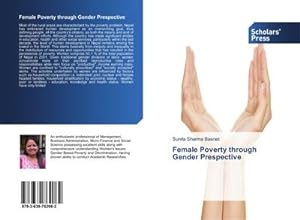
Female Poverty through Gender Prespective
Da: BuchWeltWeit Ludwig Meier e.K., Bergisch Gladbach, Germania
Valutazione del venditore 5 su 5 stelle

EUR 45,90
Spedizione EUR 23,00
Spedito da Germania a U.S.A.Quantità: 2 disponibili
Aggiungi al carrelloTaschenbuch. Condizione: Neu. This item is printed on demand - it takes 3-4 days longer - Neuware -Most of the rural areas are characterized by the poverty problem. Nepal has embraced human development as an overarching goal, thus defining people, all the country's citizens, as both the means and end of development efforts. Although the country has made significant strides in education, health and other social services, particularly within the last decade, the level of human development in Nepal remains among the lowest in the World. This stems basically from inequity and inequality in the distribution of resources and opportunities that has resulted in the persistence of poverty. Women comprise 50.1 % of the total population of Nepal in 2001. Given traditional gender divisions of labor, women concentrate more on their ascribed reproductive roles and responsibilities while men focus on 'productive', income earning roles. Women are confined to 'culturally prescribed' and 'socially accepted' works. The activities undertaken by women are influenced by factors such as household composition i.e. extended/ joint, nuclear and female headed families, household stratification by economic status - wealthy, poor or landless - education, knowledge and health status. Women have only limited 76 pp. Englisch.
-
Female Poverty Through Gender Prespective
Da: Majestic Books, Hounslow, Regno Unito
Valutazione del venditore 4 su 5 stelle
EUR 68,40
Spedizione EUR 7,46
Spedito da Regno Unito a U.S.A.Quantità: 4 disponibili
Aggiungi al carrelloCondizione: New. Print on Demand pp. 76.
-
Female Poverty Through Gender Prespective
Da: Biblios, Frankfurt am main, HESSE, Germania
Valutazione del venditore 4 su 5 stelle
EUR 70,00
Spedizione EUR 9,95
Spedito da Germania a U.S.A.Quantità: 4 disponibili
Aggiungi al carrelloCondizione: New. PRINT ON DEMAND pp. 76.
-

EUR 38,74
Spedizione EUR 48,99
Spedito da Germania a U.S.A.Quantità: Più di 20 disponibili
Aggiungi al carrelloCondizione: New. Dieser Artikel ist ein Print on Demand Artikel und wird nach Ihrer Bestellung fuer Sie gedruckt. Autor/Autorin: Sharma Basnet SunitaAn enthusiastic professional of Management, Business Administration, Micro-Finance and Social Science possessing excellent skills along with comprehensive understanding Women s Issues Gender Based Poverty and Dis.
-

Female Poverty through Gender Prespective
Da: buchversandmimpf2000, Emtmannsberg, BAYE, Germania
Valutazione del venditore 5 su 5 stelle
EUR 45,90
Spedizione EUR 60,00
Spedito da Germania a U.S.A.Quantità: 1 disponibili
Aggiungi al carrelloTaschenbuch. Condizione: Neu. This item is printed on demand - Print on Demand Titel. Neuware -Most of the rural areas are characterized by the poverty problem. Nepal has embraced human development as an overarching goal, thus defining people, all the country's citizens, as both the means and end of development efforts. Although the country has made significant strides in education, health and other social services, particularly within the last decade, the level of human development in Nepal remains among the lowest in the World. This stems basically from inequity and inequality in the distribution of resources and opportunities that has resulted in the persistence of poverty. Women comprise 50.1 % of the total population of Nepal in 2001. Given traditional gender divisions of labor, women concentrate more on their ascribed reproductive roles and responsibilities while men focus on 'productive', income earning roles. Women are confined to 'culturally prescribed' and 'socially accepted' works. The activities undertaken by women are influenced by factors such as household composition i.e. extended/ joint, nuclear and female headed families, household stratification by economic status - wealthy, poor or landless - education, knowledge and health status. Women have only limitedVDM Verlag, Dudweiler Landstraße 99, 66123 Saarbrücken 76 pp. Englisch.
-

EUR 45,90
Spedizione EUR 60,66
Spedito da Germania a U.S.A.Quantità: 1 disponibili
Aggiungi al carrelloTaschenbuch. Condizione: Neu. nach der Bestellung gedruckt Neuware - Printed after ordering - Most of the rural areas are characterized by the poverty problem. Nepal has embraced human development as an overarching goal, thus defining people, all the country's citizens, as both the means and end of development efforts. Although the country has made significant strides in education, health and other social services, particularly within the last decade, the level of human development in Nepal remains among the lowest in the World. This stems basically from inequity and inequality in the distribution of resources and opportunities that has resulted in the persistence of poverty. Women comprise 50.1 % of the total population of Nepal in 2001. Given traditional gender divisions of labor, women concentrate more on their ascribed reproductive roles and responsibilities while men focus on 'productive', income earning roles. Women are confined to 'culturally prescribed' and 'socially accepted' works. The activities undertaken by women are influenced by factors such as household composition i.e. extended/ joint, nuclear and female headed families, household stratification by economic status - wealthy, poor or landless - education, knowledge and health status. Women have only limited.

