Importo totale (1 articolo articoli):
Destinazione ordine:

sutcliffe legrand jacques (1 risultati)
Vai alla pagina principale dei risultati di ricerca
Filtri di ricerca
Tipo di articolo
- Tutti i tipi di prodotto
- Libri (1)
- Riviste e Giornali (Nessun altro risultato corrispondente a questo perfezionamento)
- Fumetti (Nessun altro risultato corrispondente a questo perfezionamento)
- Spartiti (Nessun altro risultato corrispondente a questo perfezionamento)
- Arte, Stampe e Poster (Nessun altro risultato corrispondente a questo perfezionamento)
- Fotografie (Nessun altro risultato corrispondente a questo perfezionamento)
- Mappe (Nessun altro risultato corrispondente a questo perfezionamento)
- Manoscritti e Collezionismo cartaceo (Nessun altro risultato corrispondente a questo perfezionamento)
Condizioni Maggiori informazioni
- Nuovo (Nessun altro risultato corrispondente a questo perfezionamento)
- Come nuovo, Ottimo o Quasi ottimo (Nessun altro risultato corrispondente a questo perfezionamento)
- Molto buono o Buono (Nessun altro risultato corrispondente a questo perfezionamento)
- Discreto o Mediocre (Nessun altro risultato corrispondente a questo perfezionamento)
- Come descritto (1)
Legatura
- Tutte
- Rilegato (Nessun altro risultato corrispondente a questo perfezionamento)
- Brossura (Nessun altro risultato corrispondente a questo perfezionamento)
Ulteriori caratteristiche
- Prima ed. (Nessun altro risultato corrispondente a questo perfezionamento)
- Copia autograf. (Nessun altro risultato corrispondente a questo perfezionamento)
- Sovracoperta (Nessun altro risultato corrispondente a questo perfezionamento)
- Con foto (1)
- Non Print on Demand (1)
Lingua (1)
Prezzo
- Qualsiasi prezzo
- Inferiore a EUR 20 (Nessun altro risultato corrispondente a questo perfezionamento)
- EUR 20 a EUR 40 (Nessun altro risultato corrispondente a questo perfezionamento)
- Superiore a EUR 40
Spedizione gratuita
- Spedizione gratuita in U.S.A. (Nessun altro risultato corrispondente a questo perfezionamento)
Paese del venditore
Valutazione venditore
-
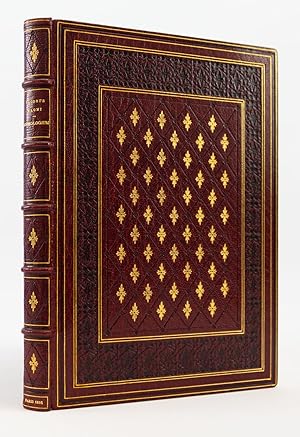
SOPHOLOGIUM . . . NOVITER AUCTUM ET RECOGNITUM ET VITA EIUSDEM CUM EPISTOLA BERNARDI PRO RE FAMILIARI GUBERNANDA. ET REGULIS JOANNIS GERSONIS DE MODO VIVENDI
Editore: Wolfgang Hopyl [for himself and Franciscus Birckmann in London], Paris, 1516
Da: Phillip J. Pirages Rare Books (ABAA), McMinnville, OR, U.S.A.
Membro dell'associazione: ABAA ILAB
Valutazione del venditore 4 su 5 stelle

242 x 168 mm. (9 1/2 x 6 1/2"). 4 p.l. C [100] leaves. HANDSOME MAROON CRUSHED MOROCCO DECORATED IN GILT AND BLIND BY SANGORSKI & SUTCLIFFE (stamp-signed on front turn-in), covers with central panel diapered in blind, the compartments with a gilt Maltese cross, this framed by gilt rules, a wide blind-tooled foliate border enclosed by gilt and blind rules, raised bands, spine compartments with gilt Maltese cross within a blind-tooled lozenge, gilt lettering, turn-ins with gilt and blind rules, all edges gilt. In matching morocco-lipped, felt-lined slipcase. Title page with full-page woodcut of the Virgin Mary being crowned Queen of Heaven, final page with Brinkmann's unusual full-page device featuring three scenes: the Virgin and Child enthroned, St. Ursula sheltering the 11,000 virgins under her cloak, and the Martyrdom of the seven Maccabee brothers and their mother (for their refusal to eat pork). Front pastedown with bookplate of the Paolino Gerli Collection at Manhattan College and with fabric library shelf label, verso of title page with library number stamped to tail margin in blue ink. USTC 144650; not in Adams or Mortimer. Text perhaps lightly washed, but still quite fresh, touch of rubbing to front joint, but A LOVELY COPY, with almost no signs of use. This is a rare edition of the French Augustinian's compilation of moral philosophy in elaborately decorated morocco by one of the great English binderies. Composed by Jacques Legrand (d. 1425) in the early 15th century, this work first appeared in print, in Strassburg, around 1468--a publication date sufficiently early to suggest the work's importance. Legrand drew on the writings of a wide variaty of ancient philosophers from Aristotle and Augustine to Avicenna and Averroes, with considerable amounts Scripture thrown in. Very popular in the 15th and 16th centuries, the work is divided into three parts--arts and sciences, vice and virtue, and good manners and personal conduct. Our edition incorporates the "rules for living" of the major theologian Jean Gerson (1363-1429), Chancellor of the University of Paris. It was printed in Paris by Wolfgang Hopyl, who operated a press there between 1489 and 1523. Hopyl was one of several Parisian printers who made books for Franz Birckmann (d. 1530; fl. 1504-30), a publisher and bookseller with offices in Cologne, Antwerp, and London, specializing in liturgical supplied to the English and Dutch. Our copy was bound in a retrospective style by one of the great English workshops to emerge from the Arts & Crafts Movement. After studying under, and then working for, Douglas Cockerell, Francis Sangorski and George Sutcliffe founded their own bindery in 1901 and continued in a successful partnership until 1912. During that year, the firm suffered three major blows: their famously splendid jewelled binding, dubbed the "Great Omar," was lost on the Titanic; a few weeks after this accident, Francis himself drowned; and Francis' brother, Alberto, who had been a central figure in producing the firm's vellum illuminated manuscripts, went over to Riviere. Despite these losses, the firm grew and prospered, employing a staff of 80 by the mid-1920s and becoming perhaps the most successful English bindery of the 20th century. Our copy was owned by American silk manufacturer Paolino Gerli (1890-1982) who donated a number of works from his library to Manhattan College, which had bestowed an honorary degree on him.