
Importo totale (1 articolo articoli):
Destinazione ordine:

westgard sten (11 risultati)
Vai alla pagina principale dei risultati di ricerca
Filtri di ricerca
Tipo di articolo
- Tutti i tipi di prodotto
- Libri (11)
- Riviste e Giornali (Nessun altro risultato corrispondente a questo perfezionamento)
- Fumetti (Nessun altro risultato corrispondente a questo perfezionamento)
- Spartiti (Nessun altro risultato corrispondente a questo perfezionamento)
- Arte, Stampe e Poster (Nessun altro risultato corrispondente a questo perfezionamento)
- Fotografie (Nessun altro risultato corrispondente a questo perfezionamento)
- Mappe (Nessun altro risultato corrispondente a questo perfezionamento)
- Manoscritti e Collezionismo cartaceo (Nessun altro risultato corrispondente a questo perfezionamento)
Condizioni Maggiori informazioni
- Nuovo (11)
- Come nuovo, Ottimo o Quasi ottimo (Nessun altro risultato corrispondente a questo perfezionamento)
- Molto buono o Buono (Nessun altro risultato corrispondente a questo perfezionamento)
- Discreto o Mediocre (Nessun altro risultato corrispondente a questo perfezionamento)
- Come descritto (Nessun altro risultato corrispondente a questo perfezionamento)
Legatura
- Tutte
- Rilegato (11)
- Brossura (Nessun altro risultato corrispondente a questo perfezionamento)
Ulteriori caratteristiche
- Prima ed. (Nessun altro risultato corrispondente a questo perfezionamento)
- Copia autograf. (Nessun altro risultato corrispondente a questo perfezionamento)
- Sovracoperta (Nessun altro risultato corrispondente a questo perfezionamento)
- Con foto (3)
- Non Print on Demand (8)
Lingua (2)
Prezzo
- Qualsiasi prezzo
- Inferiore a EUR 20 (Nessun altro risultato corrispondente a questo perfezionamento)
- EUR 20 a EUR 40
- Superiore a EUR 40
Spedizione gratuita
- Spedizione gratuita in U.S.A. (Nessun altro risultato corrispondente a questo perfezionamento)
Paese del venditore
Valutazione venditore
-
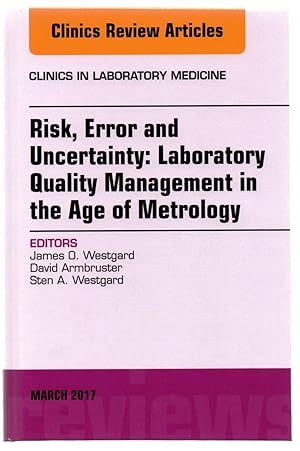
Risk, Error and Uncertainty: Laboratory Quality Management in the Age of Metrology
Editore: Elsevier March 2017, Philadelphia, 2017
ISBN 10: 0323477437 ISBN 13: 9780323477437
Da: Attic Books (ABAC, ILAB), London, ON, Canada
Membro dell'associazione: ABAC ILAB
Valutazione del venditore 5 su 5 stelle

EUR 26,19
Spedizione EUR 12,71
Spedito da Canada a U.S.A.Quantità: 1 disponibili
Aggiungi al carrelloHardcover. Condizione: New. Clinics in Laboratory Medicine. xvii, 241 p. 24 cm. Colour and b&w graphs, figures, and tables. Hardcover.
-

Quality Control in the Age of Risk Management (Clinics in Laboratory Medicine)
Da: Chiron Media, Wallingford, Regno Unito
Valutazione del venditore 5 su 5 stelle
EUR 63,81
Spedizione EUR 17,95
Spedito da Regno Unito a U.S.A.Quantità: Più di 20 disponibili
Aggiungi al carrelloHardcover. Condizione: New.
-
Quality Control in the Age of Risk Management, An Issue of Clinics in Laboratory Medicine
Da: Majestic Books, Hounslow, Regno Unito
Valutazione del venditore 4 su 5 stelle

EUR 74,99
Spedizione EUR 7,53
Spedito da Regno Unito a U.S.A.Quantità: 3 disponibili
Aggiungi al carrelloCondizione: New.
-
Quality Control in the Age of Risk Management: An Issue of Clinics in Laboratory Medicine
Lingua: Inglese
Editore: Elsevier Science Health Science div, 2013
ISBN 10: 1455771104 ISBN 13: 9781455771103
Da: Revaluation Books, Exeter, Regno Unito
Valutazione del venditore 5 su 5 stelle
EUR 71,21
Spedizione EUR 14,49
Spedito da Regno Unito a U.S.A.Quantità: 2 disponibili
Aggiungi al carrelloHardcover. Condizione: Brand New. 1st edition. 205 pages. 9.10x6.10x0.70 inches. In Stock.
-
Quality Control in the Age of Risk Management, An Issue of Clinics in Laboratory Medicine
Da: Books Puddle, New York, NY, U.S.A.
Valutazione del venditore 4 su 5 stelle
Condizione: New.
-
Quality Control in the age of Risk Management, An Issue of Clinics in Laboratory Medicine
Lingua: Inglese
Editore: Elsevier - Health Sciences Division, 2013
ISBN 10: 1455771104 ISBN 13: 9781455771103
Da: THE SAINT BOOKSTORE, Southport, Regno Unito
Valutazione del venditore 5 su 5 stelle
EUR 80,38
Spedizione EUR 18,07
Spedito da Regno Unito a U.S.A.Quantità: Più di 20 disponibili
Aggiungi al carrelloHardback. Condizione: New. New copy - Usually dispatched within 4 working days.
-
Quality Control in the Age of Risk Management, An Issue of Clinics in Laboratory Medicine
Da: Biblios, Frankfurt am main, HESSE, Germania
Valutazione del venditore 4 su 5 stelle
EUR 87,21
Spedizione EUR 9,95
Spedito da Germania a U.S.A.Quantità: 3 disponibili
Aggiungi al carrelloCondizione: New.
-

Risk, Error and Uncertainty: Laboratory Quality Management in the Age of Metrology, An Issue of the Clinics in Laboratory Medicine, 1e (The Clinics: Internal Medicine)
Da: Revaluation Books, Exeter, Regno Unito
Valutazione del venditore 5 su 5 stelle
EUR 86,81
Spedizione EUR 14,49
Spedito da Regno Unito a U.S.A.Quantità: 2 disponibili
Aggiungi al carrelloHardcover. Condizione: Brand New. 9.10x6.00x0.80 inches. In Stock.
-
Quality Control in the age of Risk Management, An Issue of Clinics in Laboratory Medicine: Volume 33-1
Da: Brook Bookstore On Demand, Napoli, NA, Italia
Valutazione del venditore 5 su 5 stelle
EUR 82,78
Spedizione EUR 5,50
Spedito da Italia a U.S.A.Quantità: Più di 20 disponibili
Aggiungi al carrelloCondizione: new. Questo è un articolo print on demand.
-

Quality Control in the Age of Risk Management, an Issue of Clinics in Laboratory Medicine
Lingua: Inglese
Editore: Elsevier Health Sciences Jan 2013, 2013
ISBN 10: 1455771104 ISBN 13: 9781455771103
Da: BuchWeltWeit Ludwig Meier e.K., Bergisch Gladbach, Germania
Valutazione del venditore 5 su 5 stelle
EUR 81,99
Spedizione EUR 23,00
Spedito da Germania a U.S.A.Quantità: 2 disponibili
Aggiungi al carrelloBuch. Condizione: Neu. This item is printed on demand - it takes 3-4 days longer - Neuware -In October of 2011, CLSI published a new guideline EP23A on 'Laboratory Quality Control Based on Risk Management.? In March, 2012, CMS announced its intention to incorporate key concepts from EP23A into its Interpretative Guidelines and QC policy for 'Individualized Quality Control Plans.? Thus begins a new era of Quality Control in the Age of Risk Management. This issue is intended to help laboratories with the transition between traditional QC practices and the new risk management approach. Laboratories face a steep learning curve to apply risk analysis for identifying and prioritizing failure-modes, developing and implementing control mechanisms to detect those failure-modes, and assessing the acceptability of the residual risks that exist after implementation of a QC Plan. One of the main benefits of the new risk analysis based QC Plans should be an integration of all the control mechanisms that are needed to monitor the total testing process, including pre-analytic, analytic, and post-analytic controls. One of the main risks of the new approach is an expectation that Statistical QC is no longer important, even though SQC still remains the most useful and flexible approach for monitoring the quality of the analytic process. The key to the future is the successful integration of all these control mechanisms to provide a cost-effective quality system that monitors all phases of the total testing process. This issue should help laboratories understand the evolution of QC practices to include risk management, but also to recognize the need to maintain traditional techniques such as Statistical QC, especially during the transition to well-designed and carefully-validated QC Plans. Risk analysis may be risky business unless laboratories proceed carefully and cautiously. 205 pp. Englisch.
-

EUR 93,27
Spedizione EUR 63,06
Spedito da Germania a U.S.A.Quantità: 2 disponibili
Aggiungi al carrelloBuch. Condizione: Neu. nach der Bestellung gedruckt Neuware - Printed after ordering - In October of 2011, CLSI published a new guideline EP23A on 'Laboratory Quality Control Based on Risk Management.? In March, 2012, CMS announced its intention to incorporate key concepts from EP23A into its Interpretative Guidelines and QC policy for 'Individualized Quality Control Plans.? Thus begins a new era of Quality Control in the Age of Risk Management. This issue is intended to help laboratories with the transition between traditional QC practices and the new risk management approach. Laboratories face a steep learning curve to apply risk analysis for identifying and prioritizing failure-modes, developing and implementing control mechanisms to detect those failure-modes, and assessing the acceptability of the residual risks that exist after implementation of a QC Plan. One of the main benefits of the new risk analysis based QC Plans should be an integration of all the control mechanisms that are needed to monitor the total testing process, including pre-analytic, analytic, and post-analytic controls. One of the main risks of the new approach is an expectation that Statistical QC is no longer important, even though SQC still remains the most useful and flexible approach for monitoring the quality of the analytic process. The key to the future is the successful integration of all these control mechanisms to provide a cost-effective quality system that monitors all phases of the total testing process. This issue should help laboratories understand the evolution of QC practices to include risk management, but also to recognize the need to maintain traditional techniques such as Statistical QC, especially during the transition to well-designed and carefully-validated QC Plans. Risk analysis may be risky business unless laboratories proceed carefully and cautiously.

