

Importo totale (1 articolo articoli):
Destinazione ordine:

with j a ewing (3 risultati)
Vai alla pagina principale dei risultati di ricerca
Filtri di ricerca
Tipo di articolo
- Tutti i tipi di prodotto
- Libri (3)
- Riviste e Giornali (Nessun altro risultato corrispondente a questo perfezionamento)
- Fumetti (Nessun altro risultato corrispondente a questo perfezionamento)
- Spartiti (Nessun altro risultato corrispondente a questo perfezionamento)
- Arte, Stampe e Poster (Nessun altro risultato corrispondente a questo perfezionamento)
- Fotografie (Nessun altro risultato corrispondente a questo perfezionamento)
- Mappe (Nessun altro risultato corrispondente a questo perfezionamento)
- Manoscritti e Collezionismo cartaceo (Nessun altro risultato corrispondente a questo perfezionamento)
Condizioni Maggiori informazioni
- Nuovo (Nessun altro risultato corrispondente a questo perfezionamento)
- Come nuovo, Ottimo o Quasi ottimo (1)
- Molto buono o Buono (2)
- Discreto o Mediocre (Nessun altro risultato corrispondente a questo perfezionamento)
- Come descritto (Nessun altro risultato corrispondente a questo perfezionamento)
Legatura
Ulteriori caratteristiche
- Prima ed. (Nessun altro risultato corrispondente a questo perfezionamento)
- Copia autograf. (Nessun altro risultato corrispondente a questo perfezionamento)
- Sovracoperta (Nessun altro risultato corrispondente a questo perfezionamento)
- Con foto (1)
- Non Print on Demand (3)
Lingua (2)
Prezzo
- Qualsiasi prezzo
- Inferiore a EUR 20 (Nessun altro risultato corrispondente a questo perfezionamento)
- EUR 20 a EUR 45 (Nessun altro risultato corrispondente a questo perfezionamento)
- Superiore a EUR 45
Spedizione gratuita
- Spedizione gratuita in U.S.A. (Nessun altro risultato corrispondente a questo perfezionamento)
Paese del venditore
Valutazione venditore
-

The Steam Engine and Other Heat Engines
Lingua: Inglese
Editore: The University Press, Cambridge, 1894
Da: J J Basset Books, bassettbooks, bookfarm.co.uk, Peter Tavy, Regno Unito
Valutazione del venditore 4 su 5 stelle

EUR 89,33
Spedizione EUR 23,13
Spedito da Regno Unito a U.S.A.Quantità: 1 disponibili
Aggiungi al carrelloBlack Cloth. Condizione: Very Good. No Jacket. Illustrated with Many Diagrams (illustratore). Reprint 1902 (Stereotyped Edition ). Front Free Endpaper Missing.Please Email For Further Details. Size: 8vo - over 7¾" - 9¾". Signed By "B Lyler,1 Greenland.
-
"On Friction between Surfaces Moving at Low Speeds", from the Philosophical Transactions of the Royal Society.
Editore: Trubner and Co., 1878
Da: JF Ptak Science Books, Hendersonville, NC, U.S.A.
Valutazione del venditore 5 su 5 stelle

Soft cover. Condizione: Very Good. JENKIN, Fleeming; with J.A. Ewing. "On Friction between Surfaces Moving at Low Speeds", separate printing from the Philosophical Transactions of the Royal Society, Trubner and Co., vol 167, Part II, No 59, 1877, pp 509-528 (printed 1878). Cleanly extracted from a larger bound volume. VGcopy. [++] Jenkin is generally considered as an engineer of high order and also as an electrical engineer, and was active at a high level across a number of disciplines. Robert Louis Stevenson (of all people) wrote a lengthy memoir on Jenkin 15 years after the man's death (published 1901), in which he seems to sum up Jenkin's thinking as a sort of "rainbow vision", which is very interesting given Jenkin's severe-ish behavior. (Wm Thomson also gives an appraisal of Jenkin in an appendix to that work.) [++] "Charles Augustin de Coulomb had only carried out sliding (dynamic) friction experiments in which the two surfaces were moving across each other at relatively high velocities, and so did not test his law of friction at low velocities. English engineers Fleeming Jenkin (1833-1885) and Alfred Ewing (1855-1935) filled the gap by conducting experiments at low velocities and found that the coefficient of friction increases to approach that of static friction as relative velocity approaches zero, indicating that Coulomb s law should be restated to include a smooth rather than abrupt transition from static friction to dynamic friction. Jenkin and Ewing published their findings in a paper titled 'On Friction between Surfaces moving at Low Speeds'."--David Wenner, History of Physics Collection. (The Royal Society (London) elected Jenkin a fellow in 1865; the Royal Society of Edinburgh followed suit in 1869, and he was its vice-president in 1879. He was also a member of the Institution of Civil Engineers and held an honorary LL.D. from the University of Glasgow (1883). 714.3.
-
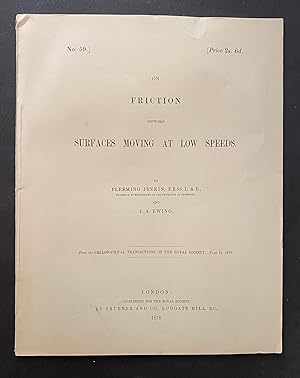
"On Friction between Surfaces Moving at Low Speeds", separate printing from the Philosophical Transactions of the Royal Society.
Editore: Trubner and Co., London, 1878
Da: JF Ptak Science Books, Hendersonville, NC, U.S.A.
Valutazione del venditore 5 su 5 stelle
Soft cover. Condizione: Near Fine. JENKIN, Fleeming; with J.A. Ewing. "On Friction between Surfaces Moving at Low Speeds", separate printing from the Philosophical Transactions of the Royal Society, Trubner and Co., vol 167, Part II, No 59, 1877, pp 509-528 (printed 1878). Original wrappers. FINE copy. [++] Jenkin is generally considered as an engineer of high order and also as an electrical engineer, and was active at a high level across a number of disciplines. Robert Louis Stevenson (of all people) wrote a lengthy memoir on Jenkin 15 years after the man's death (published 1901), in which he seems to sum up Jenkin's thinking as a sort of "rainbow vision", which is very interesting given Jenkin's severe-ish behavior. (Wm Thomson also gives an appraisal of Jenkin in an appendix to that work.) [++] "Charles Augustin de Coulomb had only carried out sliding (dynamic) friction experiments in which the two surfaces were moving across each other at relatively high velocities, and so did not test his law of friction at low velocities. English engineers Fleeming Jenkin (1833-1885) and Alfred Ewing (1855-1935) filled the gap by conducting experiments at low velocities and found that the coefficient of friction increases to approach that of static friction as relative velocity approaches zero, indicating that Coulomb s law should be restated to include a smooth rather than abrupt transition from static friction to dynamic friction. Jenkin and Ewing published their findings in a paper titled 'On Friction between Surfaces moving at Low Speeds'."--David Wenner, History of Physics Collection. (The Royal Society (London) elected Jenkin a fellow in 1865; the Royal Society of Edinburgh followed suit in 1869, and he was its vice-president in 1879. He was also a member of the Institution of Civil Engineers and held an honorary LL.D. from the University of Glasgow (1883).).


