

Importo totale (1 articolo articoli):
Destinazione ordine:

9780120887637 - WISC-IV Advanced Clinical Interpretation di Weiss, Lawrence G.; Saklofske, Donald H.; Prifitera, Aurelio; Holdnack, James A. (8 risultati)
Vai alla pagina principale dei risultati di ricerca
Filtri di ricerca
Tipo di articolo
- Tutti i tipi di prodotto
- Libri (8)
- Riviste e Giornali (Nessun altro risultato corrispondente a questo perfezionamento)
- Fumetti (Nessun altro risultato corrispondente a questo perfezionamento)
- Spartiti (Nessun altro risultato corrispondente a questo perfezionamento)
- Arte, Stampe e Poster (Nessun altro risultato corrispondente a questo perfezionamento)
- Fotografie (Nessun altro risultato corrispondente a questo perfezionamento)
- Mappe (Nessun altro risultato corrispondente a questo perfezionamento)
- Manoscritti e Collezionismo cartaceo (Nessun altro risultato corrispondente a questo perfezionamento)
Condizioni Maggiori informazioni
- Nuovo (4)
- Come nuovo, Ottimo o Quasi ottimo (Nessun altro risultato corrispondente a questo perfezionamento)
- Molto buono o Buono (4)
- Discreto o Mediocre (Nessun altro risultato corrispondente a questo perfezionamento)
- Come descritto (Nessun altro risultato corrispondente a questo perfezionamento)
Legatura
- Tutte
- Rilegato (8)
- Brossura (Nessun altro risultato corrispondente a questo perfezionamento)
Ulteriori caratteristiche
- Prima ed. (Nessun altro risultato corrispondente a questo perfezionamento)
- Copia autograf. (Nessun altro risultato corrispondente a questo perfezionamento)
- Sovracoperta (Nessun altro risultato corrispondente a questo perfezionamento)
- Con foto (3)
- Non Print on Demand (6)
Lingua (1)
Spedizione gratuita
Paese del venditore
Valutazione venditore
-
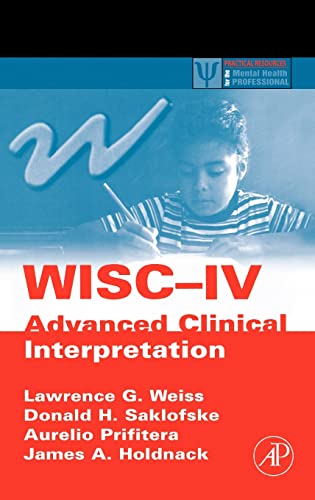
WISC-IV Advanced Clinical Interpretation
Libro 20 di 54: ISSNLingua: Inglese
Editore: Elsevier Science & Technology, 2006
ISBN 10: 0120887630 ISBN 13: 9780120887637
Da: Better World Books, Mishawaka, IN, U.S.A.
Valutazione del venditore 5 su 5 stelle

Condizione: Very Good. 1 Edition. Pages intact with possible writing/highlighting. Binding strong with minor wear. Dust jackets/supplements may not be included. Stock photo provided. Product includes identifying sticker. Better World Books: Buy Books. Do Good.
-

WISC-IV Advanced Clinical Interpretation (Practical Resources for the Mental Health Professional)
Libro 20 di 54: ISSNDa: Reliant Bookstore, El Dorado, KS, U.S.A.
Valutazione del venditore 5 su 5 stelle
Condizione: very_good. This book is in excellent condition. There may be minimal writing on the inside cover or cover page. Cover image on the book may vary from photo. Ships out quickly in a secure plastic mailer.
-
hardcover. Condizione: Good. Connecting readers with great books since 1972! Used textbooks may not include companion materials such as access codes, etc. May have some wear or writing/highlighting. We ship orders daily and Customer Service is our top priority!
-
WISC-IV Advanced Clinical Interpretation
Libro 20 di 54: ISSNLingua: Inglese
Editore: Elsevier Science & Technology, 2006
ISBN 10: 0120887630 ISBN 13: 9780120887637
Da: Better World Books Ltd, Dunfermline, Regno Unito
Valutazione del venditore 5 su 5 stelle
EUR 27,30
Spedizione EUR 5,78
Spedito da Regno Unito a U.S.A.Quantità: 1 disponibili
Aggiungi al carrelloCondizione: Good. 1 Edition. Former library copy. Pages intact with minimal writing/highlighting. The binding may be loose and creased. Dust jackets/supplements are not included. Includes library markings. Stock photo provided. Product includes identifying sticker. Better World Books: Buy Books. Do Good.
-
WISC-IV Advanced Clinical Interpretation (Practical Resources for the Mental Health Professional)
Libro 20 di 54: ISSNDa: BennettBooksLtd, Los Angeles, CA, U.S.A.
Valutazione del venditore 5 su 5 stelle
hardcover. Condizione: New. In shrink wrap. Looks like an interesting title!
-
WISC-IV Advanced Clinical Interpretation Weiss, Lawrence G.; Saklofske, Donald H.; Prifitera, Aurelio and Holdnack, James A.
Libro 20 di 54: ISSNDa: Aragon Books Canada, OTTAWA, ON, Canada
Valutazione del venditore 3 su 5 stelle

EUR 79,82
Spedizione EUR 19,80
Spedito da Canada a U.S.A.Quantità: 1 disponibili
Aggiungi al carrelloCondizione: New.
-

WISC-IV Advanced Clinical Interpretation
Libro 20 di 54: ISSNDa: BuchWeltWeit Ludwig Meier e.K., Bergisch Gladbach, Germania
Valutazione del venditore 5 su 5 stelle
EUR 61,20
Spedizione EUR 23,00
Spedito da Germania a U.S.A.Quantità: 2 disponibili
Aggiungi al carrelloBuch. Condizione: Neu. This item is printed on demand - it takes 3-4 days longer - Neuware -For both experienced psychologists and graduate students, WISC-IV Advanced Clinical Interpretation moves quickly through the essentials of WISC-IV interpretation and onto an insightful analysis of the major cognitive domains assessed by WISC-IV. It is the intention of the editors to raise the standard of practice from a simplistic 'test-label-place' model to a clinical model of assessing to understand and intervene. In the first chapter, the reader is presented with a comprehensive array of societal and home environment factors for which there is empirical evidence indicating their impact on the development of children's cognitive abilities, and ultimately their scores on intelligence tests. Subsequent chapters address issues related to the assessment of cognitive abilities that compose 'g', with special emphasis on the clinical correlates of working memory and processing speed from both neuropsychological and cognitive information processing perspectives. Each new chapter builds on material presented in previous chapters and progresses the reader purposefully through deeper levels of understanding of WISC-IV and cognitive assessment in general. Two chapters explicate the processing approach to interpretation that is the corner stone of the WISC-IV Integrated. A further chapter addresses the interpretation of WISC-IV findings within the context of other instruments as part of a full psychological evaluation. The final chapter provides an extensive case example of how to write psychological evaluation reports from a child-centered rather than a score-centered perspective that can have transforming impact on parents and teachers approach to the child. Overall, these four authors are the architects of a masterful new book on advanced WISC-IV interpretation from a clinical perspective, Together with the complimentary book, WISC-IV Clinical Assessment and Intervention, Second Edition these books provide the complete spectrum of information needed by all psychologists who use the WISC-IV in clinical practice. The Wechsler scale is the most widely used assessment of children's intelligence Authored by assessment experts including Harcourt Assessment staff with exclusive data on the WISC-IV Discusses interpretation of 4 index scores of WISC-IV Examines the WISC-IV in relation to other frequently used psychological tests Describes the importance of the WISC-IV integrated in clinical assessment Predicts scholastic achievement based on WISC-IV subtest scores Discusses modification of score interpretation based on culture, SES, & other contextual factors 448 pp. Englisch.
-

EUR 66,20
Spedizione EUR 64,24
Spedito da Germania a U.S.A.Quantità: 2 disponibili
Aggiungi al carrelloBuch. Condizione: Neu. nach der Bestellung gedruckt Neuware - Printed after ordering - For both experienced psychologists and graduate students, WISC-IV Advanced Clinical Interpretation moves quickly through the essentials of WISC-IV interpretation and onto an insightful analysis of the major cognitive domains assessed by WISC-IV. It is the intention of the editors to raise the standard of practice from a simplistic 'test-label-place' model to a clinical model of assessing to understand and intervene. In the first chapter, the reader is presented with a comprehensive array of societal and home environment factors for which there is empirical evidence indicating their impact on the development of children's cognitive abilities, and ultimately their scores on intelligence tests. Subsequent chapters address issues related to the assessment of cognitive abilities that compose 'g', with special emphasis on the clinical correlates of working memory and processing speed from both neuropsychological and cognitive information processing perspectives. Each new chapter builds on material presented in previous chapters and progresses the reader purposefully through deeper levels of understanding of WISC-IV and cognitive assessment in general. Two chapters explicate the processing approach to interpretation that is the corner stone of the WISC-IV Integrated. A further chapter addresses the interpretation of WISC-IV findings within the context of other instruments as part of a full psychological evaluation. The final chapter provides an extensive case example of how to write psychological evaluation reports from a child-centered rather than a score-centered perspective that can have transforming impact on parents and teachers approach to the child. Overall, these four authors are the architects of a masterful new book on advanced WISC-IV interpretation from a clinical perspective, Together with the complimentary book, WISC-IV Clinical Assessment and Intervention, Second Edition these books provide the complete spectrum of information needed by all psychologists who use the WISC-IV in clinical practice.

