Importo totale (1 articolo articoli):
Destinazione ordine:

9780190846466 - The Normative Animal?: On the Anthropological Significance of Social, Moral, and Linguistic Norms (18 risultati)
Vai alla pagina principale dei risultati di ricerca
Filtri di ricerca
Tipo di articolo
- Tutti i tipi di prodotto
- Libri (18)
- Riviste e Giornali (Nessun altro risultato corrispondente a questo perfezionamento)
- Fumetti (Nessun altro risultato corrispondente a questo perfezionamento)
- Spartiti (Nessun altro risultato corrispondente a questo perfezionamento)
- Arte, Stampe e Poster (Nessun altro risultato corrispondente a questo perfezionamento)
- Fotografie (Nessun altro risultato corrispondente a questo perfezionamento)
- Mappe (Nessun altro risultato corrispondente a questo perfezionamento)
- Manoscritti e Collezionismo cartaceo (Nessun altro risultato corrispondente a questo perfezionamento)
Condizioni Maggiori informazioni
- Nuovo (15)
- Come nuovo, Ottimo o Quasi ottimo (2)
- Molto buono o Buono (1)
- Discreto o Mediocre (Nessun altro risultato corrispondente a questo perfezionamento)
- Come descritto (Nessun altro risultato corrispondente a questo perfezionamento)
Legatura
- Tutte
- Rilegato (18)
- Brossura (Nessun altro risultato corrispondente a questo perfezionamento)
Ulteriori caratteristiche
- Prima ed. (Nessun altro risultato corrispondente a questo perfezionamento)
- Copia autograf. (Nessun altro risultato corrispondente a questo perfezionamento)
- Sovracoperta (Nessun altro risultato corrispondente a questo perfezionamento)
- Con foto (4)
- Non Print on Demand (8)
Lingua (1)
Prezzo
- Qualsiasi prezzo
- Inferiore a EUR 20 (Nessun altro risultato corrispondente a questo perfezionamento)
- EUR 20 a EUR 45 (Nessun altro risultato corrispondente a questo perfezionamento)
- Superiore a EUR 45
Spedizione gratuita
Paese del venditore
Valutazione venditore
-

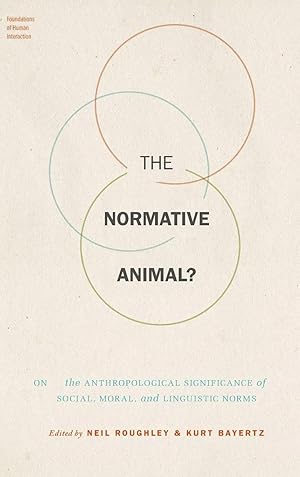
The Normative Animal?: On the Anthropological Significance of Social, Moral, and Linguistic Norms (Foundations of Human Interaction)
Libro 12 di 15: FOUNDATIONS OF HUMAN INTERACTIONLingua: Inglese
Editore: Oxford University Press (edition ), 2019
ISBN 10: 0190846461 ISBN 13: 9780190846466
Da: BooksRun, Philadelphia, PA, U.S.A.
Valutazione del venditore 5 su 5 stelle

Hardcover. Condizione: Very Good. It's a well-cared-for item that has seen limited use. The item may show minor signs of wear. All the text is legible, with all pages included. It may have slight markings and/or highlighting.
-
Normative Animal? : On the Anthropological Significance of Social, Moral, and Linguistic Norms
Libro 12 di 15: FOUNDATIONS OF HUMAN INTERACTIONDa: GreatBookPrices, Columbia, MD, U.S.A.
Valutazione del venditore 5 su 5 stelle
EUR 90,92
Spedizione EUR 2,29
Spedito in U.S.A.Quantità: Più di 20 disponibili
Aggiungi al carrelloCondizione: New.
-
Normative Animal? : On the Anthropological Significance of Social, Moral, and Linguistic Norms
Libro 12 di 15: FOUNDATIONS OF HUMAN INTERACTIONDa: GreatBookPrices, Columbia, MD, U.S.A.
Valutazione del venditore 5 su 5 stelle
EUR 94,76
Spedizione EUR 2,29
Spedito in U.S.A.Quantità: Più di 20 disponibili
Aggiungi al carrelloCondizione: As New. Unread book in perfect condition.
-
The Normative Animal?: On the Anthropological Significance of Social, Moral, and Linguistic Norms (Foundations of Human Interaction)
Libro 12 di 15: FOUNDATIONS OF HUMAN INTERACTIONDa: Ria Christie Collections, Uxbridge, Regno Unito
Valutazione del venditore 5 su 5 stelle
EUR 86,55
Spedizione EUR 13,85
Spedito da Regno Unito a U.S.A.Quantità: Più di 20 disponibili
Aggiungi al carrelloCondizione: New. In.
-
Normative Animal? : On the Anthropological Significance of Social, Moral, and Linguistic Norms
Libro 12 di 15: FOUNDATIONS OF HUMAN INTERACTIONDa: GreatBookPricesUK, Woodford Green, Regno Unito
Valutazione del venditore 5 su 5 stelle
EUR 86,54
Spedizione EUR 17,34
Spedito da Regno Unito a U.S.A.Quantità: Più di 20 disponibili
Aggiungi al carrelloCondizione: New.
-

The Normative Animal?
Libro 12 di 15: FOUNDATIONS OF HUMAN INTERACTIONLingua: Inglese
Editore: Oxford University Press Inc, US, 2019
ISBN 10: 0190846461 ISBN 13: 9780190846466
Da: Rarewaves.com USA, London, LONDO, Regno Unito
Valutazione del venditore 5 su 5 stelle
EUR 113,07
Spedizione gratuita
Spedito da Regno Unito a U.S.A.Quantità: Più di 20 disponibili
Aggiungi al carrelloHardback. Condizione: New. It is often claimed that humans are rational, linguistic, cultural, or moral creatures. What these characterizations may all have in common is the more fundamental claim that humans are normative animals, in the sense that they are creatures whose lives are structured at a fundamental level by their relationships to norms. The various capacities singled out by discussion of rational, linguistic, cultural, or moral animals might then all essentially involve an orientation to obligations, permissions and prohibitions. And, if this is so, then perhaps it is a basic susceptibility, or proclivity to normative or deontic regulation of thought and behaviour that enables humans to develop the various specific features of their life form.This volume of new essays investigates the claim that humans are essentially normative animals in this sense. The contributors do so by looking at the nature and relations of three types of norms, or putative norms-social, moral, and linguistic-and asking whether they might all be different expressions of one basic structure unique to humankind. These questions are posed by philosophers, primatologists, behavioural biologists, psychologists, linguists, and cultural anthropologists, who have collaborated on this topic for many years. The contributors are committed to the idea that understanding normativity is a two-way process, involving a close interaction between conceptual clarification and empirical research.
-
Normative Animal? : On the Anthropological Significance of Social, Moral, and Linguistic Norms
Libro 12 di 15: FOUNDATIONS OF HUMAN INTERACTIONDa: GreatBookPricesUK, Woodford Green, Regno Unito
Valutazione del venditore 5 su 5 stelle
EUR 94,84
Spedizione EUR 17,34
Spedito da Regno Unito a U.S.A.Quantità: Più di 20 disponibili
Aggiungi al carrelloCondizione: As New. Unread book in perfect condition.
-

The Normative Animal?
Libro 12 di 15: FOUNDATIONS OF HUMAN INTERACTIONLingua: Inglese
Editore: Oxford University Press Inc, US, 2019
ISBN 10: 0190846461 ISBN 13: 9780190846466
Da: Rarewaves.com UK, London, Regno Unito
Valutazione del venditore 5 su 5 stelle
EUR 105,51
Spedizione EUR 75,13
Spedito da Regno Unito a U.S.A.Quantità: Più di 20 disponibili
Aggiungi al carrelloHardback. Condizione: New. It is often claimed that humans are rational, linguistic, cultural, or moral creatures. What these characterizations may all have in common is the more fundamental claim that humans are normative animals, in the sense that they are creatures whose lives are structured at a fundamental level by their relationships to norms. The various capacities singled out by discussion of rational, linguistic, cultural, or moral animals might then all essentially involve an orientation to obligations, permissions and prohibitions. And, if this is so, then perhaps it is a basic susceptibility, or proclivity to normative or deontic regulation of thought and behaviour that enables humans to develop the various specific features of their life form.This volume of new essays investigates the claim that humans are essentially normative animals in this sense. The contributors do so by looking at the nature and relations of three types of norms, or putative norms-social, moral, and linguistic-and asking whether they might all be different expressions of one basic structure unique to humankind. These questions are posed by philosophers, primatologists, behavioural biologists, psychologists, linguists, and cultural anthropologists, who have collaborated on this topic for many years. The contributors are committed to the idea that understanding normativity is a two-way process, involving a close interaction between conceptual clarification and empirical research.
-
The Normative Animal?
Libro 12 di 15: FOUNDATIONS OF HUMAN INTERACTIONDa: PBShop.store US, Wood Dale, IL, U.S.A.
Valutazione del venditore 5 su 5 stelle
EUR 93,29
Spedizione gratuita
Spedito in U.S.A.Quantità: Più di 20 disponibili
Aggiungi al carrelloHRD. Condizione: New. New Book. Shipped from UK. THIS BOOK IS PRINTED ON DEMAND. Established seller since 2000.
-
The Normative Animal?
Libro 12 di 15: FOUNDATIONS OF HUMAN INTERACTIONDa: PBShop.store UK, Fairford, GLOS, Regno Unito
Valutazione del venditore 5 su 5 stelle
EUR 89,50
Spedizione EUR 5,80
Spedito da Regno Unito a U.S.A.Quantità: Più di 20 disponibili
Aggiungi al carrelloHRD. Condizione: New. New Book. Delivered from our UK warehouse in 4 to 14 business days. THIS BOOK IS PRINTED ON DEMAND. Established seller since 2000.
-
The Normative Animal?: On the Anthropological Significance of Social, Moral, and Linguistic Norms (eng)
Libro 12 di 15: FOUNDATIONS OF HUMAN INTERACTIONDa: Brook Bookstore On Demand, Napoli, NA, Italia
Valutazione del venditore 3 su 5 stelle

EUR 108,98
Spedizione EUR 6,80
Spedito da Italia a U.S.A.Quantità: Più di 20 disponibili
Aggiungi al carrelloCondizione: new. Questo è un articolo print on demand.
-
The Normative Animal?: On the Anthropological Significance of Social, Moral, and Linguistic Norms
Libro 12 di 15: FOUNDATIONS OF HUMAN INTERACTIONLingua: Inglese
Editore: Oxford University Press Inc, 2019
ISBN 10: 0190846461 ISBN 13: 9780190846466
Da: THE SAINT BOOKSTORE, Southport, Regno Unito
Valutazione del venditore 5 su 5 stelle
EUR 100,57
Spedizione EUR 20,34
Spedito da Regno Unito a U.S.A.Quantità: Più di 20 disponibili
Aggiungi al carrelloHardback. Condizione: New. This item is printed on demand. New copy - Usually dispatched within 5-9 working days.
-
The Normative Animal? (Hardcover)
Libro 12 di 15: FOUNDATIONS OF HUMAN INTERACTIONLingua: Inglese
Editore: Oxford University Press Inc, New York, 2019
ISBN 10: 0190846461 ISBN 13: 9780190846466
Da: CitiRetail, Stevenage, Regno Unito
Valutazione del venditore 5 su 5 stelle
EUR 93,44
Spedizione EUR 42,77
Spedito da Regno Unito a U.S.A.Quantità: 1 disponibili
Aggiungi al carrelloHardcover. Condizione: new. Hardcover. It is often claimed that humans are rational, linguistic, cultural, or moral creatures. What these characterizations may all have in common is the more fundamental claim that humans are normative animals, in the sense that they are creatures whose lives are structured at a fundamental level by their relationships to norms. The various capacities singled out by discussion of rational, linguistic, cultural, or moral animals might then all essentially involve anorientation to obligations, permissions and prohibitions. And, if this is so, then perhaps it is a basic susceptibility, or proclivity to normative or deontic regulation of thought and behavior that enableshumans to develop the various specific features of their life form.This volume of new essays investigates the claim that humans are essentially normative animals in this sense. The contributors do so by looking at the nature and relations of three types of norms, or putative norms-social, moral, and linguistic-and asking whether they might all be different expressions of one basic structure unique to humankind. These questions are posed by philosophers, primatologists,behavioral biologists, psychologists, linguists, and cultural anthropologists, who have collaborated on this topic for many years. The contributors are committed to the idea that understanding normativityis a two-way process, involving a close interaction between conceptual clarification and empirical research. An interdisciplinary group of scholars investigates the claim that humans are essentially normative animals. They do so by looking at the nature and relations of three types of norms, or putative norms--social, moral, and linguistic--and asking whether they might be different expressions of one basic structure unique to humankind. This item is printed on demand. Shipping may be from our UK warehouse or from our Australian or US warehouses, depending on stock availability.
-
The Normative Animal?: On the Anthropological Significance of Social, Moral, and Linguistic Norms
Libro 12 di 15: FOUNDATIONS OF HUMAN INTERACTIONDa: Majestic Books, Hounslow, Regno Unito
Valutazione del venditore 4 su 5 stelle

EUR 141,40
Spedizione EUR 7,51
Spedito da Regno Unito a U.S.A.Quantità: 4 disponibili
Aggiungi al carrelloCondizione: New. Print on Demand.
-
The Normative Animal?: On the Anthropological Significance of Social, Moral, and Linguistic Norms
Libro 12 di 15: FOUNDATIONS OF HUMAN INTERACTIONDa: Books Puddle, New York, NY, U.S.A.
Valutazione del venditore 4 su 5 stelle
Condizione: New. Print on Demand.
-
The Normative Animal?: On the Anthropological Significance of Social, Moral, and Linguistic Norms
Libro 12 di 15: FOUNDATIONS OF HUMAN INTERACTIONDa: Biblios, Frankfurt am main, HESSE, Germania
Valutazione del venditore 4 su 5 stelle
EUR 141,64
Spedizione EUR 9,95
Spedito da Germania a U.S.A.Quantità: 4 disponibili
Aggiungi al carrelloCondizione: New. PRINT ON DEMAND.
-

EUR 119,63
Spedizione EUR 63,76
Spedito da Germania a U.S.A.Quantità: 2 disponibili
Aggiungi al carrelloBuch. Condizione: Neu. nach der Bestellung gedruckt Neuware - Printed after ordering - It is often claimed that humans are rational, linguistic, cultural, or moral creatures. What these characterizations may all have in common is the more fundamental claim that humans are normative animals, in the sense that they are creatures whose lives are structured at a fundamental level by their relationships to norms. The various capacities singled out by discussion of rational, linguistic, cultural, or moral animals might then all essentially involve an orientation to obligations, permissions and prohibitions. And, if this is so, then perhaps it is a basic susceptibility, or proclivity to normative or deontic regulation of thought and behavior that enables humans to develop the various specific features of their life form. This volume of new essays investigates the claim that humans are essentially normative animals in this sense. The contributors do so by looking at the nature and relations of three types of norms, or putative norms-social, moral, and linguistic-and asking whether they might all be different expressions of one basic structure unique to humankind. These questions are posed by philosophers, primatologists, behavioral biologists, psychologists, linguists, and cultural anthropologists, who have collaborated on this topic for many years. The contributors are committed to the idea that understanding normativity is a two-way process, involving a close interaction between conceptual clarification and empirical research.
-
EUR 149,20
Spedizione EUR 70,00
Spedito da Germania a U.S.A.Quantità: 5 disponibili
Aggiungi al carrelloBuch. Condizione: Neu. NORMATIVE ANIMAL? FHI C | Bayertz Roughley | Buch | Gebunden | Englisch | 2019 | ACADEMIC | EAN 9780190846466 | Verantwortliche Person für die EU: Libri GmbH, Europaallee 1, 36244 Bad Hersfeld, gpsr[at]libri[dot]de | Anbieter: preigu Print on Demand.